Brian Keegan: Post-Covid Ireland could need new tax policies
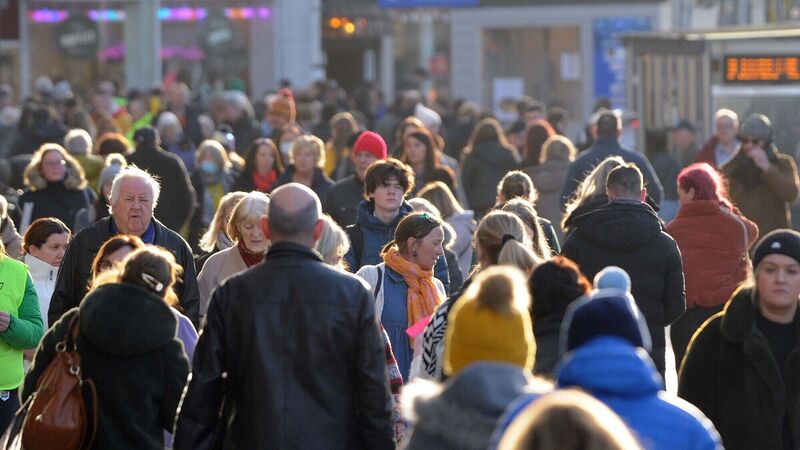
"Inflation has a practical effect on people's spending power but it also has a psychological effect," writes Brian Keegan. Picture Denis Minihane.
It now seems that the run up to the outbreak of Covid-19 three years ago was atypical. A relatively calm economic environment, where globalisation flourished against a backdrop of low interest rates and low inflation, is now a distant memory.
Was the invasion of Ukraine, or the inflationary trends which were becoming apparent even before Russia’s evil war, or the fragmentation of international trade relations a consequence of the pandemic in some way? Or would these have happened anyway?
The respite offered to Irish business, particularly the service industries, with the lifting of the pandemic restrictions proved all too temporary. Nevertheless, the economic bounce back from the restrictions, as underlined by the positive exchequer figures throughout the year, is quite remarkable.
It is almost as if the Irish economy had been designed to withstand pandemic lockdowns with an emphasis on fostering industry which produces highly-in-demand information and communications technology products and pharmaceuticals, along with a tax base that collects the most income tax from those best able to work from home and a high rate of value added tax to catch bumper receipts as the brakes on consumer spending were lifted.
The price that had to be paid for this rapid recovery is what the chief economist of the European Central Bank, Philip Lane, described earlier this year as a pandemic cycle of inflation. This description implies a cyclical return over time to more normal inflation rates, but energy insecurity across Europe has extended that cycle.
Inflation has a practical effect on people's spending power but it also has a psychological effect. There are two approaches that any government can take to tackle inflation. One approach is to reduce the amount of taxes charged on goods and services.
By reducing Vat or Excise on fuel, services and some grocery categories, government can moderate higher prices. The other approach is to leave citizens with more purchasing power by reducing income tax. During 2022 the government did both while putting a range of social welfare and energy payment supports in place.
There was insufficient recognition that the Government was only in a position to help people thanks to the buoyancy of tax receipts. During 2022, Ireland’s exchequer was mostly funded by consumer activity, income tax receipts from higher earners, and corporate profits. All these stayed buoyant.
That buoyancy may have led to tax policy complacency. We saw no fundamental shift in industrial policy during 2022 as compared say with 2018 when the world was a very different place.
Government’s recently published White Paper on Enterprise is more a plan of adaption rather than a major departure from current policy.
One way of sustaining the corporation tax receipts along with the earning and spending capacity of individuals is to start thinking more about trade in services, which in international trade terms rivals our trade in goods.
Taxation policy does not favour our services sector in the same way as it favours our manufacturing and distribution sectors. Investment incentives in the areas of research and development (R&D) and employment investment (EIIS) are in many cases impossible for the services industry to use.
Services rely on people participation, and initiatives such as remote working hubs have built capacity and promoted labour market participation. Just as important, remote working facilities can serve as a recruitment and retention inducement especially if workers are looking more closely at the cost of commuting and subsistence in the workplace as prices rise.
We also cannot continue to tolerate residential property complacency. If tax policy was the main driver of foreign direct investment in the past, prospective investors are now asking different questions when they are making investment decisions. Some of these new questions, like the availability of an educated workforce, are to be expected. Others, like the availability of housing and green public transport, are now more pressing.
While Irish destinations like Cork and Dublin compete with major cities across Europe, many of which are also experiencing significant housing challenges, housing supply has now both an economic as well as a social cost.
Very simply, we are not completing enough new housing units for the size of our population and to meet the demands of our economic activity.
Yet 2022 saw many positives. Compare the Irish position with the position in the UK, where a mini budget to tackle cost of living issues was presented in September only days before our own. The recklessness of that British budget cost the then prime minister Liz Truss her job.
That mini budget was the culmination of a series of reckless decisions in the previous decade which led to the Brexit referendum and the much-maligned Northern Ireland Protocol.
The protocol may ultimately be dragged down not because of its economic failure, as over half of businesses surveyed by the Northern Ireland Chamber of Commerce believe that the Protocol is helping their businesses to grow, but because politicians don’t understand it. The British will have to borrow to keep their people warm this winter. This is not the case here.
Our significant economic success during 2022 was sadly not reflected in housing or healthcare availability. We can no longer blame these problems on the pandemic. We still have to build capacity so that no one needs to wait in A&E for more than a few hours, and so that more of us can afford to live where we need to.
- Brian Keegan is Director of Public Policy at Chartered Accountants Ireland