Markets love a Democrat in the White House
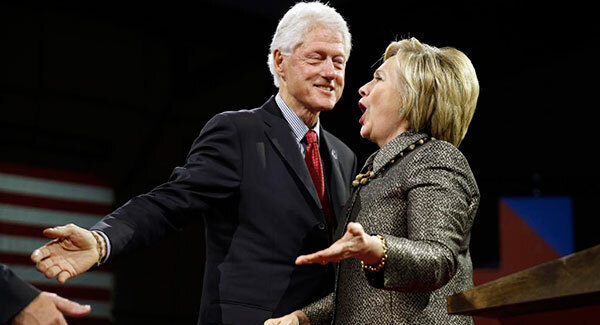
According to much financial lore, a Republican president is often seen as a champion of free trade and the best bet for a rising Dow Jones index, while Democrats suffer the perception of leaning toward regulation and a willingness to harness the excesses of Wall Street.
However, in her famous 2013 speech at a Goldman Sachs’ investment symposium, Ms Clinton said it was “an oversimplification” to say the banking system caused the 2008 economic collapse, and that blaming banks was “politicising” the issue.
Turney Duff, a former Wall Street trader and author of the New York Times bestseller, The Buy Side, sees a preferable security in a Democratic victory.
“Clinton is a known quantity, it is much easier to predict the markets if she is president.
"There’s a widespread feeling that she can communicate with world leaders and provide a stability that Trump can’t. If Trump is elected, you can throw everything you think you know out the window,” he says.
Her ties to Wall Street derive not just from her times as First Lady during her husband’s presidency, but, more recently, as a respected New York senator.
“All of the people in New York, not just in New York City, but throughout the state of New York know the secretary well,” said Robert Wolf, the former president of UBS Investment Bank.
Looking to history as a possible guide to the economic swings and roundabouts of Republican versus Democrat, a pair of finance professors at the University of California published findings pointing to better stock market returns and less volatility when the Democrats are in power.
The paper of professors Pedro Santa-Clara and Rossen Valkanov, The Presidential Puzzle: Political Cycles And The Stock Market, reveals that stock market returns are 5% higher when the White House is run by a Democrat.
Since 1929, both political parties have split the presidency evenly. Excluding the 1930s crash and subsequent Great Depression under Hoover, the four-decade Republican reign produced a gain of 4.7%, against the almost double 8.9% figure achieved by their Democratic counterparts.
A further confirmation of this trend is made by Jeffrey Hirsch in the Stock Trader’s Almanac.
The stock market under Democrat Franklin D Roosevelt, who was much maligned by free marketeers on gaining the White House after Hoover, did extremely well to pull the market from the depths of despair, a situation somewhat comparable to Obama’s occupancy of the Oval Office after Bush.
Under Roosevelt’s stewardship, which included the Second World War, stocks achieved returns of nearly 9% each year from 1932 to 1945, well above the 6.5% average real returns on the market.
If there are possible parallels between the presidency of Hillary and her husband Bill’s stewardship of the economy, the returns under the eight-year Clinton administration averaged 19% a year, the highest of any president since Calvin Coolidge in the 1920s.