‘That’s like being asked would I sooner be burnt or scalded’
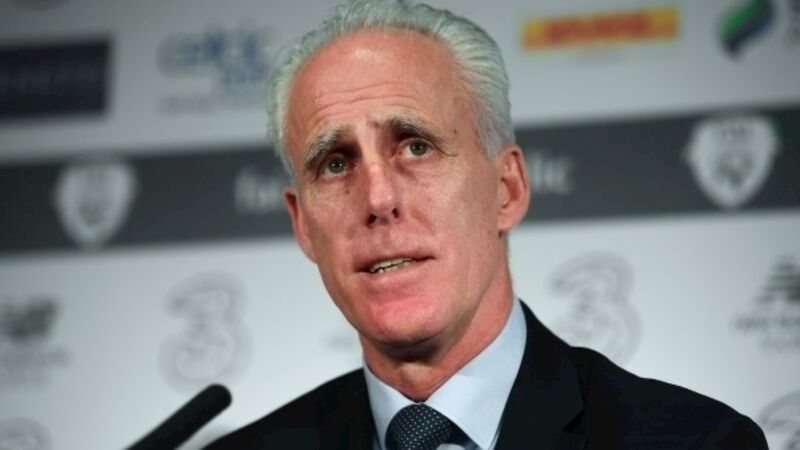
Mick McCarthy arches his eyebrows the way he does when a question comes from a bit out of left-field.
“That’s like being asked would I sooner be burnt or scalded,” he suggests, wisely avoiding the temptation to extract more mileage from the one about the rock and the hard place. (We’ll take care of that, thanks very much).

With the game in Gibraltar’s Victoria Stadium now looming as large as the Rock itself, the Ireland manager has just been asked which he would take if offered the choice: A good artificial pitch or a crap grass one.
“Do you know, I’m not bothered,” he continues, after dropping his quotable quote. “I don’t whinge about what we have to do, there’s no point.
“It is what it is. If it was a bad pitch, I’d have gone and looked at it but we would still have had to deal with it.
“And that’s just what we have to do: deal with it. Whatever it is, we have to make the best of it.”
McCarthy knows whereof he speaks, having recently done his own recce of Gibraltar’s home (artificial) turf.
“The pitch is fine,” he reports. “I was on it and it’s fine. It’s just a different bounce and the ball rolls differently. It depends on whether they wet it or it’s dry or they wet it in the first half and it dries out over the course of the game. It does make a difference.
If you play on it regularly, you get used to it. It does have a different bounce, nobody will ever tell me that it is the same as regular grass because it’s not. And I guess the opposition will try to use it. It’s almost like psychological warfare that one, with the plastic pitch.
But it’s not just the tricky surface which might help cut Ireland down to size.
Everything about the tiny Victoria Stadium will feel alien to players accustomed to bigger, and at least in a few cases, much bigger arenas.
“It only affects you if you allow it to affect you,” McCarthy insists. “It’s about your mental approach going into the game. We know we’ve got to go to Gibraltar. We know it’s a plastic pitch. We know there are 2,300 people there. You’ve just got to go and adapt to your surroundings as far as I’m concerned and make the best of it.” Have any of the players expressed reservations about the pitch?
“I don’t know. I haven’t asked them and I’m not going to ask them because we have to go and play on it.”
In any case, it’s not the pitch or the stadium but the team which calls the place home that most concerns the manager.
“In the last games that Gibraltar played they got a couple of good results,” McCarthy notes of a side who managed two wins in the Nations League. “They make it really tough to play against, just pack in and defend and try to catch you on the break. And they are a threat at free kicks and corners. They will just make it exceptionally hard to play against them. They can get on the ball and play a bit. If we allow them to, they will try and keep it.”
And, of course, the very first game of the Euros campaign should also find them at their perkiest. McCarthy doesn’t disagree.
“Well, come on, it’s exciting isn’t it, the start of a new competition,” he says. “So for them as well - starting at home against Ireland, who have been in European Championships and World Cups and have had a good standing for a long time - it’s a huge game. They fought hard to bring us there, absolutely, and they’ll be looking forward to it. They’ll want to turn us over.”
Whereas, for the start of his second spell as Ireland manager, McCarthy would be only too happy to reprise what was his very first competitive outing as the national gaffer boss back in August 1996 when his team visited minnows Liechtenstein in their own tiny home ground in Eschen – and emerged with a 5-0 win.
“That would be nice, wouldn’t it?” he smiles.