Unseen footage delivers reel deal of WW2, trauma and the human experience
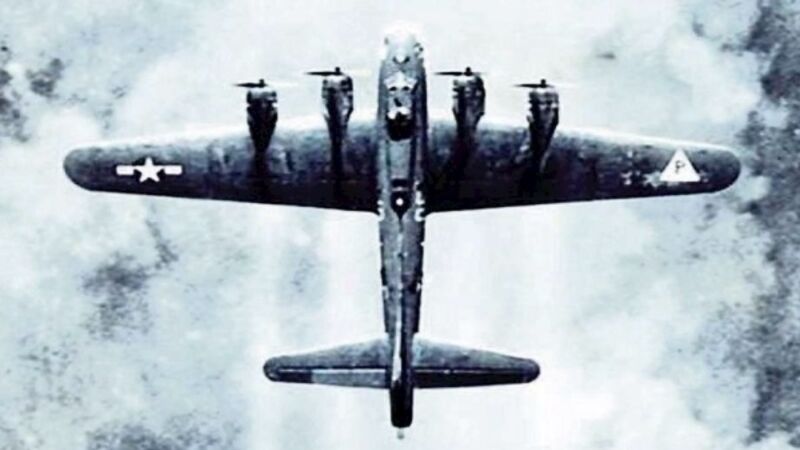
Unseen colour footage and the testimonies of surviving WW2 veterans result in an immersive film about war, trauma and the human experience, writes .
In a movie packed with astonishing moments, one story from a former Second World War B-17 flyer stands out. Revealing how the temperature in the unpressurised cabin could drop as low as -60, he tells how a colleagueâs finger froze to the glass and had to be amputated.
Itâs just one of the remarkable testimonies in The Cold Blue, a film that uses unseen colour footage shot by acclaimed filmmaker William Wyler for his 1944 film The Memphis Belle, and brings it to life with the testimonies of surviving US air corps veterans, now in their mid- to late-90s.
What emerges is an immersive film about war, trauma, and the human experience, placing us in the cabins with these men as they embarked on their perilous missions. The film will screen in Irish cinemas for one night only, tonight, July 4.
âFlying in a B-17 in a mission is the equivalent of standing on the top of Mount Everest for five or six hours, without pressurisation, in that cold,â says the filmâs director and producer, Erik Nelson.
âThey had open doors so it was 60 degrees below zero up there. As one of the guys says, somebody lost consciousness and his naked hand was on the plexiglass and it froze to the plexiglass and they had to cut his finger off. Guys had to knock the ice out of their masks. These were just things that people werenât prepared for.â

Upon discovering that dozens of reels of footage from the great Wyler, a best director Oscar winner for Ben-Hur and Mrs Miniver and whose credits also included Roman Holiday, lay in the vaults of the US National Archive, Nelson knew that he had found his next project.
âThe footage has been hiding in plain sight in the US National Archives. I was on a hunt looking for World War II colour aeroplane footage. I had a vague idea about doing something about the classic war documentarians. Within two days of my researcher going in, she said, âWell thereâs this, thereâs that, and thereâs the reels of the Memphis Belleâ. I said: âExcuse me?â âThereâs 34 reels. 15 hours.ââ
First of all, Nelson would have to get permission to have the spectacular footage restored. While film studios were commonly shooting in Technicolor since the 1930s, newsreel footage in colour from the Second World War was rare, certainly on combat missions.
âThe key process was that of the 34 reels, some were closer to the negative than others. So some were really crisp and sharp. Some werenât quite as sharp. The most important step was to go from the original reel of film to 4K. Thread the original film up in a projector-like device and transfer it to digital 4K which is a technology that really didnât exist a couple of years ago. And that was done at the National Archives. They wouldnât let the footage out. Itâs a treasure but they recognise the film isnât fading, the sprockets are falling apart. They canât run under projector anymore.â
Once that was done, Nelson set about selecting the best shots and sequences for The Cold Blue, as it wasnât practical to restore 15 hours of footage. He also restored Wylerâs original 1944 completed documentary Memphis Belle: The Story of a Flying Fortress, after reaching out to the filmmakerâs estate. âIt was a huge part of this project. I felt as I was propelling Wylerâs legacy into a new millennium it wouldnât have been fair not to restore his original film.â
Nelson says Wyler and his cinematographers took a huge personal risk taking part in the combat missions. One of them, Harold Tannenbaum, died when the B-24 he was in was shot down over Brest in France.
âWilliam Wyler put his ass in a sling in a B-17 five times, personally going down to the ball turret. And you see the shots of the gear retracting, thatâs shot in the ball turret. So we use both of those shots in their entirety.â Wylerâs wife accepted his Oscar for Mrs Miniver as the filmmaker was filming on a B-17 at that time.
âThe idea that William Wyler is flying in a B-17, 25,000ft up, 60 degrees below zero at the moment heâs winning an Academy Award for Mrs Miniver, and his wife is accepting, heâs literally in the air when heâs winning an Academy Award. He didnât have to be there. Heâs in his 40s, 20 years older than these guys. And heâs Jewish. Two things could have happened: He could have either been killed, or shot down and managed to figure out a way to bail out, if he was lucky, and then he would have been captured.â
While none of the crew of the Memphis Belle are still alive, Nelson interviewed nine different B-17 crewmen, all now in their 90s, who shared their stories and experiences. One man can be heard breaking down as he recounts the story of a colleague who died on the same day his son was born.
âI kind of made the film for two demographics; the guys, which is one of the reasons we finished the movie so fast so they could see it while they were still alive to appreciate it, and everybody else.
And Iâm happy to say that every one of the nine guys who we interviewed two years ago, all of them are still with us.
âI think they were surprised at some of the questions I was asking them. Theyâre not used to being asked questions about how cold it was. âDid you have a dog?â âWhat was breakfast like?â I asked them questions that were much more experiential. I wanted to know what it felt like. I wanted to connect people with the past and I didnât want this to be a history documentary no more than Dunkirk is a history film.â
The film also features footage shot by filmmaker John Sturges of a desecrated Berlin in the latter days of the war. âI wanted to make it clear that there are consequences to this. We had to have that chapter in the film because itâs too easy to forget what it was like.â
The film is preceded by a chilling, fascinating short feature of a rare Nazi newsreel, which were commonly shown in German cinemas before a movie. âI wanted to do something special for the audience,â said Nelson. âSo we put the newsreel at the top, which I think really sets up the context. The idea was to give cinema goers something extra, almost like a short subject.
âItâs meant to be seen in cinemas just like Dunkirk was meant to be seen. I think the Peter Jackson film (First World War documentary They Shall Not Grow Old), I know Apollo 11 is coming, itâs a new genre. Itâs a big screen immersive history. Itâs creating a time machine, really, that brings people back in time.â