The book that delves into the details of Harry Clarke's stained glass windows
A new book delves into the details of Harry Clarke’s stained glass windows in such places as Dingle and Cork, writes .
It may have been almost 35 years ago but Lucy Costigan can clearly recall the magical moment when she first laid eyes on the work of the renowned Irish stained-glass artist, Harry Clarke.
“I remember it very well — I was a student in Dublin, it was a lovely autumn day and I just found myself in Parnell Square. I never even knew that the Hugh Lane gallery existed because I would have always gone into the National Gallery, at the other end of the city.
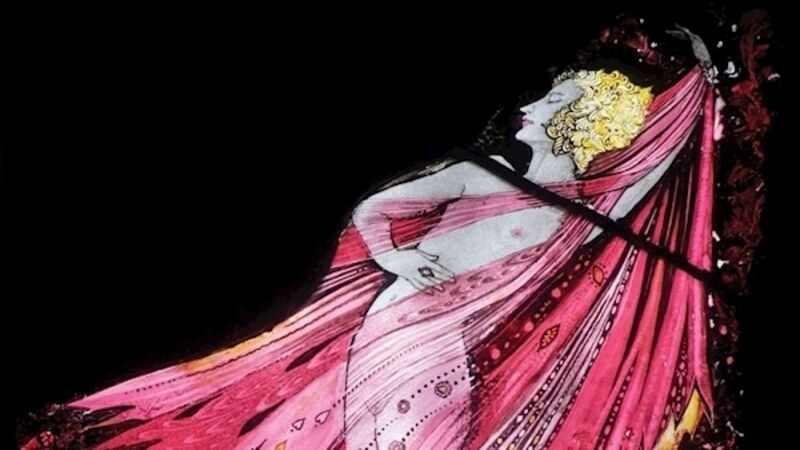
"I wandered into the Hugh Lane, and when I saw this incredible window [The Eve of St Agnes], I was just mesmerised. I didn’t really know what it was, I hadn’t a clue who did it but it was out of this world — just enchanting.”
The encounter marked the start of Costigan’s lifelong passion for the work of the Dublin artist, and she took every opportunity to visit the churches that featured his work,including the Honan Chapel in UCC, Clarke’s first major commission, for which he created nine windows, a process that took over three years.
“I went to Cork to visit a friend maybe a few months after seeing the window in the Hugh Lane. I was only in my early 20s and it was probably an unusual request, to go to the Honan Chapel for one of our outings. It was absolutely incredible and it was the same when I went to see the windows he had done in Díseart in Dingle.”
FAMILY AFFAIR
The Wexford native eventually channelled her interest in Clarke’s work into the 2010 book, Strangest Genius, on which she collaborated with her nephew, the photographer Michael Cullen. They spent two years photographing Clarke’s entire stained glass oeuvre — 174 windows and a small number of panels.
While Clarke’s work was well-known within artistic circles,Strangest Genius helped raise awareness of his talents among a wider audience, and Costigan and Cullen followed it up with a documentary on the artist, A Revel in Blue.
Now, they have released another book, Dark Beauty: Hidden Detail in Harry Clarke’s Stained Glass, which coincides with the 130th anniversary of his birth, and features previously unpublished images of his work. There was no shortage of material to choose from, says Costigan.
“We had 50,000 images which we had taken for the previous book. There were so many of these beautiful details that we wanted to show — all the animals, flowers, beautiful gowns, accessories, self-portraits, and the little faces that look out at you in the various windows.
The images were a marvellous resource — to be able to look at all that detail.
“When you have a photo in front of you, you can really see it, because you’re in front of your laptop, in a comfortable environment. If you go into a church, you may not be able to see a window directly, or sit down and look at it. Sometimes, I think it would be lovely to have a nice comfy chair and just plop it in front of any of the windows and just sit back and relax and really take it all in.”
Clarke’s huge breadth of local, historical and ecclesiastical knowledge is reflected in the intricate imagery of the windows he crafted. “He was so multi-dimensional and I think that is why his artworks are so amazing. Outside of stained glass, he was a brilliant graphic artist and book illustrator. He took that ability to sketch, draw and paint and applied it to glass in a way that no-one had ever been done before.
“His windows are really like an illustration on glass, especially when you get to the lower panels — they are like the pages of a book. For example, in The Eve of St Agnes [based on the poem by John Keats], my favourite panel is where Madeline is in her bed chamber and you see the utensils on the chest of drawers, the little tassels on the bedspread, the wall hangings and even the carpet design, it is just incredible.”
PERSONAL APPEAL
Costigan has no formal art training, but she believes this has been an asset in terms of looking at Clarke’s work through a different lens.
“What we have tried to do is to take back his art from the academic realm and bring it back to a view of Harry Clarke as the people’s artist. That is very much what we wanted to do because his is a living art, especially for the generations of people who have experienced his work in their local churches.

"People would tell us how they had prayed at a certain window for their whole lifetime, in times of celebration, like a wedding or baptism, or at times of trouble, loss or bereavement. These windows are special, not only as beautiful works of art but in the way they take on a life of their own as a kind of a spiritual release for some people.
“And of course, there are a lot of people who don’t really like going into galleries, they see art as a kind of snobbish entertainment. Whereas, at any talks we’ve done or any time we’ve shown the film, around the country, it would be salt-of-the-earth people who would come up to you and just talk about Harry Clarke and certain details or colours that they’ve really loved in a particular window.”
EARLY DEATH
Clarke died when he was only 41 after contracting tuberculosis but achieved a huge amount in his short life. He died in Switzerland in 1931,as he attempted to return home to Ireland. At the time of his death, he was working on the Geneva Window, an Irish government commission for the International Labour Commission in the Swiss city.
The window, which depicted scenes from Irish literature, fell foul of the Church because of the nature of some of the images and the fact that it featured the work of banned writers. It was never installed and was bought back from the State after Clarke’s death by his widow Margaret, who was also an artist and whose work was exhibited to acclaim in the National Gallery in 2017. According to Costigan, Harry Clarke’s career could have gone in many directions if he had lived.
While Costigan is gratified to see Clarke being recognised and appreciated more in recent years, she still thinks more could be done in terms of promoting his work.
“What we have in Harry Clarke is such a huge resource for the country and certainly more could be done, even in tourism, there’s no doubt about that. That’s a huge area, you could have little tours of maybe three or four churches at a time. I think people would love that.”