Nuclear arms and ending Iran and Ukraine wars top Trump-Xi-Putin meeting agenda
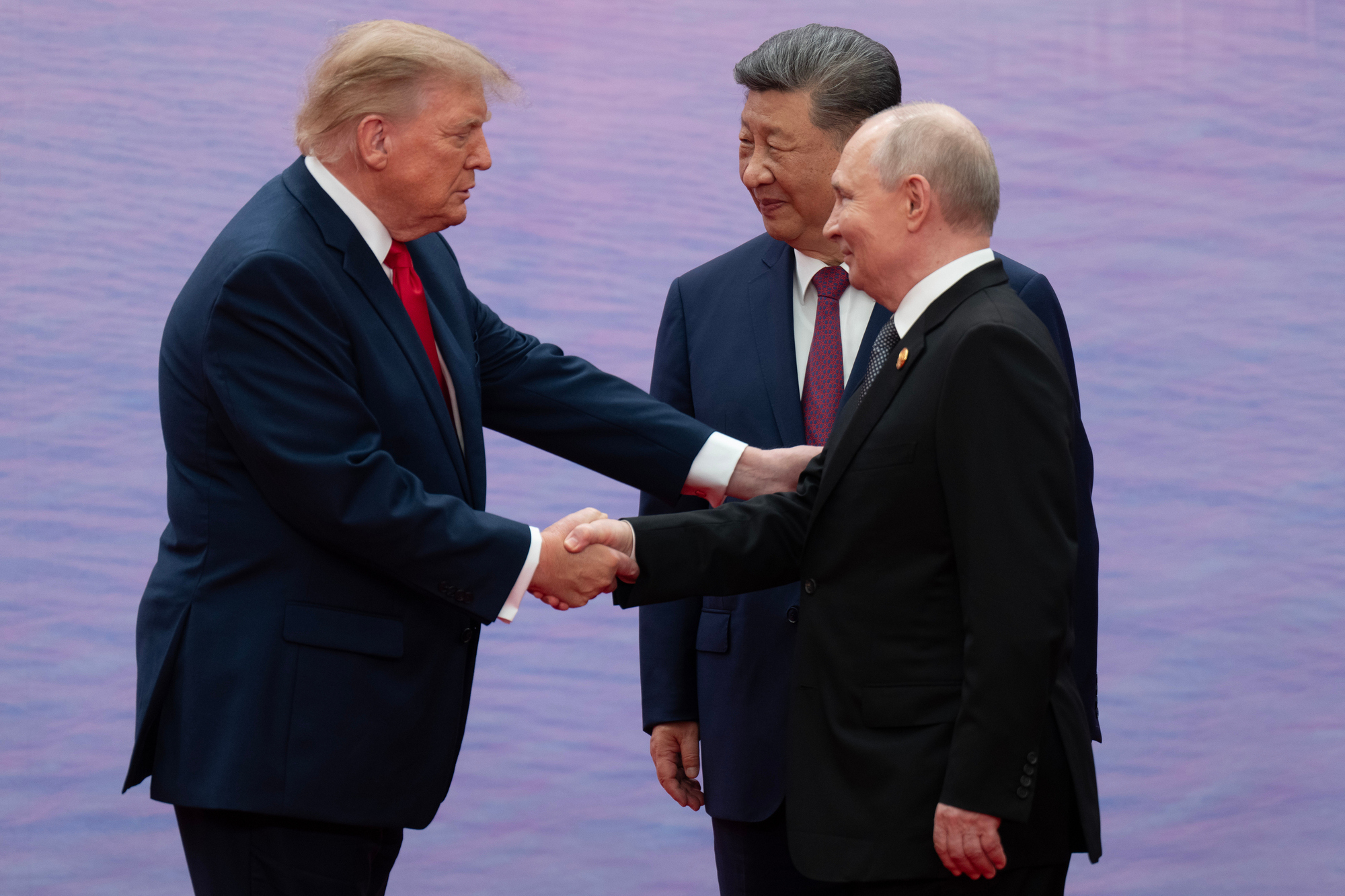
US President Donald Trump is meeting China’s Xi Jinping and Russia’s Vladimir Putin in a moment that could mark a pivot in world history – or become a quickly forgotten photo op.
Mr Trump, who will test his reputation as an expert dealmaker in the trilateral meeting, has promoted his time with Mr Xi and Mr Putin — two of America’s leading rivals — as a chance to hash out rules for controlling nuclear arms and to start resolving the wars in Ukraine and Iran.
However, experts have kept expectations low for major breakthroughs.
Mr Trump had a separate one-on-one meeting with Mr Xi — his third substantial meeting with him this year — right before the trilateral.
The US president praised their friendship and their shared interest in having oil shipped through the Strait of Hormuz, which has become a key site of attacks in the Iran war.
Mr Trump suggested he would push Mr Xi to buy more agricultural products from America.
“I’ll be asking you to do some more for our farmers,” Mr Trump said.
Mr Xi said that relations between the United States and China have been “generally stable and improved” during Mr Trump’s presidency.
“The efforts you have made are there for all to see and will go down in history,” Mr Xi said.
The meeting between Mr Trump and Mr Xi lasted roughly an hour, after which the two leaders and their delegations had lunch.
Mr Trump also added a separate sit-down with Mr Putin to his schedule, marking the first time the leaders have held talks since their discussions in Alaska last year that failed to broker a deal to ease Russia’s war in Ukraine.
“Wonderful things can come out of this — or at least start,” Mr Trump said after joining Mr Putin for the one-on-one meeting on the sidelines of the Asia-Pacific Economic Co-operation Summit, calling Mr Putin “my friend”.
“We’ve had a great relationship for many years,” Mr Trump said after shaking hands with Mr Putin. Their meeting together lasted roughly 40 minutes.
Mr Trump has frequently boasted of his rapport with Mr Putin, even as relations between the US and Ukraine appear to have cratered recently. Mr Trump rejected new Russia sanctions, while Kyiv was undermined by disruptions in satellite support for its drones during the war.
Along for the trip — but so far keeping a low profile — is Elon Musk, whose company SpaceX has intermittently throttled the military-grade Starshield satellite system used by Ukraine for launching its drones and intercepting hits from Russia.
Mr Trump has said he wants to talk to the leaders about their nuclear stockpiles.
The last nuclear arms pact between Russia and the United States, known as New Start, expired in February, and Mr Trump has said he wants “a new, improved and modernised” deal that includes China.
But China has less motivation to accept limits given that its arsenal of more than 600 warheads is far smaller than the more than 5,000 warheads believed to be in each of the US and Russian stockpiles.
Daryl Kimball, executive director of the Arms Control Association, said Mr Trump’s showmanship could at best start a process that would eventually lead to a sustained set of talks for reducing nuclear arsenals.
“We need more than diplomatic theatre and photo opportunities between Xi, Putin and Trump at Apec,” Mr Kimball said. “And one meeting will not likely produce dramatic breakthroughs.”
Mr Trump told Fox News in his interview that “it’s a very hard thing to do” to ask a leader to reduce nuclear stockpiles.
The US president’s ambitions recall an era of great power politics when wealthier countries felt entitled to decide the fate of seemingly lesser nations.
Mr Trump is negotiating with China and Russia without the involvement of Ukraine — or countries such as Germany, France, the UK, Japan and South Korea that also have stakes in the outcome of any talks.
The US president has openly pursued a Nobel Peace Prize even as he took military action against Venezuela and Iran.
Mr Trump has long believed his ability to create personal connections gives him a diplomatic edge. Mr Xi appealed to his ego on Wednesday by greeting Air Force One on the airport tarmac, as the two leaders turned their handshake into a one-armed hug.
But Mr Trump does not appear to always have the same deep relationship based on common interests that Mr Xi and Mr Putin share. For all the compliments the US president has showered on the two autocrats, the warmth has not always been mutually effusive.
On Wednesday at Apec, Mr Xi greeted Mr Putin by calling him “my old friend”. The Russian leader responded by declaring Mr Xi to be his “dear friend”. China has helped economically support Russia after its 2022 invasion of Ukraine, providing Mr Putin with a financial lifeline after the US and its allies imposed new sanctions.
By contrast, when Mr Xi came to the White House for a state visit in September, he was far more restrained with Mr Trump, saying they had built a “personal rapport and stayed in touch”.
Ukraine and its European allies are suspicious of the trilateral meeting that could potentially cut them out of the process. German Chancellor Friedrich Merz has said Europeans feared another “Anchorage moment”, a reference to last year’s Putin-Trump meeting in Alaska that produced proposals that were rejected by Ukraine and its partners.

BLACK FRIDAY
Already a subscriber? Sign in

CONNECT WITH US TODAY



Be the first to know the latest news and updates