Serbian leader ousted by student movement in seismic election
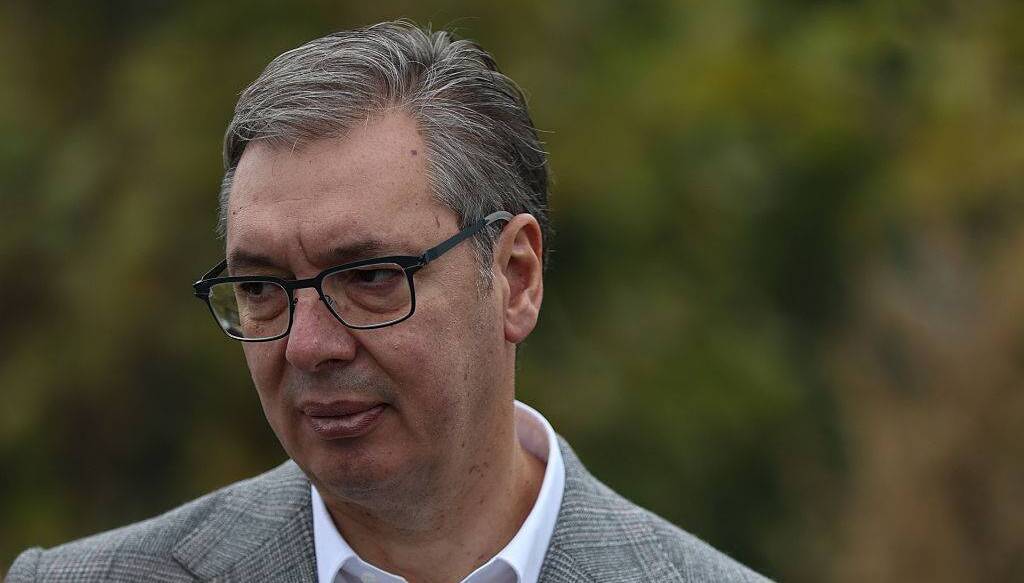
The long-serving leader of Serbia, Aleksandar Vučić, has conceded defeat, ushering in a seismic political shift after a historic election that saw the increasingly authoritarian leader pitted against a student-led movement that had spent two years protesting against his government. Picture: Danil Shamkin/NurPhoto via Getty Images
The long-serving leader of Serbia, Aleksandar Vučić, has conceded defeat, ushering in a seismic political shift after a historic election that saw the increasingly authoritarian leader pitted against a student-led movement that had spent two years protesting against his government.
Vučić pointed to preliminary results that suggested voters had overwhelmingly backed the students, potentially giving them a majority in the country’s 250-seat parliament.
“We still do not have final results,” Vučić told supporters at his party headquarters in Belgrade.
“On the basis of a sample … it is clear that we have lost these elections, the Student List has won, they will have between 135 and 140 seats and we will have 105.”
Read More
A representative sample by the CeSID-IPSPS pollsters suggested that the Student List’s candidate list will have 138 deputies, while Vučić’s rightwing Serbian Progressive party (SNS) garnered 104 seats.
The remaining seats were likely to be shared between ethnic national minority parties, said the pollsters.
As news broke that Vučić’s 12 years in power had come to an end, celebrations erupted on the streets of Belgrade and other cities.
In the capital, Ivana, 43, was ecstatic. “This feels like New Year’s Eve to me, like three New Year’s Eves all at once, really,” she said. “We can finally breathe again.”
She added that she was hoping for swift accountability for top members of the ousted regime, a key campaign pledge from the Student List.
Others offered handshakes, high fives and hugs to police officers in the streets, while a chorus of honking horns rang out from passing cars.
At the headquarters of the Student List, supporters chanted “Victory, victory!” as they applauded, cried and traded hugs. “Dear Serbia, tonight the voice of the people is being heard,” said Radomir Saičić, a professor at Belgrade University, speaking on behalf of the students at their headquarters.
“Tonight we celebrate victory, tomorrow we build the future.”
The scenes of joy came hours after a record number of voters turned up to cast their ballot on Sunday.
Across the country, long lines snaked out of polling stations, with some reporting wait times of up to two hours.
By 7pm local time pollsters and monitors CeSID and Ipsos put the turnout at 67.6%, the highest since the breakup of Yugoslavia in 1992.
The high turnout, along with the estimated 150,000 people who flocked to the students’ final pre-election rally last week in Belgrade, fuelled early speculation that the students may have rallied enough support to launch a new political era in the Balkan country.
In the lead-up to the vote, opinion polls had varied wildly, with analysts pointing to the high degree of uncertainty at play as the candidates representing the grassroots student movement went up against Vučić’s SNS.
The results were watched across the world as part of 10 pivotal days of elections across the globe in which the authoritarian right is facing off against pro-democracy forces.
The victory for the student-led movement in Serbia is also likely to reverberate across Europe, adding momentum to the youth and student protests that have rocked cities across the continent.
As people waited for the election results to come in, speculation had begun to swirl online about whether Vučić would seek to hold on to power regardless.
His swift admission of defeat, however, was reminiscent of his ally, Viktor Orbán, in neighbouring Hungary six months ago, fuelling hopes of a democratic resurgence to central Europe.
The high-stakes election in the EU-candidate country traces back to November 2024, when a concrete canopy collapsed at the Novi Sad railway station, killing 16 people.
The tragedy set off protests among students, snowballing into a broad anti-government movement as evidence suggested that slipshod construction, fraud and corruption were to blame for the roof collapse.
As Vučić, the increasingly authoritarian leader who has dominated Serbian politics for more than a decade, grappled with mounting pressure from the students, he resigned the presidency last month to gamble on snap elections.
The students seized on the chance to transform the movement into political power.
They announced a slate of 250 candidates for the 250-seat parliament, ranging from academics to athletes and farmers, as they called on voters to back their push to rebuild Serbia’s economy and restore its democracy.
The campaign pitted them against the political monolith of Vučić’s SNS party, leaving them in an uphill battle against a ruling party that had taken over almost all of the broadcast channels and which wielded ministries and other state institutions as political tools.
Vučić had repeatedly sought to undermine the students by accusing them of being stooges of foreign powers, a charge that the students have dismissed.
As he pledged to increase pensions and public sector salaries, Vučić sought to present himself as a leader capable of walking the diplomatic tightrope between the country’s ties with the west, and Russia and China to steer Serbia through global uncertainties.
Undaunted, the students took to the streets, staging rallies, turning up in the rural areas that had long been Vučić strongholds and going door-to-door as they sought to pitch themselves as the anti-establishment candidates and to rally voters behind their slogan of “Serbia or Mafia?”
The message was reiterated on Sunday as Dejan Bodiroga, a candidate on the Student List and the Euroleague Basketball president, cast his ballot in Belgrade.
“Today, above all, Serbia is fighting for freedom and for the return of a country that has been hijacked,” Bodiroga told reporters.
“Serbia is voting today to decide which direction it will take – towards the future or the past.”
In the lead-up to Sunday’s vote, both international and local election monitors expressed concerns about detentions and reports of surveillance and cyber-attacks against activists.
On Sunday, independent monitoring groups warned of recorded cases of photographing of ballots that suggested pressure on voters, attempted vote-buying and carousel voting.
Among them was Raša Nedeljkov of the election monitory CRTA, who said that “a large number of irregularities continue to be recorded, while violent incidents outside polling stations are also becoming increasingly frequent”.

CONNECT WITH US TODAY



Be the first to know the latest news and updates