Greek wildfires halted after fatal helicopter crash
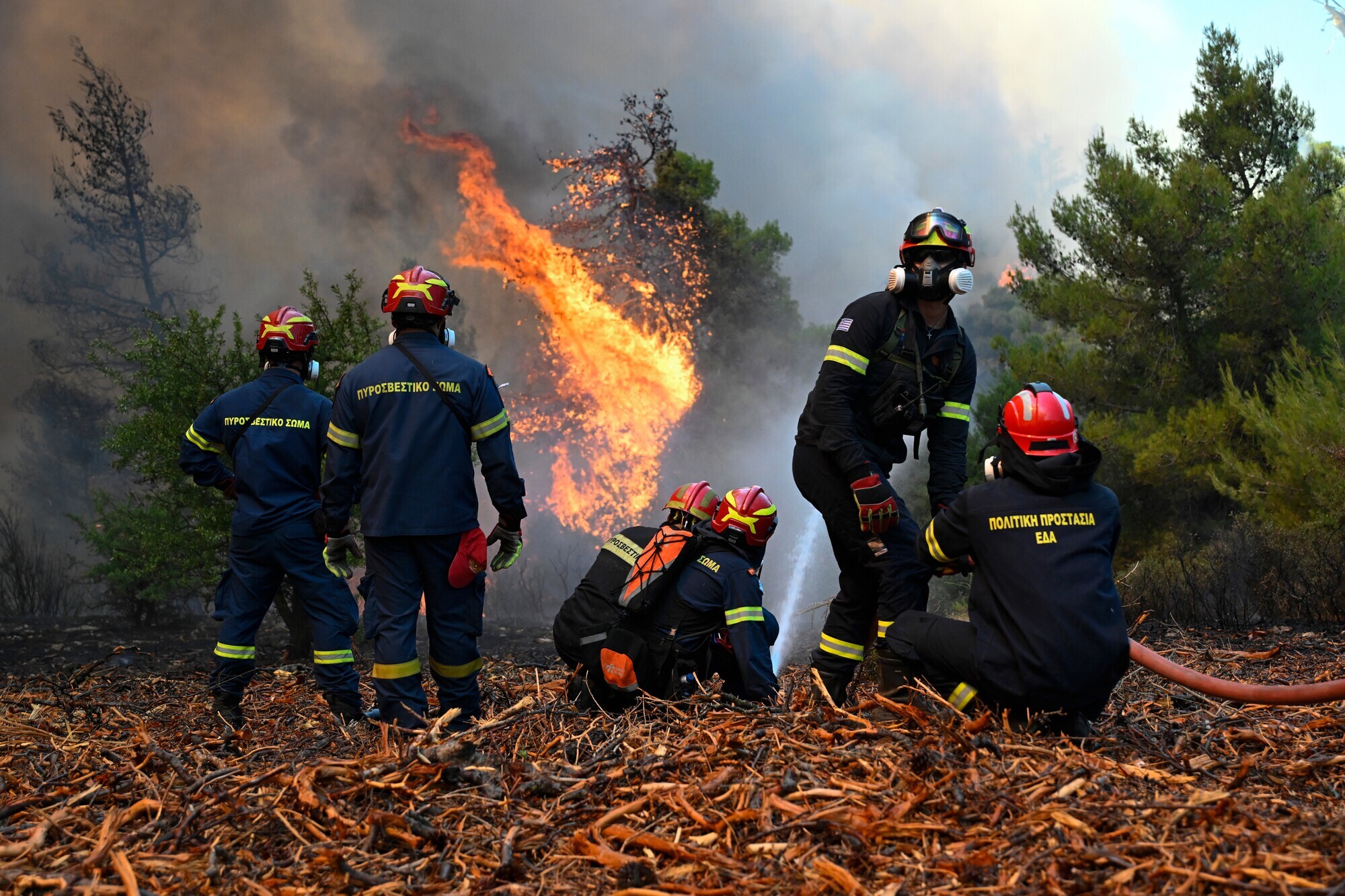
Water-dropping planes swooped over a major wildfire west of Athens on Monday, a day after a mid-air collision between two firefighting helicopters killed two crew members.
A Greek and a Danish national died and two others – all privately charted operators – were admitted to hospital after the collision while the firefighting effort along mountainous and coastal areas at the weekend was hindered by powerful gales.
As parts of southern Europe continued to struggle with high temperatures, firefighters in France guarded against potential flare ups inside a still-burning scar four times the size of Paris.
Strong winds eased on Monday, allowing the deployment of 12 water-dropping planes and 11 helicopters around the fire-hit seaside resort of Porto Germenos, where multiple evacuations have been ordered.
Fire service spokesman Yiannis Artopios said: “To put it in a headline: conditions are better but we are pressing forward because there are still multiple points of activity. This is a difficult fire that has troubled us.”
Some 500 firefighters halted the fire’s advance but authorities warned areas surrounding Athens remained at high risk.
More than 1,000 people have been evacuated from the region, including more than 250 rescued by boats from beaches in the area.
The blaze was blamed on a faulty power line from a wind farm and led to the arrests of two contractors on charges of negligent arson.
Despite improved detection methods and an expanded co-operation between European Union members, Greece and other countries along Europe’s Mediterranean coast suffer devastating wildfires every summer as spells of heat wave temperatures grow longer.
Europe is Earth’s fastest-warming continent, heating at more than twice the global average since the 1980s, according to the European Union’s Copernicus climate service.
Rising temperatures and prolonged drought leave vegetation drier and more combustible, allowing fires to spread faster and burn more intensely.
In France, thousands of evacuees were allowed to return home or to holiday accommodation Monday after a massive wildfire remained contained.
More than 224,000 people had fled in what officials said was the country’s largest civilian evacuation outside wartime.
The wildfire burned about 420 square kilometres, making it France’s largest wildfire on record.
Monday’s return includes Cap Ferret peninsula, a tourist hot spot along the Atlantic coast, and Le Porge, the municipality hardest hit by the fire, where 183 homes were destroyed. Campsites remain closed.
A second wildfire in Provence did not flare up overnight, but was still not contained Monday as stronger winds were expected, firefighters and authorities said.
About 1,500 firefighters, supported by water-dropping helicopters, continued reinforcing fire lines along the blaze that tore through about 18 square kilometres.

CONNECT WITH US TODAY



Be the first to know the latest news and updates