Ceasefire proposal sent to US and Iran as air strikes leave 25 dead
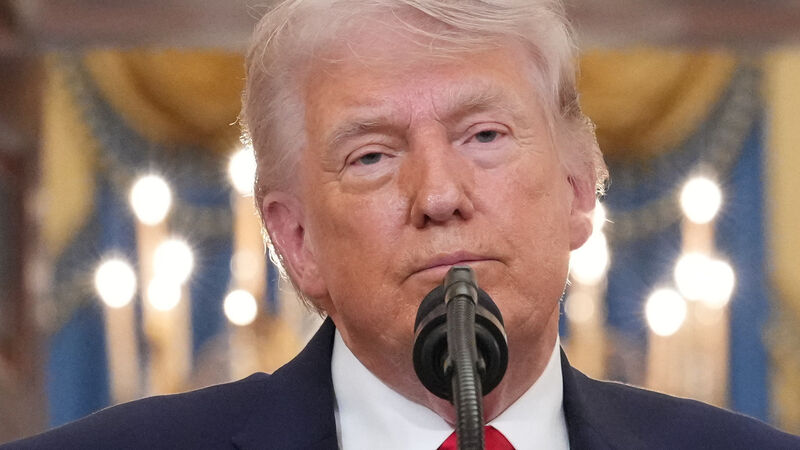
Donald Trump speaks about the Iran war (Alex Brandon/AP)
Israel and the United States have carried out a wave of attacks which killed more than 25 people in Iran as mediators circulated a new ceasefire proposal.
Tehran responded with missile fire on Israel and its Gulf neighbours as US President Donald Trump’s deadline for Tehran to reopen the Strait of Hormuz loomed.
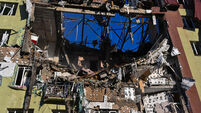
Explosions rang out in Tehran and low-flying jets could be heard for hours as the capital was pounded. Thick black smoke rose near the city’s Azadi Square after one air strike hit the Sharif University of Technology grounds.
Among those killed in an attack was the head of intelligence for Iran’s paramilitary Revolutionary Guard, Major General Majid Khademi, Iranian state media reported.
Two people were found dead in the rubble of a residential building in Haifa, according to Israeli authorities. The search was ongoing for two more even as new Iranian missile attacks hit the northern Israeli city early on Monday.
Kuwait and the United Arab Emirates both activated their air defence systems to intercept incoming Iranian missiles and drones, as Tehran kept up the pressure on its Gulf neighbours.
Iran’s regular attacks on regional energy infrastructure and its stranglehold on the Strait of Hormuz, through which a fifth of the world’s oil is shipped in peacetime, have sent global energy prices soaring.
Under pressure at home as consumers are growing increasingly concerned, Mr Trump gave Tehran a deadline that expires on Monday night, Washington time, saying if no deal was reached to reopen the strait the US would hit Iran’s power plants and other infrastructure targets and set the country “back to the stone ages”.
“Tuesday will be Power Plant Day, and Bridge Day, all wrapped up in one, in Iran,” he threatened in a social media post, adding that if Iran did not open the strait “you’ll be living in Hell”.
In an effort to stop the fighting, Egyptian, Pakistani and Turkish mediators have sent Iran and the US a proposal calling for a 45-day ceasefire and the reopening of the Strait of Hormuz to give time to find a way to end the war, two Middle East officials told The Associated Press.
Iran and the US have not responded to the proposal, sent late on Sunday night to both Iranian foreign minister Abbas Araghchi and US Middle East envoy Steve Witkoff, the officials said.
Tehran has shown no signs of backing down on its stranglehold on shipping through the strait, which was fully open before Israel and the US attacked Iran on February 28 to start the war.
Following Mr Trump’s expletive-laced posts on Easter Sunday, Iran’s parliamentary speaker Mohammad Bagher Qalibaf called the threats of targeting Iran’s infrastructure “reckless”.
“You won’t gain anything through war crimes,” Mr Qalibaf wrote on X. “The only real solution is respecting the rights of the Iranian people and ending this dangerous game.” Iran has let some vessels through the strait since the war began, but none belonging to the US, Israel or countries perceived as helping them. Some have paid Iran for passage and the overall flow of traffic is down more than 90% over the same period last year.
Beyond Mr Trump’s military threats, diplomatic efforts are still underway to see if a solution can be reached to open the waterway.
Oman’s Foreign Ministry said that deputy foreign ministers and experts from Iran and Oman met to discuss proposals to ensure “smooth transit” through the strait.
Egypt said that foreign minister Badr Abdelatty had spoken with US envoy Steve Witkoff and Iranian foreign minister Abbas Araghchi, as well as with Turkish and Pakistani counterparts. Russia said Mr Araghchi also spoke with Russian foreign minister Sergey Lavrov.
One of Monday’s morning air strikes targeted Tehran’s Sharif University of Technology, where Iranian media reported damage to the buildings as well as a natural gas distribution site next to the campus.
It was not immediately clear what had been targeted on the grounds of the university, which is empty of students as the war has forced all schools into the country into online classes.
Multiple countries over the years have sanctioned the university for its work with the military, particularly on Iran’s ballistic missile programme, which is controlled by the country’s paramilitary Revolutionary Guard.
A strike near Eslamshar, southwest of Tehran, killed at least 13 people, the semi-official Fars news agency reported.
Five others were killed when a residential area in the city of Qom was hit, and six more were killed in strikes on other cities, the state-run IRAN daily newspaper reported.
Three more people were killed when an air strike hit a home in Tehran, Iranian state television reported.



CONNECT WITH US TODAY



Be the first to know the latest news and updates