Iran fires more missiles at Israel and Gulf states after Trump’s claim of talks
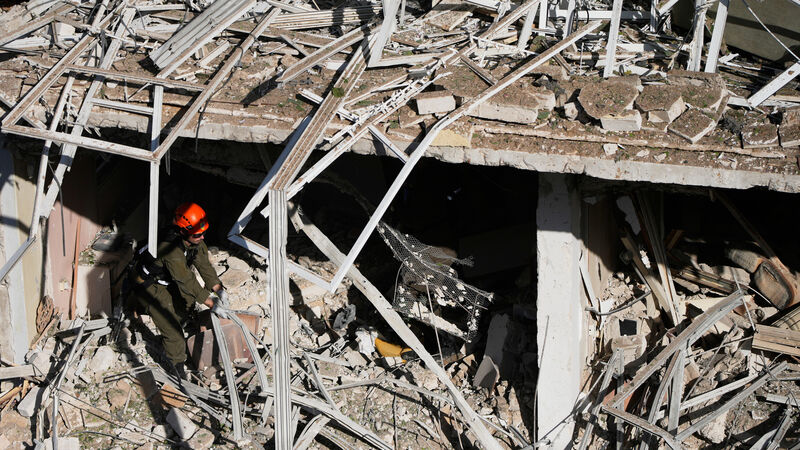
An Israeli rescue officer at the site of an Iranian missile strike in Tel Aviv (Ohad Zwigenberg/AP)
A missile has slammed into a street in central Tel Aviv as Iran kept up its barrages targeting Israel and Gulf states, even as President Donald Trump said the US is in talks with the Islamic Republic to end the war.
Mr Trump also delayed a deadline for Iran to open the strategic Strait of Hormuz for shipping or see its power stations targeted by air strikes, briefly driving down oil prices and boosting stocks.
The delay offered a reprieve after the US and Iran traded threats over the weekend of strikes that could have cut electricity to millions in Iran and around the Gulf and knocked out desalination plants that provide many desert nations with drinking water, while raising fears of possible catastrophe if nuclear plants were hit.
But any information on the talks described by Mr Trump remains in dispute with Iran, which denied any talks had been held.
“No negotiations have been held with the US,” Iranian parliament speaker Mohammad Bagher Qalibaf posted on X, adding that “fake news is used to manipulate the financial and oil markets”.
Israeli Prime Minister Benjamin Netanyahu also said Israel will continue to strike Iran and Lebanon even as the US considers a ceasefire.
“There’s more to come,” he said.
Iran’s foreign minister Abbas Araghchi has been talking about the war this week to his counterparts in Azerbaijan, Egypt, Oman, Pakistan, Russia, South Korea, Turkey and Turkmenistan, his office said.
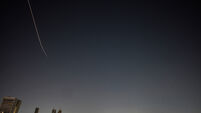
Iran fired multiple waves of missiles at Israel early on Tuesday, with reports of an impact in the country’s north.
In Tel Aviv, a missile with a 100 kilogram warhead escaped Israeli defences to slam into a street in the centre of the city, blowing out windows of a neighbouring apartment building and sending smoke billowing.

“We saw destruction, smoke, and chaos,” rescue service worker Yoel Moshe told reporters of his arrival at the scene minutes after the missile struck. Four people suffered minor wounds, he said.
Emerging from the shelter, Amir Hasid said he expected the scene to be far worse. “It feels like you’re a (sitting) duck, waiting for the missiles to hit you, or someone next to you,” he said.
Earlier in the day, Israel pounded Beirut’s southern suburbs, saying that it was targeting infrastructure used by the Iran-linked Hezbollah militant group.
According to the Lebanese Health Ministry, at least eight people died. A strike on a residential apartment south east of the Lebanese capital killed at least three, including a three-year-old girl. Another two people were killed in the village of Salaa and three in the village of Srifa.
More than 1,000 people have been killed in Lebanon since the war between Israel and the Lebanese militant Hezbollah group, an Iranian ally, resumed on March 2 and more than 1 million people have been displaced.
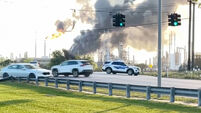
In Kuwait, power lines were hit from air defence shrapnel, causing partial electricity outages for several hours. Missile alert sirens sounded in Bahrain, and Saudi Arabia’s Defence Ministry said it had destroyed 19 Iranian drones targeting its oil-rich Eastern Province.
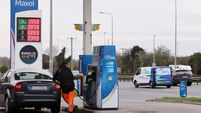
Oil prices briefly fell below 100 dollars a barrel after Mr Trump claimed his government was in talks to end the war.
But that respite was short lived, with the price of Brent crude, the international standard, back to 104 dollars a barrel in morning trading, up more than 40% since Israel and the US started the war on February 28.

Mr Trump initially set a deadline of late Monday for Iran to reopen the Strait of Hormuz or face attacks on its power plants, but on Monday he gave Tehran five more days to comply.
Iran has allowed a small number of ships through the strait, which leads from the Persian Gulf to the open ocean, but has said it will continue to target vessels linked to the US, Israel or its allies.
Its leaders are wary of Washington’s motives, in part because Tehran was in negotiations with the US before the surprise attack that started the war. Iran were also in talks last year when the US and Israel attacked its nuclear facilities, starting a 12-day war.
“Trump, Netanyahu and the like are inherently liars and their nature is to create division,” Esmail Kowsari, a member of the Iranian parliament’s national security and foreign policy committee, was quoted as saying by the semiofficial Fars news agency.
“We must think wisely. Their nature is to sow discord so that they can make people distrust officials and believe that such actions have taken place, whereas no such action has occurred.”


CONNECT WITH US TODAY



Be the first to know the latest news and updates