Trump warns Iran to reopen Hormuz or face strikes on power plants
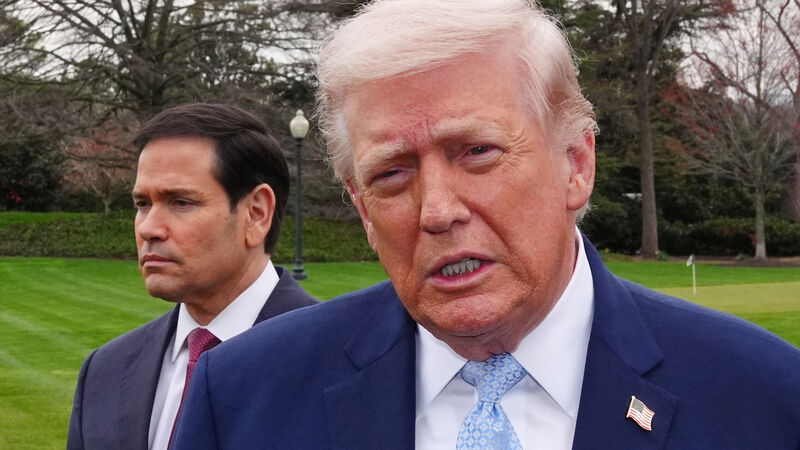
President Donald Trump speaks with reporters before departing on Marine One (Alex Brandon/AP)
President Donald Trump warned the US will “obliterate” Iranianpower plants if it does not fully open the Strait of Hormuz within 48 hours.
His statement came hours after Iranian missiles struck two communities in southern Israel late on Saturday, leaving buildings shattered and dozens injured in dual attacks not far from Israel’s main nuclear research centre.
The developments signalled the war was moving in a dangerous new direction at the start of its fourth week.
Mr Trump — who is facing increasing pressure at home to secure the Strait as oil prices soar — issued the ultimatum in a social media post while he spent the weekend at his Florida home.
Mr Trump said he is giving Iran 48 hours to open the vital waterway or face a new round of attacks. He said the US would destroy “various POWER PLANTS, STARTING WITH THE BIGGEST ONE FIRST!”
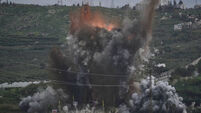
The Iranian strikes in Israel came after Tehran’s main nuclear enrichment site at Natanz was hit earlier in the day.
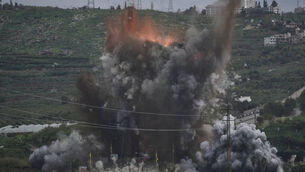
Israel’s military said it was not able to intercept missiles that hit the southern cities of Dimona and Arad, the largest near the centre in Israel’s sparsely populated Negev desert. It was the first time Iranian missiles penetrated Israel’s air defence systems in the area around the nuclear site.
“If the Israeli regime is unable to intercept missiles in the heavily protected Dimona area, it is, operationally, a sign of entering a new phase of the battle,” Iran’s parliament speaker Mohammad Bagher Ghalibaf said on X before word of the Arad strike spread.
Israeli Prime Minister Benjamin Netanyahu said more emergency crews were being sent to the scene.
“This is a very difficult evening,” he said.
Rescue workers said the direct hit in Arad caused widespread damage across at least 10 apartment buildings, three of them badly damaged and in danger of collapsing. At least 64 people were taken to hospitals.
Dimona is about 12 miles west of the nuclear research centre and Arad is around 22 miles north.
Israel is believed to be the only Middle East nation with nuclear weapons, though its leaders refuse to confirm or deny their existence. The UN nuclear watchdog said on X it had not received reports of damage to the Israeli centre or abnormal radiation levels.
“The war is not close to ending,” Israel’s army chief, General Eyal Zamir, said earlier in the day.
Iran also targeted the joint UK-US Diego Garcia military base in the Indian Ocean about 2,500 miles away, suggesting that Tehran has missiles that can go farther than previously acknowledged — or that it had used its space program for an improvised launch.
The US and Israel have offered shifting rationales for the war, from hoping to foment an uprising that topples Iran’s leadership to eliminating its nuclear and missile programs and its support for armed proxies.
There have been no signs of an uprising, while internet restrictions limit information from Iran.

The war’s effects are felt far beyond the Middle East, raising food and fuel prices.
It is not clear how much damage Iran has sustained in the US and Israeli strikes that began February 28, or even who is truly in charge.
Supreme leader Ayatollah Mojtaba Khamenei has not been seen in public since being named to the role.
Israel earlier on Saturday denied responsibility for the strike on the Natanz nuclear facility, nearly 135 miles southeast of Tehran.
The Iranian judiciary’s official news agency, Mizan, said there was no leakage.
The International Atomic Energy Agency has said the bulk of Iran’s estimated 970 pounds of enriched uranium is elsewhere, beneath the rubble at its Isfahan facility.
It said on X that it was looking into the strike.
The Pentagon declined to comment on the strike on Natanz, which was also hit in the first week of the war and in the 12-day war last June.
Russian Foreign Ministry spokesperson Maria Zakharova said such strikes posed a “real risk of catastrophic disaster throughout the Middle East”.
CONNECT WITH US TODAY



Be the first to know the latest news and updates