Iran rejects de-escalation offers; Israel says it kills Iranian security chief
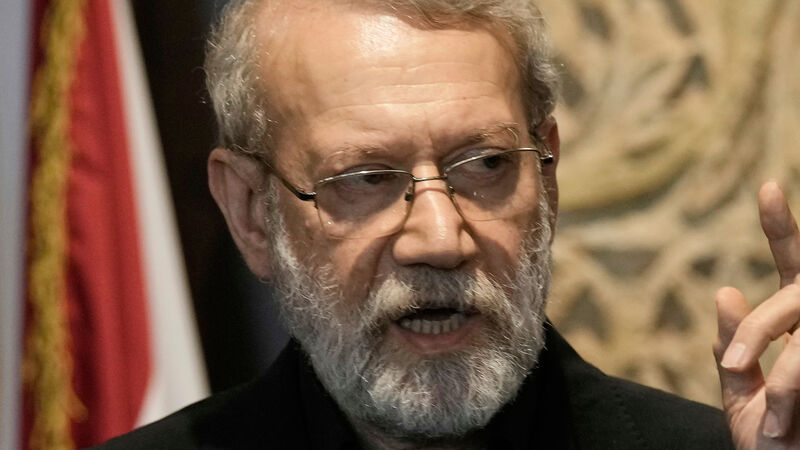
Ali Larijani, has been killed, Israel said (Bilal Hussein/AP)
Israel claimed on Tuesday to have killed Iran's security chief, while a senior Iranian official said the new supreme leader had rejected de-escalation offers conveyed by intermediaries, demanding Israel and the US first be "brought to their knees".
The senior official, who asked not to be identified, said two intermediary countries had conveyed proposals to Iran's Foreign Ministry for "reducing tensions or ceasefire with the United States". The official did not give further details.
Ayatollah Mojtaba Khamenei, who had held his first foreign policy session since being named supreme leader, had responded that it was not "the right time for peace until the United States and Israel are brought to their knees, accept defeat, and pay compensation", the official said.
He did not clarify whether Khamenei, who has not yet been pictured since being named last week to replace his slain father, had attended the meeting in person or remotely.
The US-Israeli war on Iran is now in its third week, with at least 2,000 people killed and no end in sight.
The Strait of Hormuz remains largely closed off and U.S. allies have rebuffed US President Donald Trump's calls for them to help to reopen the vital waterway, through which about 20% of global oil and liquefied natural gas flows.
Iran’s 86-year-old Supreme Leader Ayatollah Ali Khamenei died in an air strike on February 28, the first day of the war launched by the United States and Israel, and other top leaders from the Iranian theocracy have been killed since then.
Read More
Iranian state media did not immediately confirm either death. However, it said a message from Mr Larijani’s office would be published shortly.

The announcement came after the Israeli military earlier said it had carried out a “wide-scale wave of strikes” across Iran’s capital and stepped up strikes on Iran-backed Hezbollah militants in Lebanon. Israel also reported two incoming salvos before dawn from Iran aimed at Tel Aviv and elsewhere, and said Hezbollah targeted Israel’s north.
Incoming Iranian missiles on the United Arab Emirates prompted Dubai, a major transit hub for international travel, to briefly shut its airspace and a man was killed by the debris of a missile intercepted over Abu Dhabi.
Mr Larijani hails from one of Iran’s most famous political families. A former parliamentary speaker and senior policy adviser, he was appointed to advise the late Mr Khamenei on strategy in nuclear talks with the Trump administration.
He also served as the secretary of Iran’s Supreme National Security Council, its top security body.

Soleimani was the head of the Basij militia forces, which Israel’s military called an “armed apparatus of the Iranian terror regime”.
An Israeli military spokesperson said: “During internal protests in Iran, particularly in recent periods as demonstrations intensified, Basij forces under Soleimani’s command led the main repression operations, employing severe violence, widespread arrests and the use of force against civilian demonstrators.”
The US Treasury lists Soleimani as having been born in 1965. He has been sanctioned by the US, the European Union and other nations over his role in helping suppress dissent for years through the Basij.
Since the war began on February 28, Israel has launched specific attacks targeting Iran’s leadership, killing 86-year-old Supreme Leader Ayatollah Ali Khamenei and other military commanders.
Killing Soleimani could further strain the command and control of the Basij, which would be crucial in putting down any uprising against the theocracy. The Basij and other internal security forces have been a target of attack by both the Americans and the Israelis so far.
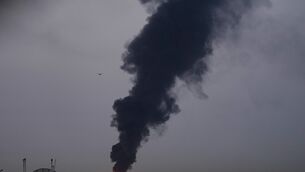
Iran has kept up the pressure on the energy infrastructure of its Gulf Arab neighbours, hitting an oil facility in Fujairah, located on the east coast of the United Arab Emirates (UAE), with the Gulf of Oman that has been repeatedly targeted. State-run WAM news reported that no one had been injured in the blast from the drone strike.
Iran’s attacks on Gulf nations and its stranglehold on the Strait of Hormuz, through which a fifth of the world’s oil is transported, have given rise to increasing concerns of a global energy crisis.
Early on Tuesday, it hit a tanker anchored off the coast of Fujairah, one of about 20 vessels hit since Israel and the United States started the war with an attack on Iran on February 28.
With Washington under increasing pressure over rising oil prices, Brent crude, the international standard, remained over 100 dollars (£75) a barrel, up more than 40% since the war started.
US President Donald Trump said he had demanded that roughly a half-dozen countries send warships to keep the Strait of Hormuz open.
But his appeals brought no immediate commitments, with many saying they are hesitant to get involved in a war with no defined exit plan and sceptical that they could do more than the US Navy.

Saudi Arabia’s Defence Ministry reported intercepting a dozen drones on Tuesday morning over the country’s vast Eastern Province, home to oil infrastructure.
In Qatar, the sounds of explosions boomed over the capital early in the day as defences worked to intercept incoming fire. Qatar’s Defence Ministry said later that it had successfully thwarted a missile attack on the city, though a fire broke out in an industrial area from a downed projectile.
Attacks from Iran-linked proxy forces continued in Iraq, as the US Embassy in Baghdad was hit with shrapnel from drones that had been intercepted.
The embassy’s air defences were able to shoot down all four drones targeting the facility, according to two Iraqi security officials, speaking on condition of anonymity to discuss intelligence matters.
A separate strike targeted a house in the heavily fortified Presidential Compound in Baghdad’s al-Jadriya area, the officials said.
It was not clear who carried out either attack, but Iran-allied militias have regularly been attacking American targets inside Iraq since the conflict began.
CONNECT WITH US TODAY



Be the first to know the latest news and updates