Iran marks anniversary of 1979 Islamic Revolution
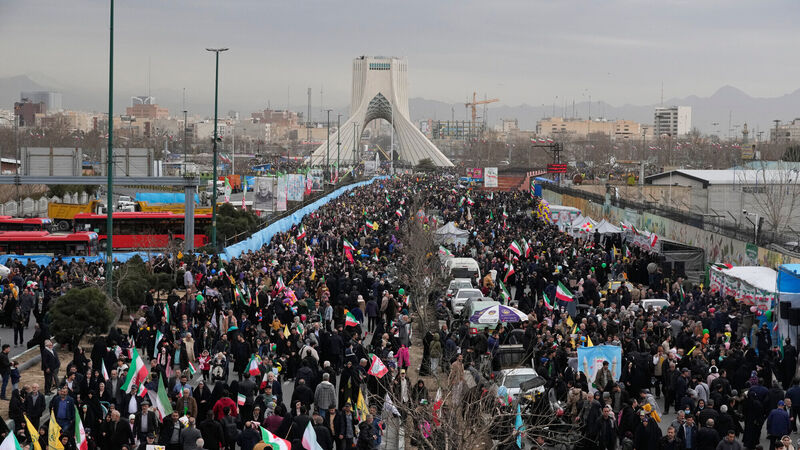
Iran has marked the 47th anniversary of its 1979 Islamic Revolution as the country’s theocracy remains under pressure.
US President Donald Trump has suggested sending another aircraft carrier group to the Middle East while many in Iran have denounced Tehran’s bloody crackdown on nationwide protests.
The commemoration represented a split-screen view of life in Iran, with state television showing hundreds of thousands of people across the country attending pro-government rallies, which included the burning of American flags and cries of “Death to America!”.
The night before, as government-sponsored fireworks lit the dark sky, witnesses heard shouts from homes in the capital, Tehran, of “Death to the dictator!”.

Meanwhile, President Masoud Pezeshkian got on stage at Azadi Square in Tehran and insisted that Iran is willing to negotiate over its nuclear programme as fledgling nuclear with the US hang in the balance.
Whether the talks succeed remains an open question — and Middle East nations fear their collapse could plunge the region into another regional war.
A top Iranian security official met Qatar’s foreign minister in Doha on Wednesday after earlier visiting Oman, which has mediated the latest round of negotiations. Just before the official’s arrival, Qatar’s ruling emir received a phone call from Mr Trump.
In his speech at the anniversary ceremony, Mr Pezeshkian said Iran was “not seeking nuclear weapons” and is “ready for any kind of verification”.
However, the United Nations’ nuclear watchdog — the International Atomic Energy Agency — has been unable for months to inspect and verify Iran’s nuclear stockpile.
“The high wall of mistrust that the United States and Europe have created through their past statements and actions does not allow these talks to reach a conclusion,” Mr Pezeshkian said. “At the same time, we are engaging with full determination in dialogue aimed at peace and stability in the region alongside our neighbouring countries.”
On Iranian state TV, authorities broadcast images of people taking to the streets across the country on Wednesday to support the theocracy and its 86-year-old Supreme Leader Ayatollah Ali Khamenei. Others criticised Iran’s exiled crown prince, Reza Pahlavi, who had been calling for anti-government protests.
“I am here to say we don’t stop supporting our leader and our country as the Americans and Israelis are increasingly threatening,” said Reza Jedi, a 43-year-old participant.
Iranian missiles were on display, as were fragments that authorities described as being from downed Israeli drones.
Fake coffins draped in the American flag could also be seen, one bearing the picture of US Navy Admiral Brad Cooper, the head of the American military’s Central Command, which covers the Middle East.

Among Iran’s 85 million people, there is a hard-line element of support for Iran’s theocracy, including members of the powerful paramilitary Revolutionary Guard, which put down the protests last month in a bloody suppression that killed thousands and saw tens of thousands detained, according to activists.
Also, many Iranians often take part in pro-theocracy demonstrations as they are government employees or turn up to enjoy the carnival atmosphere of a government-sponsored holiday. Iran has 2.5 million government employees, with a fifth in Tehran alone.
While not directly addressing the bloodshed, Mr Pezeshkian acknowledged the crackdown that began in earnest on January 8 had “caused great sorrow”.
“We are ashamed before the people, and we are obligated to assist all those who were harmed in these incidents,” he said. “We are not seeking confrontation with the people.”
One man sadly watched the commemoration from a pavement in Tehran, not taking part.
“I regularly participated in the rally in past years,” said the man, who spoke on condition of anonymity for fear of reprisal. “But how can I do that now as the streets’ asphalt were bloodied last month?”
CONNECT WITH US TODAY



Be the first to know the latest news and updates