How the US elections will unfold overnight for Irish viewers
We should know how some swing states voted before morning – and in certain scenarios the winner – whether Trump or Harris – should be apparent
How the US elections will unfold overnight for Irish viewers

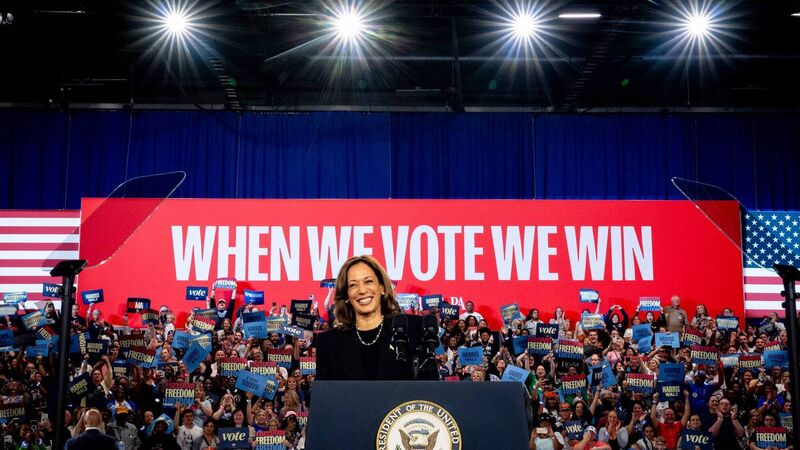
Democratic presidential nominee Kamala Harris reacts as she takes the stage during a rally at the Pennsylvania Farm Show Complex & Expo Center on October 30, 2024 in Harrisburg, Pennsylvania. Picture: Andrew Harnik/Getty Images

By late on Tuesday or early on Wednesday, we may know who is going to be the next president of the United States. Or we may know that we don’t yet know. Or we may know who’s been projected as the winner but be bracing ourselves for weeks of legal action and protest. It’s going to be that sort of night.

A reminder of the basics: whether Donald Trump or Kamala Harris is the next president will be decided by the electoral college, rather than a straight count of the national vote – meaning that the winner will be the person who gets to a simple majority of 270 of the 538 electors on offer across the 50 states, whether or not they get more votes than their opponent nationwide.


That means that the result is quite likely to come down to who prevails in the seven battleground states identified by both sides as being up for grabs – Arizona, Georgia, Michigan, Nevada, North Carolina, Pennsylvania and Wisconsin. Meanwhile, all 435 seats in the House of Representatives are on the ballot, as are 34 of the 100 seats in the Senate. There are also 13 state and territorial governorships to be decided.

Here is a guide to how the night will unfold. Irish residents determined to stick around to the bitter end, whenever that might be, should consider getting some sleep at 8pm or 9pm, and setting alarms (at least six, at three-minute intervals) for midnight or 1am, since not much will happen before then anyway. 

But pace yourself. For all that we talk about election night, any of the key races – or several of them – could take well into the next day, or longer, to produce a clear result.

Candidate yard signs arrayed near Arlington, Virginia Court House before the start of early voting

10pm Irish time (IST) (5pm Eastern Time): exit polls give context 

Voting ends in Indiana and most of Kentucky, but neither is in play. Meanwhile, the first batch of exit polls are released. 

Unlike in the UK, where exit polls are usually a decent guide to the final outcome, the American version offers only a tantalising hint of what may be in store: rather than providing a projection of final results based on asking people at polling stations how they voted, they give a view of what respondents have said the issues that mattered the most to them were.

They’re based on a bigger sample than typical polls – numbering in the tens of thousands – so they ought to give pretty robust findings. But knowing that voters were motivated by the economy or abortion, for example, will only be a clue to how the night might go, rather than a basis for projecting the result.

Midnight IST/7pm ET: Georgia and North Carolina – the first clues 

Polls close in nine states over the next hour. Don’t just follow the running count of electoral college votes to get a sense of how it’s going, though: Trump is expected to have the biggest tally coming out of this first batch, however, his night is going.

But polls also close in the first battleground states that could give a major indication of what’s happening: Georgia and North Carolina. Just as importantly, we may start to see whether any clear pattern is emerging that holds true across different states and therefore provides evidence of what could happen elsewhere.

We don’t know when any of the states will be called, and even the results in Georgia and North Carolina may not be known for hours – or, and let’s hope not, days – yet. It’s possible that broadcasters and the Associated Press will start to call some states that haven’t even finished counting if they conclude that the other side has no chance of catching up but the closer the race the longer it may take.

(When we talk about states being “called”, we mean that major news organisations have examined the data and reached a conclusion that it is statistically impossible for the other side to win. Official declarations can take much longer.) 

Former US president and Republican presidential nominee Donald Trump speaks at a campaign rally at Resch Center in Green Bay, Wisconsin, on October 30, 2024. Picture: Alex Wroblewski / AFP

1am IST/8pm ET: Oh God, it’s Pennsylvania 

Polls close in about half the country – so any nationwide patterns should be becoming clear. But it’s Pennsylvania that matters most. With more electoral votes – 19 – than any other swing state, and polls suggesting that it’s the closest race in the country, this is a huge moment. If Trump wins, tell your friends that it was madness for Harris not to pick the state’s popular Democratic governor, Josh Shapiro, as her running mate; if Harris wins, you can muse that the insults hurled towards the state’s 470,000 Puerto Ricans at a recent Trump rally might have made the difference.

Again, the polls closing doesn’t necessarily mean a quick declaration. In Pennsylvania, rules against counting mail-in ballots before polls close are likely to slow things down. So it might end up being one of the later races to be called among the key states. It took four days in 2020.

Whenever they come, if Pennsylvania, Georgia and North Carolina all go in one candidate’s favour, it will be very difficult for the other to win. If we don’t get that sort of news by now, find some caffeine or a cocktail and pin your eyelids to your forehead: we might be in for a long night.

2am IST/9pm ET: Three more battleground states 

In this hour, polls will close in 15 states, including three of the four remaining battlegrounds: Arizona, Michigan and Wisconsin. But Wisconsin wasn’t called until after 2pm the following day in 2016 or 2020. Arizona took more than a week in 2020, and there are more onerous rules in place around the count this time.

It was around now in 2016 – 2.29am, to be precise – that AP called the race for Trump, with Clinton calling to concede a few minutes later. In 2020, the result wasn’t called for four more days (the following Saturday).

Another interesting state to watch now: Iowa, where a shock poll at the weekend gave Harris a lead of three points in a state generally assumed to be a sure thing for Trump, who won it at the last two elections. If that bears out in reality, it probably won’t make a difference to the overall outcome – but only because it is likely to indicate that Harris has had a better night than expected in other similar states, such as Michigan and Pennsylvania.

By now, Trump is likely to have a solid-looking lead in the running electoral college count you’ll probably see on screen – but that is expected to start whittling down as polls close in big, solid blue states, including New York and California, from this point. But if and when those six swing states where polls have closed by now are called, it’s very likely that the result will be apparent.

Supporters of former US President and Republican presidential candidate Donald Trump campaign in rural Schuylkill Haven, Pennsylvania, on October 16, 2024. Picture:  DESOBEAU/AFP via Getty Images

3am IST/10pm ET: Nevada 

Polls close in Nevada, the last swing state, this hour. It’s unlikely that its eight electoral college votes will be decisive but if they are, things are probably going to feel uncertain for a while yet. It took 88 hours to call the state in 2020.

Another question will be whether either candidate comes out to speak to their supporters, and when. Everything Trump has said suggests that it is very unlikely that he will concede defeat on election night, except in the unlikely event of a landslide against him. (In 2020, he made a speech at the White House at 2.21am ET in which he made his first false claims of electoral fraud.) 

The tone he and Harris strike in these hours and afterwards will give a sense of whether the result is going to be accepted all around – or if we could be in for a much more febrile period.

4am IST/11pm ET: California, Alaska and everything after 

The last polls close over the next two hours and, while it is just about theoretically possible that it could all come down to Alaska, I wouldn’t bet your house on it. What seems significantly more likely is: whatever the candidates have said, if the race looks close, lawyers for both sides will be gearing up for court challenges in key states – while pro-Trump poll watchers and other supporters are likely to be making numerous claims of election interference.

Last time around, exhaustive legal processes found similar claims to be without foundation but that doesn’t mean they won’t be repeated. It is entirely possible that we will have a clear call of a result from the major networks by this time – but everything will still appear to be in flux.

- The Guardian

More in this section

Cookie Policy Privacy Policy Brand Safety FAQ Help Contact Us Terms and Conditions

© Examiner Echo Group Limited