Hungarian leader blocks EU aid package for Ukraine
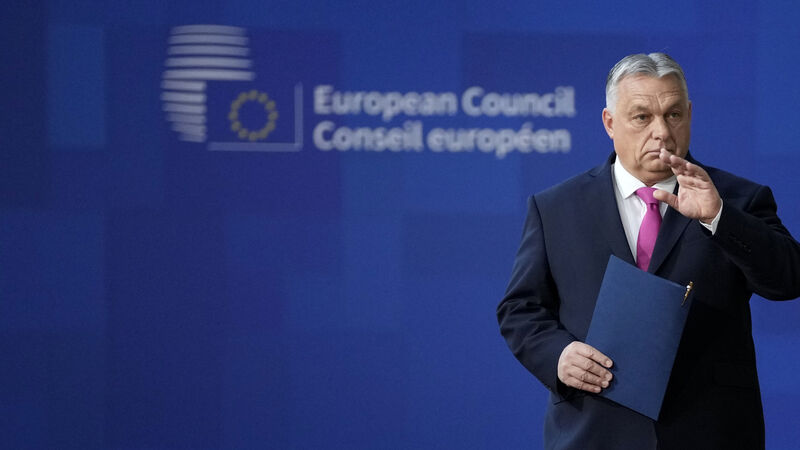
Hungaryâs Prime Minister Viktor Orban arrives for the EU summit in Brussel (Picture: Virginia Mayo/AP)
The European Union has failed to agree on a âŹ50 billion aid package for Ukraine, even after deciding to open accession negotiations with the war-torn country.
The aid was vetoed by Hungarian Prime Minister Viktor Orban on Thursday, delivering another tough blow to Ukrainian President Volodymyr Zelensky after he failed this week to persuade US politicians to approve an additional $61 billion (âŹ55.5 billion), mainly to buy weapons from the US.

The start of accession talks was a momentous moment and stunning reversal for a country at war that had struggled to find the backing for its membership aspirations and long faced obstinate opposition from Mr Orban.
Hungaryâs leader decided not to veto the accession talks, but then blocked the aid package.
âI can inform you that 26 leaders agreed on the (budget negotiation),â European Council president Charles Michel said. âI should be very precise. One leader, Sweden, needs to consult its parliament, which is in line with the usual procedure for this country, and one leader couldnât agree.â
The decisions required unanimity among the EUâs members.
Mr Michel, who was chairing the Brussels summit, called the start of accession talks âa clear signal of hope for their people and our continentâ. He said leaders would reconvene in January.
Although the process between opening negotiations and Ukraine finally becoming a member could take many years, Mr Zelensky welcomed the agreement as âa victory for Ukraine. A victory for all of Europeâ.
âHistory is made by those who donât get tired of fighting for freedom,â he said.
The financial package could not be endorsed after Mr Orban vetoed both the extra money and a review of the EU budget having warned the summit that forcing a decision on the Ukraine issues could destroy EU unity.
Mr Orban said that his opposition remained steadfast, but that he decided not to use his veto because the 26 other nations were arguing so strongly in favour. Under EU rules, an abstention does not prevent a decision from being adopted.
Irish Prime Minister Leo Varadkar said: âIn fairness to Prime Minister Orban, he made his case, made it very strongly. He disagrees with this decision and heâs not changing his opinion in that sense, but essentially decided not to use the veto power.
âI respect the fact that he didnât do that, because it would have put us in a very difficult position as a European Union.â
Belgian Prime Minister Alexander De Croo called the opening of membership discussions a black eye for Russian President Vladimir Putin.
âIt is a very clear message to Moscow. Us Europeans, we donât let go of Ukraine,â he said.
He said he thought Mr Orban âdidnât use his veto because he realised that it would be indefensibleâ.
At the same time as Ukraine, the EU leaders also decided to open membership negotiations with Ukraineâs neighbour Moldova.
US national security adviser Jake Sullivan welcomed âthe EUâs historic decision to open accession negotiations with Ukraine and Moldova, a crucial step toward fulfilling their Euro-Atlantic aspirationsâ.