Russia says Wagner Group’s leader will move to Belarus
The mayor of Moscow, Sergei Sobyanin, has called on people to refrain as far as possible from trips around the city, given a counter-terrorism operation had been declared.
Russia says Wagner Group’s leader will move to Belarus

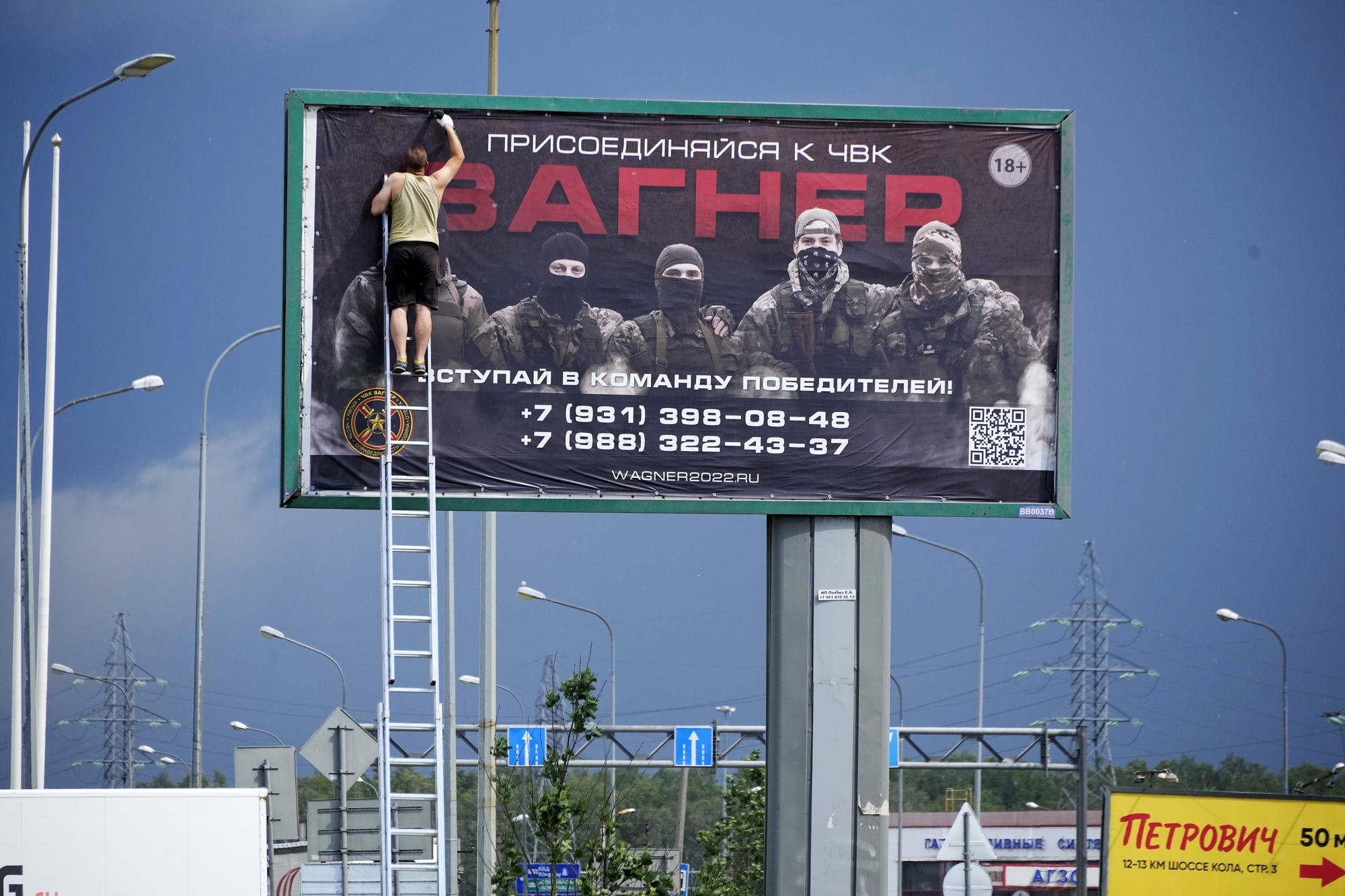
A man prepares to take down a poster reading ‘Join us at Wagner’ on the outskirts of St Petersburg (AP)

The head of the private Russian military company Wagner will move to neighboring Belarus as part of deal to defuse rebellion tensions and the criminal case against him will be closed, the Kremlin said Saturday.

Yevgeny Prigozhin’s troops who joined him in the uprising will not face prosecution and those who did not will be offered contracts by the Defense Ministry, Kremlin spokesman Dmitry Peskov said.


After the deal was reached, Prigozhin said he was ordering his troops to halt their march on Moscow and retreat to field camps in Ukraine, where they have been fighting alongside Russian troops.

The deal appeared to defuse a dramatically escalating crisis that represented the most significant challenge to President Vladimir Putin in his more than two decades in power.

The deal was mediated by Belarusian President Alexander Lukashenko, a staunch Putin ally.

The head of the Wagner force said on Saturday he has ordered his mercenaries to halt their march on Moscow and retreat to their field camps in Ukraine to avoid shedding Russian blood.

The announcement from Yevgeny Prigozhin appeared to defuse a growing crisis. Moscow had braced for the arrival of the private army led by the rebellious commander. And President Vladimir Putin had vowed he would face harsh consequences.

Prigozhin said that while his men are just 200 kilometers (120 miles) from Moscow, he decided to turn them back to avoid “shedding Russian blood.” He didn’t say whether the Kremlin has responded to his demand to oust Defense Minister Sergei Shoigu. There was no immediate comment from the Kremlin

The announcement follows a statement from the office of Belarusian President Alexander Lukashenko saying that he had negotiated a deal with Prigozhin after previously discussing the issue with Putin.

Prigozhin has accepted Lukashenko’s offer to halt the Wagner group’s advance and further steps to de-escalate the tensions, Lukashenko’s office said, adding that the proposed settlement contains security guarantees for Wagner troops. It didn’t elaborate.

Mass outdoor events and at educational institutions have been suspended in Moscow until July 1, authorities have said. 

It was issued by Governor Andrei Vorobyov and applies to the surrounding areas of the city. However, Moscow Mayor Sergei Sobyanin warned that traffic could be restricted in parts of the capital as part of the counter-terrorism operation prompted by the rebellion.

It follows the mayor of Moscow urging residents to refrain from travelling around the capital. 

Public buildings across Moscow have been evacuated as the Wagner rebels advance. According to BBC Russia, museums near the Kremlin were being evacuated. 

There have been reports over the last few hours of the evacuation of the Tretyakov Gallery, the Pushkin Museum and the GES-2 House of Culture, the BBC added.

The Mega Belaya Dacha shopping centre and the Kvartal shopping centre were also evacuated in Moscow, it said.

More roadblocks have appeared as Wagner troops proceed to Moscow via Google Maps

Russian media showed pictures of small groups of police manning machine gun positions on Moscow's southern outskirts Authorities in the Lipetsk region south of the capital told residents to stay home.

The mayor of Moscow, Sergei Sobyanin, also called on people to refrain as far as possible from trips around the city, given a counter-terrorism operation had been declared, and said the situation was "difficult."

Sobyanin also said in a statement that Monday would be a non-working day - with some exceptions - in order "to minimise risks". There was an increased security presence on the streets and Red Square was blocked off by metal barriers.

President Vladimir Putin has vowed to punish the organisers of an armed rebellion in Russia after mercenary chief Yevgeny Prigozhin led his troops out of Ukraine and into a key southern city.

Mr Putin denounced the uprising by Wagner Group forces as “a stab in the back”.

It marks the biggest threat to Mr Putin’s leadership in more than two decades in power.

The private army led by Mr Prigozhin appears to control the military headquarters in Rostov-on-Don, a city 660 miles south of Moscow that runs Russian offensive operations in Ukraine, the UK’s Ministry of Defence said.

As the fast-moving events unfolded in Russia, Ukrainian President Volodymyr Zelensky said Moscow is suffering “full-scale weakness”, and that Kyiv is protecting Europe from “the spread of Russian evil and chaos”.

Yevgeny Prigozhin said the move was a ‘march of justice’ (Prigozhin Press Service via AP)

In an address to the Russian nation, Mr Putin called the actions by Mr Prigozhin, whom he did not mention by name, a “betrayal” and “treason”.

The Russian President said: “All those who prepared the rebellion will suffer inevitable punishment.

“The armed forces and other government agencies have received the necessary orders.”

Mr Prigozhin said his fighters would not surrender, as “we do not want the country to live on in corruption, deceit and bureaucracy”.

“Regarding the betrayal of the motherland, the president was deeply mistaken. We are patriots of our homeland,” the Wagner Group said in an audio message on his Telegram channel.

Mr Prigozhin’s private military contractor has been fighting alongside Russian troops in Ukraine.

His goals were not immediately clear, but the rebellion marks an escalation in his struggle with Russian military leaders, whom he has accused of botching the war in Ukraine and hobbling his forces in the field.

“This is not a military coup, but a march of justice,” Mr Prigozhin said.

He confirmed on Saturday that he and his troops had reached Rostov-on-Don after crossing the border from Ukraine.

Mr Prigozhin posted a video of himself at the military headquarters in Rostov and claimed that his forces had taken control of the airfield and other military facilities in the city. Other videos on social media showed military vehicles, including tanks, on the streets.

The Wagner Group chief said his forces faced no resistance from young conscripts as they crossed into Russia, saying his troops “aren’t fighting against children”.

“But we will destroy anyone who stands in our way,” he said in one of a series of video and audio recordings posted on social media beginning late on Friday.

Mr Putin addressed the nation on Saturday before the rebellion was called off (Sputnik/Kremlin Pool Photo/AP)

“We are moving forward and will go until the end,” he added.

The rebellion comes at a time when Russia is “fighting the toughest battle for its future”, Mr Putin said, as Western governments heap sanctions on Moscow and arm Ukraine.

“The entire military, economic and information machine of the West is waged against us,” the Russian leader said.

Russia’s security services, including the Federal Security Service (FSB), called for Mr Prigozhin’s arrest after he declared an armed rebellion late on Friday.

In a sign of how seriously the Kremlin takes the threat, authorities declared a “counter-terrorist regime” in Moscow and its surroundings, allowing restricted freedoms and enhancing security in the capital.

It is not immediately clear how Mr Prigozhin was able to enter the southern Russian city or how many troops he had with him.

Mr Prigozhin said he wanted to punish defence minister Sergei Shoigu after he accused Russian government forces of attacking Wagner field camps in Ukraine with rockets, helicopter gunships and artillery. He claimed that “a huge number of our comrades got killed”.

A woman poses for a photo at a Russian armoured vehicle, with writing reading ‘Siberia’, parked in a street in Rostov-on-Don (AP)

He added that Wagner’s forces had shot down a Russian military helicopter that fired on a civilian convoy, but there was no independent confirmation of that.

Mr Prigozhin alleged that Gen Valery Gerasimov, chief of the general staff, ordered the attacks following a meeting with Mr Shoigu, where they decided to destroy Wagner.

The defence ministry has denied attacking the Wagner camps.

Mr Prigozhin said he had 25,000 troops under his command and urged the army not to offer resistance.

After Mr Putin’s address, in which he did not mention concrete steps to suppress the rebellion but rather called for unity, officials and state media personalities sought to reiterate their allegiance to the Kremlin and urged Mr Prigozhin to back down.

Vyacheslav Volodin, speaker of the lower house of parliament, said legislators “stand for the consolidation of forces” and support Mr Putin, adding that “Wagner fighters must make the only right choice: to be with their people, on the side of the law, to protect the security and future of the Motherland, to follow the orders of the commander-in-chief”.

Foreign ministry spokeswoman Maria Zakharova echoed Mr Volodin’s sentiment, saying in a Telegram post: “We have one commander in chief. Not two, not three. One.”

Ramzan Kadyrov, the strongman leader of the Chechnya region who used to side with Mr Prigozhin in his criticism of the military, also expressed his full support of Mr Putin’s “every word”.

Service men on the street in Rostov-on-Don (Vasily Deryugin, Kommersant Publishing House via AP)

While the outcome of the confrontation is still unclear, it appears likely to hinder Moscow’s war effort as Kyiv’s forces probed Russian defences in the initial stages of a counter-offensive.

The dispute, especially if Mr Prigozhin were to prevail, also could have repercussions for Mr Putin and his ability to maintain unity.

The Wagner forces have played a crucial role in Ukraine, capturing the eastern city of Bakhmut, an area where the bloodiest and longest battles have taken place.

However, Mr Prigozhin has increasingly criticised the Russian military’s top brass, accusing it of incompetence and of starving his troops of munitions.

Mr Zelensky noted the rebellion in his Telegram channel and said “anyone who chooses the path of evil destroys himself”.

He added: “For a long time, Russia used propaganda to mask its weakness and the stupidity of its government. And now there is so much chaos that no lie can hide it.

“Russia’s weakness is obvious. Full-scale weakness. And the longer Russia keeps its troops and mercenaries on our land, the more chaos, pain and problems it will have for itself later.”

Mr Prigozhin’s actions could have significant implications for the war. Orysia Lutsevych, the head of the Ukraine Forum at the Chatham House think tank in London, said infighting between the defence ministry and Wagner will create confusion and potential division among Russian forces.

The Wagner chief, whose feud with the defence ministry dates back years, had refused to comply with a requirement that his forces sign contracts with the ministry before July 1.

He said on Friday he was ready for a compromise, but “they have treacherously cheated us”.

Col Gen Sergei Surovikin, the deputy commander of the Russian forces in Ukraine, urged Wagner troops to stop any move against the army, saying it would play into the hands of Russia’s enemies who are “waiting to see the exacerbation of our domestic political situation”.

The US and the leaders of European countries including Italy and Poland have said they are monitoring developments closely, while Estonia, which borders Russia, stepped up border security.

x

More in this section

Cookie Policy Privacy Policy Brand Safety FAQ Help Contact Us Terms and Conditions

© Examiner Echo Group Limited