Major air defence exercise starts in Germany
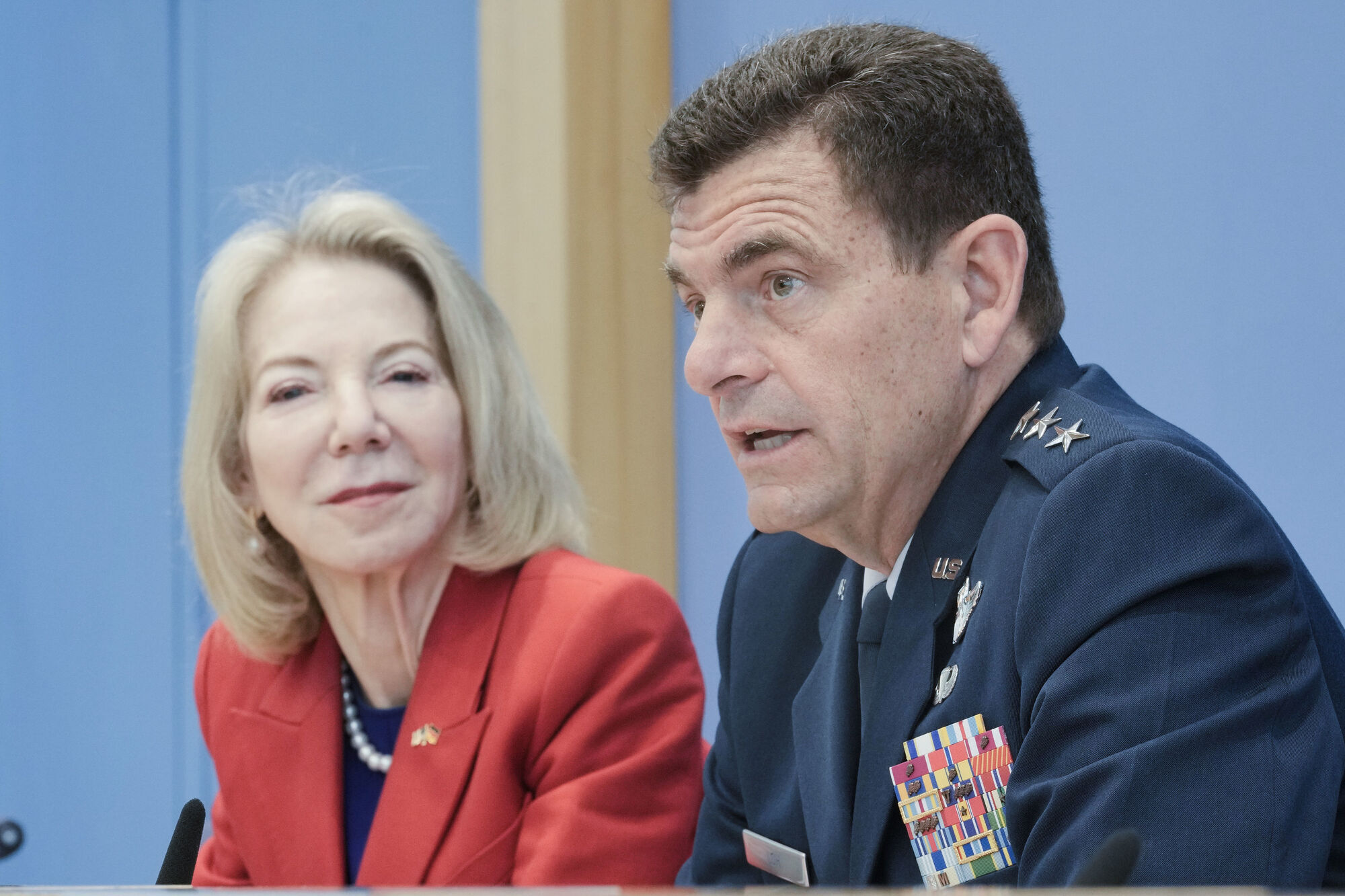
United States Ambassador to Germany Amy Gutmann, left, and U.S. Air National Guard Director Lieutenant General Michael A. Loh, brief the media during a news conference on the Air Defender military exercise in Berlin, Germany, Wednesday, June 7, 2023. (AP Photo/Markus Schreiber)
An air deployment exercise billed as the biggest in Nato’s history is getting under way in Germany.
The Air Defender 23 drill, set to run until June 23, has long been planned and serves to showcase the alliance’s capabilities amid high tensions with Russia.
Some 10,000 participants and 250 aircraft from 25 nations will respond to a simulated attack on a Nato member.
The United States alone is sending 2,000 US Air National Guard personnel and about 100 aircraft.
German air force chief Lt Gen Ingo Gerhartz told ZDF television: “The exercise is a signal – a signal above all to us, a signal to us, the Nato countries, but also to our population that we are in a position to react very quickly … that we would be able to defend the alliance in case of attack.” Lt Gen Gerhartz said he proposed the exercise in 2018, reasoning that Russia’s annexation of Crimea underlined the need to be able to defend Nato.
Russia’s invasion of Ukraine in February 2022 has jolted Nato into preparing in earnest for the possibility of an attack on its territory.
Sweden – which is hoping to join the alliance – and Japan are also taking part in the exercise.
Assessments of the extent to which the exercise will disrupt civilian flights have varied widely.
Matthias Maas, the head of a German air traffic controllers’ union, GdF, has said that it “will of course have massive effects on the operation of civilian aviation”.
Lt Gen Gerhartz disputed that, saying that Germany’s air traffic control authority has worked with the air force to keep disruption “as small as possible”.
He noted that the exercise is limited to three areas which will not all be used at the same time, and that it will be over before school holidays start in any German state.
“I hope that there we will be no cancellations; there may be delays in the order of minutes here and there,” he said, insisting that a study cited by the air traffic controllers’ union assumes a worst-case scenario in bad weather in which the military would not fly anyway.

CONNECT WITH US TODAY



Be the first to know the latest news and updates