Japan’s former prime minister Shinzo Abe has died following 'barbaric' shooting
Local fire service official Makoto Morimoto said the 67-year-old Mr Abe was not breathing and his heart had stopped while being airlifted to hospital.
Japan’s former prime minister Shinzo Abe has died following 'barbaric' shooting

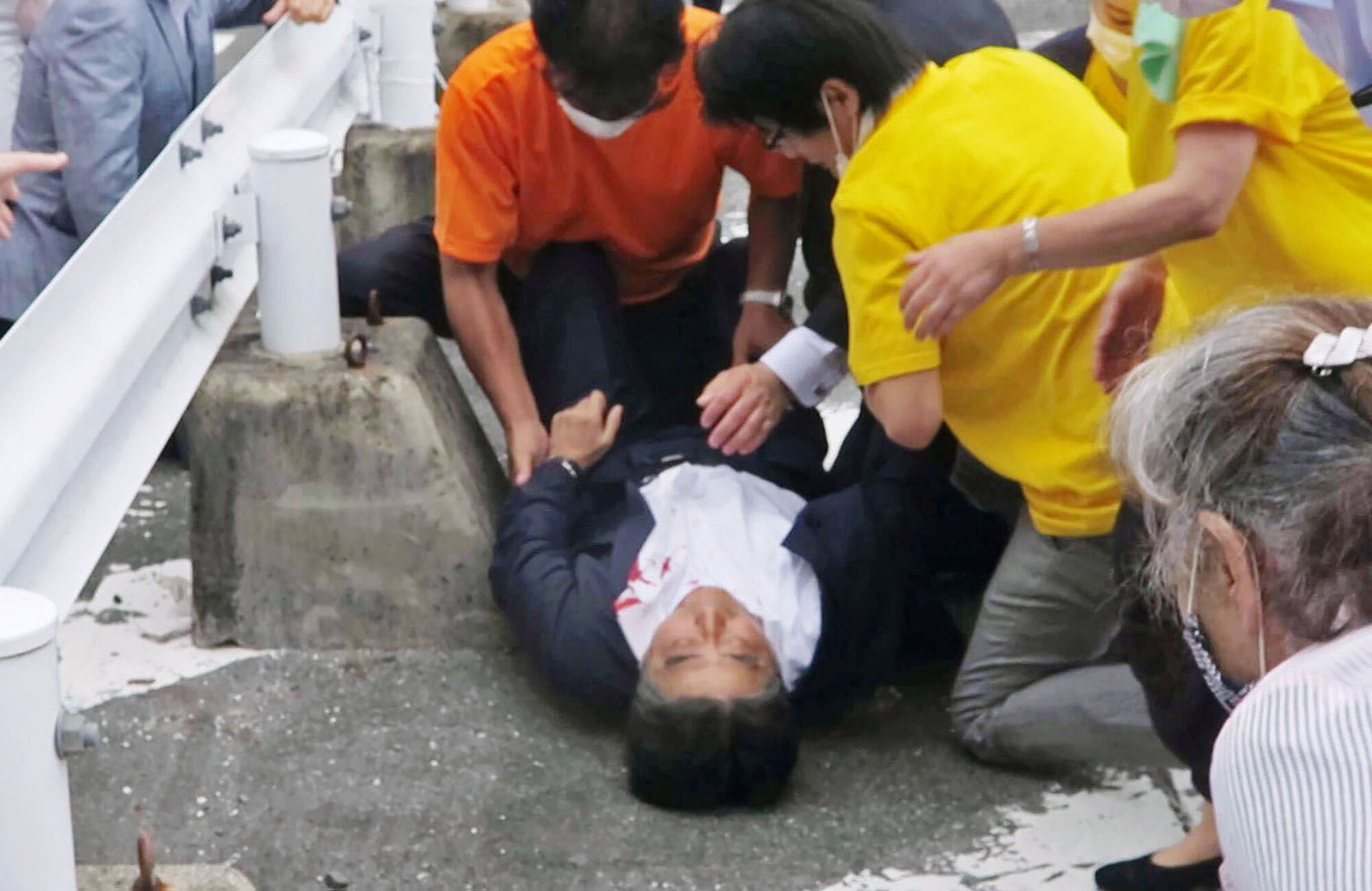
In this image from a video, Japan's former Prime Minister Shinzo Abe, center, is attended on the ground in Nara, western Japan. Picture: Kyodo News via AP

Former Japanese prime minister Shinzo Abe has died after being shot during a campaign speech, according to NHK television.

Mr Abe was shot from behind minutes after he started his speech on Friday in Nara in western Japan.


He was airlifted to a hospital for emergency treatment but was not breathing and his heart had stopped.

Nara Medical University A&E chief Hidetada Fukushima said Mr Abe suffered major damage to his heart in addition to two neck wounds that damaged an artery, causing extensive bleeding.

He never regained his vital signs, Mr Fukushima said.

Mr Abe’s treatment included large blood transfusions.

The 67-year-old was pronounced dead later at the hospital.

Mr Abe was Japan’s longest-serving leader before stepping down for health reasons in 2020.

Police arrested a male suspect at the scene of the shooting in Nara.

Nara prefectural police confirmed the arrest of Tetsuya Yamagami, 41, on suspicion of attempted murder. NHK reported that the suspect served in Japan’s Maritime Self-Defence Force for three years in the 2000s.

Japanese Prime Minister Shinzo Abe died after being shot at a campaign event in Nara on Friday.

Japanese leader Fumio Kishida, who belongs to the same political party as Mr Abe, returned to Tokyo from a campaign trip after the shooting.

The prime minister called the attack “dastardly and barbaric”, and said that it was “absolutely unforgivable” that the crime had taken place during the election campaign – the foundation of democracy.

The public broadcaster NHK aired footage showing Mr Abe collapsed on the street, with several security guards running toward him. He was bleeding and holding his chest.

In the next moment, security guards leap on top of a man in grey shirt, who lies face down on the pavement. A double-barrelled device, which appeared to be a handmade gun, can be seen on the ground.

Tetsuya Yamagami, bottom, is detained near the site of gunshots in Nara Prefecture, western Japan. Picture: Katsuhiko Hirano/The Yomiuri Shimbun via AP

Japan’s chief cabinet secretary Hirokazu Matsuno told reporters: “A barbaric act like this is absolutely unforgivable, no matter what the reasons are, and we condemn it strongly.” The popular former leader is still influential in the governing Liberal Democratic Party and heads its largest faction, Seiwakai.

The Taoiseach has described the assassination as "an attack on democracy itself".

In a statement, Micheál Martin said he was appalled by the death of Mr Abe and extended his sympathies to the people of Japan, especially his family.

Tánaiste Leo Varadkar has also expressed his shock, adding Mr Abe was a "real gentlemen and a true democrat".

Foreign Affairs Minister Simon Coveney paid tribute to Mr Abe, telling RTÉ 's Today with Claire Byrne: “He was very decent, a gentleman.” 

The two met during an Irish trade mission to Japan, explained Mr Coveney.

Elections for Japan’s upper house, the less powerful chamber of its parliament, will take place on Sunday.

Mr Abe was giving a speech when people heard gunshots. He was holding his chest when he collapsed, his shirt smeared with blood, but was able to speak before he fell unconscious.

The attack was a shock in a country that’s one of the world’s safest and with some of the strictest gun control laws anywhere.

The Yomiuri Shimbun newspaper printed extra editions, which were quickly grabbed by people on the street to read about the shooting.

An employee distributes extra editions of the Yomiuri Shimbun newspaper reporting that Japan's former Prime Minister Shinzo Abe was shot. Picture: AP Photo/Eugene Hoshiko

Nara, once the capital of Japan, is just to the east of Osaka on the country’s main Honshu island.

Mr Abe stepped down in 2020 because he said a chronic health problem has resurfaced. He has had ulcerative colitis since he was a teenager and said the condition could be controlled with treatment.

He told reporters at the time that it was “gut wrenching” to leave many of his goals unfinished.

He spoke of his failure to resolve the issue of Japanese abducted years ago by North Korea, a territorial dispute with Russia and a revision of Japan’s war-renouncing constitution.

That last goal was a big reason he was such a divisive figure.

His ultra-nationalism had riled the Koreas and China, and his push to normalise Japan’s defence posture had angered many Japanese people.

Mr Abe failed to achieve his cherished goal of formally rewriting the US-drafted pacifist constitution because of poor public support.

More in this section

Cookie Policy Privacy Policy Brand Safety FAQ Help Contact Us Terms and Conditions

© Examiner Echo Group Limited