Doctors and nurses flock to help Ukrainian refugees arriving here with health needs
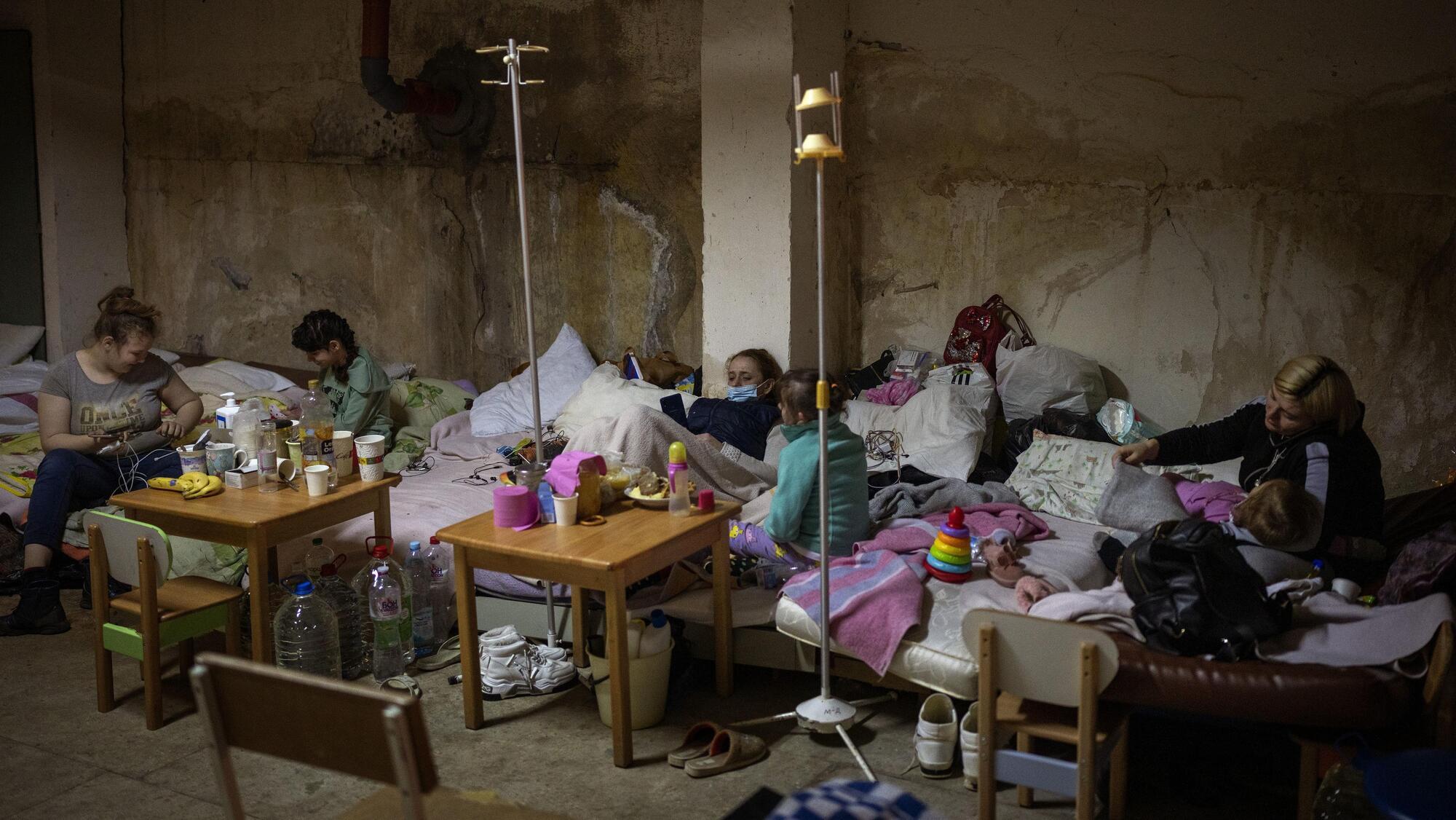
Sick children and women with their newborn babies in a basement used as a bomb shelter at the Okhmadet children's hospital in central Kyiv, Ukraine, this month. Picture: AP/Emilio Morenatti
A health network that deals primarily with vulnerable people has praised the "amazing" response to its appeal for more doctors and nurses to assist with Ukrainian refugees, particularly in congregated settings such as hotels.
SafetyNet Primary Care, which provides medical assistance to people in emergency accommodation and to rough sleepers, said it hoped to open evening and Saturday clinics to assist with the health needs for the thousands of Ukrainians already in Ireland, with many more to follow.
But the organisation's chief executive Fiona O'Reilly said the initial phase would be centred around direct medical assistance, and other difficulties could arise later, including mental health issues.
SafetyNet urged medical practitioners to come forward as part of its appeal and Ms O'Reilly said 20 have already done so, and more are likely to be required, with the Government seeking to block book hotels for lengthy periods as the crisis in Ukraine intensifies and more people arrive here.
Ms O'Reilly said a lot had already been done and extra resources had been provided, with people with pre-existing conditions coming here and needing equivalent medicines.
"People are on medication for various things, such as hypertension, diabetes. They have come with the [medicine] cabinet they've got but they don't have any more so they need their prescription redone, we have to translate it and then translate it into the appropriate medicines we would have here," she said.
"They are the immediate needs people are coming with at the moment. They are a population who were well looked after up until four weeks ago and they are resourceful and they are able to look after their health, but they need to be put into the system now.
"It's just the sheer flow and the high numbers coming in — it will take a while."
Ms O'Reilly said while language was a barrier in some cases, many of those who have already arrived don't have that issue. However, she said it was the early stage of the crisis and people could be traumatised by the circumstances of their leaving of their home country.
"At this moment, I find that in crisis, in emergencies, that the early part is about coping and surviving and it's only later when you stop moving and things settle that the trauma of what happened comes up."
As for the organisation's appeal for medical professionals to assist with those in congregated settings, she said: "We have got a good response from GPs and nurses and we will take more.
"Accommodation is obviously going to be the number one issue and then health number two.
"We are hoping to be able to have evening and Saturday clinics and that will work well with people doing normal work for those in larger congregated settings."
At the weekend, it emerged that the State is attempting to block-book entire hotels for up to a year as it scrambles to find accommodation for people fleeing the Russian invasion of Ukraine.
In Cork alone, an estimated 1,700 Ukrainian refugees are staying in hotels and guesthouses, with plans in place to cater for up to 10,000 people in the coming weeks.
Last week, the World Health Organisation highlighted the hundreds of children with cancer who have been forced to flee homes and hospital beds all over the country and undertake dangerous journeys in the hope of reconnecting with the treatments they need to survive.
The WHO is coordinating with partners on humanitarian health assistance, both within Ukraine and on its borders, and providing supplies, technical support and surge staff. It is also setting up a Ukraine support hub in Poland and working to ensure neighbouring countries have the infrastructure and expertise to serve a massive influx of refugees.
Local and international organisations are working against the clock to reconnect paediatric cancer patients with their treatments.
Children from all over Ukraine are being stabilised at the Western Ukrainian Specialized Children’s Medical Centre, then transported by ambulance to the Unicorn Marian Wilemski Clinic in Poland for triage. From there, they are sent with family members to children’s oncology centres in Poland, elsewhere in Europe and farther afield.
Yulia Nohovitsyna, working for a charitable foundation, said about 170 children have benefitted from the referral system so far.
“We are preparing for the worst: securing the windows, preparing space to evacuate in the basement. But it’s not adequate for our patients,” said Dr Severyn Ferneza, one of the centre’s physicians.
“I don’t even want to think of what would happen if this hospital ceases to be able to function. No one else could manage.”
CONNECT WITH US TODAY



Be the first to know the latest news and updates