Triumphant Trump and Sanders unnerve party rivals in US election race
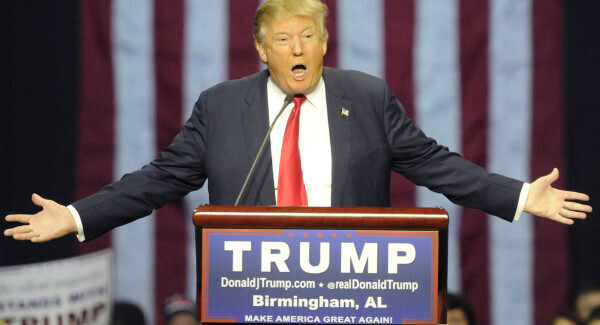
Republican Donald Trump and Democratic candidate Bernie Sanders are focusing their presidential election efforts on the next state battle for votes after decisive wins in New Hampshire.
Meanwhile the Republican field dwindled by two with announcements that Carly Fiorina and Chris Christie were dropping out of the White House race.
All signs now point to a drawn-out battle in the state-by-state contests following billionaire businessman Mr Trump’s resounding victory in New Hampshire.
Florida senator Marco Rubio, under immense pressure to prove himself after a devastating fifth-place finish, was looking for a fight that could last for months or even spill into the first contested Republican national convention since 1976.
“We very easily could be looking at May – or the convention,” Rubio campaign manager Terry Sullivan said.
If Mr Trump had Republicans on edge, Democrats were feeling no less queasy. Rejected in New Hampshire, Hillary Clinton sought redemption in Nevada, where a more diverse group of voters awaited her and Bernie Sanders.
Mr Sanders, a Vermont senator and self-proclaimed democratic socialist, raised more than $5m in less than a day after his New Hampshire triumph. The contributions came mostly in small-dollar amounts, his campaign said, illustrating the resources he will have to fight Mrs Clinton to the bitter end.
Both Mrs Clinton and Mr Sanders – the first Jew to win a presidential primary - worked to undercut each other among African-Americans and Hispanics with less than two weeks until the Democratic contests in Nevada and South Carolina. Mrs Clinton’s campaign deployed South Carolina state congressman Todd Rutherford to vouch for her support for minorities.
“Secretary Clinton has been involved in South Carolina for the last 40 years,” Mr Rutherford said. “Bernie Sanders has talked about these issues for the last 40 days.”
Mr Sanders, meanwhile, met the Rev Al Sharpton, a civil rights activist, at a Harlem restaurant.
Texas senator Ted Cruz, the conservative firebrand and victor in the lead-off Iowa caucuses, returned to the centre of the fracas after largely sitting out New Hampshire.
He drew contrasts with Mr Trump as he told a crowd of 500 in Myrtle Beach that Texans and South Carolinians were more alike than not.
“We love God, we’re gun owners, military veterans and we’re fed up with what’s happening in Washington,” he said.
Far behind in New Hampshire voting, former Hewlett-Packard CEO Ms Fiorina dropped out, and a spokeswoman for New Jersey governor Christie said his race was over, too. But a sizeeable field remained.
Almost all the Republicans have spent months building complex campaigns and blanketing airwaves in South Carolina, which heralds the start of the Republican campaign’s foray into the South.
After that primary on February 20, seven Southern states including Georgia and Virginia will anchor the Super Tuesday primaries on March 1, with a large number of delegates at stake.
Mr Rubio’s campaign has looked forward to South Carolina, yet his path grew far trickier after a fifth-place New Hampshire let-down, which terminated talk of Republican leaders quickly uniting behind him as the strongest alternative to “outsiders” Mr Trump and Mr Cruz.
His campaign’s suggestion that the race could veer a contested convention seemed to signal to mainstream Republicans that the party would be ill-served by allowing the Trump phenomenon to last much longer.
Republican officials have already had early discussions about such a July scenario, which could be triggered if no candidate secures a majority of delegates by convention time.
For governor John Kasich, whose second-place showing was New Hampshire’s primary stunner, the task was to convert new-found interest into support in a state ideologically distant from his native Ohio. With a minimal South Carolina operation compared to his rivals, Mr Kasich must work quickly.
Heading into the final two-week sprint, Mr Trump was leading in South Carolina among all demographic groups, an NBC/Marist/Wall Street Journal poll showed, with Mr Cruz and Mr Rubio a distant second and third.
Already, more than $32m has been spent on TV ads there, according to CMAG/Kantar Media data – much of it by Right to Rise, the political action committee (PAC) backing former Florida governor Jeb Bush.
Though he was placed fourth on Tuesday, Mr Bush was hoping that Mr Rubio’s slump would forestall his own removal from the race.

CONNECT WITH US TODAY



Be the first to know the latest news and updates