10 years after Hurricane Katrina, Obama praises New Orleans resilience
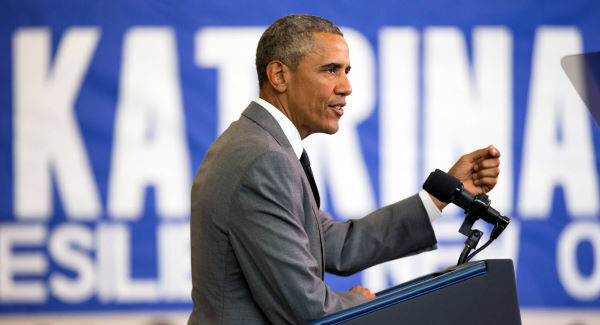
President Barack Obama has held out the people of New Orleans as an extraordinary example of renewal and resilience 10 years after the devastation of Hurricane Katrina.
The US president returned to the city to see how it has recovered from the disaster, visiting residents on porches and sampling the fried chicken at a corner restaurant,
âThereâs something in you guys that is just irrepressible,â Mr Obama told hundreds of residents assembled at a new community centre in an area of the Lower 9th Ward that was once under 17 feet (5.2 meters) of water.
âThe people of New Orleans didnât just inspire me, you inspired all of America.â
He held out the cityâs comeback as a metaphor for whatâs happening all across a nation that has moved from economic crisis to higher ground.
âLook at whatâs happened here,â he declared, speaking of a transformed American city that was once âdark and underwaterâ.
Still, Mr Obama acknowledged that much remains to be done. And after walking door to door in the historic Treme section of a city reborn from tragedy, he cautioned that âjust because the housing is nice doesnât mean our job is doneâ.
Areas of the city still suffer from high poverty, he said, and young people still take the wrong path.
There is more to be done to confront âstructural inequities that existed long before the storm happened,â he added.
In his remarks at the community centre, Mr Obama blended the same themes of resilience and renewal that he drew from encounters with the sturdy residents he met along Magic Street and at other locations.
Leah Chase, the 92-year-old proprietor of Dooky Chaseâs Restaurant, was one of those to chat with Mr Obama. She pronounced herself a fan of the man, saying heâd handled âa rough roadâ.
Ms Chase â whoâs known as the Queen of Creole Cuisine â said, âThatâs all you have to do: handle whatâs handed to you.â
Mr Obama was clearly energised by his visits, at one point breaking into a song from âThe Jeffersonsâ sitcom after meeting a young woman who calls herself âOuisie.â
He stopped for fried chicken at Willie Maeâs Scotch House, and pronounced the resulting grease stain on his suit a good indication that heâd enjoyed his stay in the city.
He held out the community centre as âan example of what is possible when, in the face of tragedy and in the face of hardship, good people come together to lend a hand and, brick by brick, block by block, neighbourhood by neighbourhood, you build a better future.â
âAnd that more than any other reason is why Iâve come back here today,â he said.
Mr Obama was a new US senator when Katrinaâs powerful winds and driving rain bore down on Louisiana on August 29, 2005. The storm caused major damage to the Gulf Coast from Texas to central Florida while powering a storm surge that breached the system of levees meant to protect New Orleans from flooding.
Nearly 2,000 people died, most in New Orleans. Video of residents seeking refuge on rooftops, inside the Superdome and at the convention center dominated news coverage as Katrina came to symbolise government failure at every level.
In his speech, Mr Obama said Katrina helped expose inequalities that long plagued New Orleans and left too many people, especially minorities, without good jobs, affordable health care or decent housing and too many children growing up in the midst of violent crime and attending inefficient schools.
The setting of his address at the community centre spoke to the stark contrasts that remain. It sits near nicely renovated homes but also next to a boarded-up wooden house. The area is filled with vacantareas where houses used to stand, so overgrown that local residents sometimes refer to it as the wilderness and worry about snakes hiding in the grass.
Colette Pichon Battle, executive director of Gulf Coast Centre for Law & Policy, cautioned against slapping too happy a face on New Orleans, saying ârebuilding since the storm favours privileged private enterprise and this illusion of recovery is not progressâ.