Batman massacre case prosecutor sorry for not securing death sentence
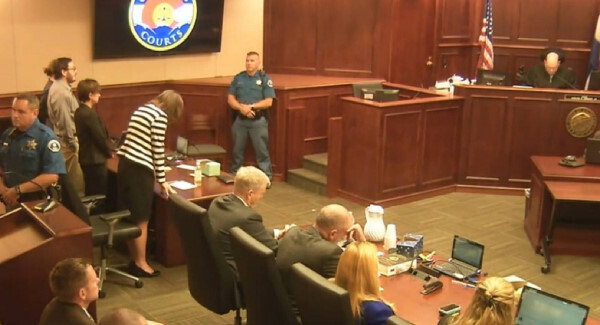
The lead prosecutor in the Colorado cinema shooting case has said he is frustrated that gunman James Holmes did not get the death penalty, but he praised jurors for doing a “hell of a job”.
Shortly after midnight on July 20, 2012, Holmes slipped into the premiere of The Dark Knight Rises, stood before the capacity crowd of more than 400 people, threw gas canisters, and then opened fire with a shotgun, assault rifle and semi-automatic pistol. Twelve people died.
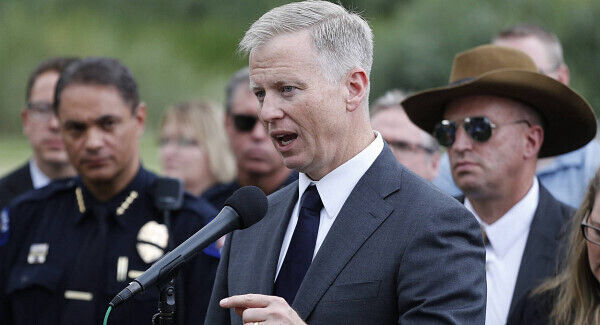
District Attorney George Brauchler, pictured above, commended the nine women and three men for sitting through more than three months of gruelling testimony without being able to discuss the case with anyone.
Mr Brauchler recited the names and ages of the 12 people killed by Holmes and said they were at the heart of the case.
He said he has apologised to the victims’ families for failing to win a death sentence and added that he does not regret not accepting a plea deal earlier with strings attached for Holmes.
He says the attack was the type of crime that called out for the community, through the jury system, to be involved in the sentence.
The offer he rejected from Holmes’ lawyers was for a plea to life in prison without the possibility of parole.
Mr Brauchler said he did so because the defence refused to let Holmes be examined by a state psychiatrist and produce a notebook in which he explained the attack.
Holmes was eventually subjected to two lengthy psychiatric evaluations and the notebook was entered as evidence.
His parents testified that he seemed a normal, affectionate child who withdrew socially in adolescence and became fascinated with science but did not seem abnormal.
Holmes studied neuroscience hoping to understand what was happening to his mind. But it was when he moved from San Diego to Colorado to attend graduate school that his meltdown accelerated.
Holmes dropped out of his prestigious doctoral programme at the University of Colorado and broke up with a fellow student, the only girlfriend he had ever had.
He began to buy guns and thousands of rounds of ammunition and scouted out The Century 16 cinema complex to learn which auditorium would offer the highest number of victims.
Holmes also constructed an elaborate booby-trap in his flat a few miles away. It failed to explode, but it was designed to blow up and divert police and firefighters at the precise moment of his calculated attack.
He described his plans in a notebook that he kept secret until hours before the attack, when he mailed it to his psychiatrist.
In it, Holmes diagnosed himself with a litany of mental problems and methodically laid out his plans, even calculating police response times.
Four mental health experts testified that the shooting would not have happened if Holmes were not severely mentally ill. He was having increasingly palpable delusions that killing others would increase his own self-worth, forensic psychiatrist Jeffrey Metzner said.

CONNECT WITH US TODAY



Be the first to know the latest news and updates