Poison gases halt search for bodies at erupting Japanese volcano
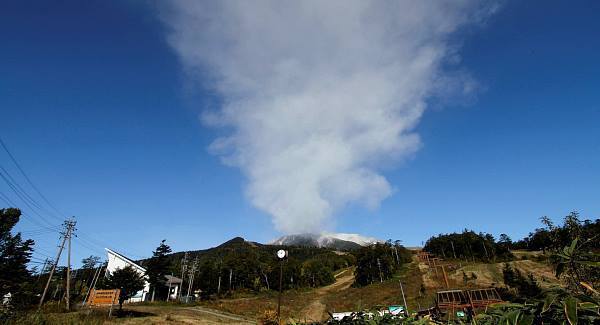
Toxic gases and ash have forced recovery teams to suspend their search at the still-erupting Mount Ontake volcano.

Poison gases halt search for bodies at erupting Japanese volcano

Toxic gases and ash have forced recovery teams to suspend their search at the still-erupting Mount Ontake volcano.

The military and other rescue workers have begun airlifting more than two dozen bodies from the ash-blanketed peak on the island of Honshu, as anguished relatives of the missing waited at a nearby school.

Plumes of smoke and ash billow from Mount Ontake. Pic: AP.

Japanese soldiers managed to bring down eight more bodies by helicopter today.

At least 31 people are believed to have died. Four victims were flown down yesterday and rescuers had returned to the 10,062ft volcano to recover the remaining 27 before suspending the effort.

Exactly how the victims died remains unclear, whether from gases, suffocating ash, falling rocks or other causes.

Scenes broadcast live on Japanese TV station TBS showed soldiers carrying yellow body bags to a military helicopter that had landed in a relatively wide-open area of the now bleak landscape, its rotors still spinning.

The bodies were then taken to a small wooden primary school in the nearby town of Kiso, where they were being examined in the gymnasium.

Family members of the missing waited at a nearby civic hall.

More than 200 soldiers and firefighters, including units with gas-detection equipment, were part of the search mission near the peak, said Katsunori Morimoto, an official in the village of Otaki.

The effort was halted because of an increase in toxic gas and ash as the volcano continued to spew fumes, he said, adding: “It sounds like there is enormous ashfall up there.”

Some rescue workers near the summit had retreated to lower areas to stand by. The rescuers reported a strong smell of sulphur earlier, Mr Morimoto said.

The four victims brought down yesterday were confirmed dead and the 27 others are listed as having heart and lung failure – the customary way for Japanese authorities to describe a body until police doctors can examine it.

Saturday’s eruption was the first fatal one in modern times at Mt Ontake, a popular climbing destination 130 miles west of Tokyo on Honshu, the main Japanese island. A similar eruption occurred in 1979, but no one died.

Japanese media reported that some of the bodies were found in a lodge near the summit and that others were buried in ash up to 20 inches deep. Police said only two of the four confirmed dead had been identified. Both were men, aged 23 and 45.

Mt Ontake erupted shortly before noon at perhaps the worst possible time, with at least 250 people taking advantage of a beautiful autumnal Saturday to go for a hike. The blast spewed large white plumes of gas and ash high into the sky, blotted out the midday sun and blanketed the surrounding area.

Hundreds were initially trapped on the slopes, though most made their way down by Saturday night.

About 40 people who were stranded overnight came down yesterday. Many were injured and some had to be rescued by helicopters or carried down on stretchers. By nightfall, all the injured had been brought down.

Japan’s Fire and Disaster Management Agency recorded 40 injured people and said it was trying to update the number still missing.

Takehiko Furukoshi, a Nagano prefecture (state) crisis-management officer, said rescuers gave priority to helping the survivors come down, leaving behind those who were obviously without hope.

Survivors told Japanese media that they were pelted by rocks. One man said he and others went into the basement of a lodge, fearing that the rocks would penetrate the roof. He covered himself with a futon, a thin Japanese mattress, for protection.

“Even small eruptions can cause major damage if people are around, as they get hit by rocks that come flying,” Nagoya University volcanologist Koshun Yamaoka said.

Volcanoes can also kill by spewing toxic gases and lung-choking ash.

Shinichi Shimohara, who works at a shrine at the foot of the mountain, said he was on his way up on Saturday morning when he heard a loud noise that sounded like strong winds followed by “thunder” as the volcano erupted.

x

More in this section

Cookie Policy Privacy Policy Brand Safety FAQ Help Contact Us Terms and Conditions

© Examiner Echo Group Limited