Dramatic CCTV footage of fatal Spanish train crash released
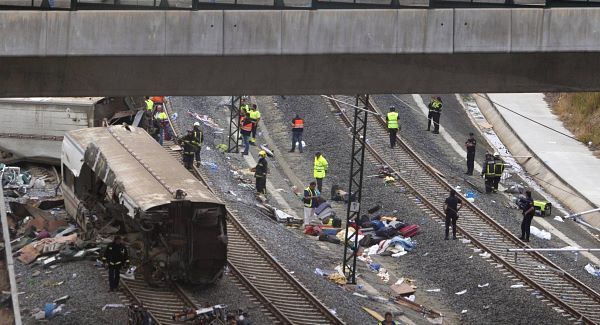
Spanish investigators were today trying to find out why a passenger train jumped the tracks and sent eight cars crashing into each other killing at least 77 people and injuring more than 140.
The train derailed just before arriving in the northwestern shrine city of Santiago de Compostela on the eve of a major Christian religious festival.
73 people were found dead at the scene of the accident and four died in hospitals, said Maria Pardo Rios, spokeswoman for the Galicia region’s main court. At least 141 people were injured – some of them critically – after the eight-carriage train carrying 218 passengers derailed about an hour before sunset last night.
The accident happened on a pronounced curve just outside Santiago de Compostela. A spokeswoman with Spain’s Interior Ministry said authorities have ruled out the possibility that the derailment was caused by a terrorist attack.
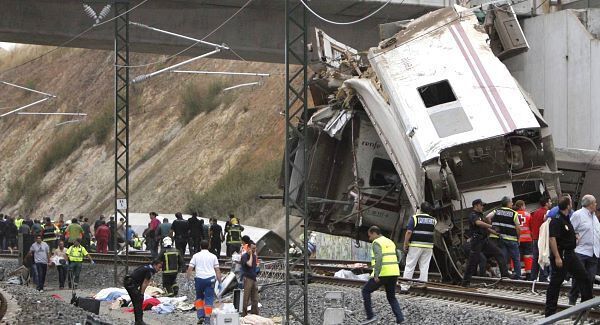
Prime Minister Mariano Rajoy, who was born in Santiago de Compostela, went to the crash scene today. Officials cancelled ceremonies for the annual religious festival that attracts tens of thousands of Christians from around the world.
Rescue workers spent the night searching through smashed cars alongside the tracks. A local health official told reporters that 141 passengers from the train had been treated at area hospitals, with their injuries ranging from light to serious. Some were still in surgery hours after the crash. Many of the dead were taken to a makeshift morgue set up in the city’s largest indoor sports arena.
As dawn arrived, cranes brought to the scene were used to lift the cars off the tracks and rescue workers were seen collecting passenger luggage and putting it into a truck.
The site itself was a scene of horror immediately after the crash. Smoke billowed from at least one car which caught fire; another broke into two parts. Residents of the urban neighbourhood alongside the tracks struggled to help victims out of the toppled cars.
Rescue workers lined up bodies covered in blankets alongside the tracks and some passengers were pulled out of broken windows. Television images showed one man atop a carriage lying on its side, using a pickaxe to try to smash through a window. Residents said other rescuers used rocks.
State-owned train operator Renfe said in a statement an unspecified number of staff were also on board the train during the 8.41 pm crash on a section of tracks about 2.5 miles (4 kms) from Santiago de Compostela that came online two years ago. Spanish media said the train had two conductors aboard and that both survived.
Renfe and Adif, the state-owned company which manages tracks, signals and other railway infrastructure, was co-operating with a judge who has been appointed to investigate the accident, Renfe said.
Catholic pilgrims converge on the Santiago de Compostela annually to celebrate a festival honouring St James, the disciple of Jesus whose remains are said to rest in a shrine. The city is the main gathering point for the faithful who make it to the end of the El Camino de Santiago pilgrimage route that has drawn Christians since the Middle Ages.
The accident created a scene that was “Dante-esque,” said Alberto Nunez Feijoo, president of the region of Galicia where Santiago de Compostela is the capital. He declared seven days of mourning to honor the victims.
Several injured passengers said they felt a strong vibration just before the cars jumped the tracks, said Xabier Martinez, a photographer who talked with them after arriving at the scene.
Passenger Ricardo Montero told the Cadena Ser radio station that “when the train reached that bend it began to flip over, many times, with some carriages ending up on top of others, leaving many people trapped below. We had to get under the carriages to get out.”
Another passenger, Sergio Prego, said the train “travelled very fast” just before it derailed and the cars flipped upside down, on their sides and into the air. “I’ve been very lucky because I’m one of the few able to walk out,” he said.
The Alvia 730 series train started from Madrid and was scheduled to end its journey at El Ferrol, about 95 kms (60 miles) north of Santiago de Compostela. Alvias are high-speed but do not go as fast as Spain’s fastest bullet trains called AVEs.
The maximum Alvia speed is 250 kph (155 mph) on tracks made especially for the AVEs, and they travel at a maximum speed of 220 kph (137 mph) on normal gauge rails.
It was Spain’s deadliest train accident since 1972, when a train collided with a bus in southwestern Spain, killing 86 people and injuring 112.
CONNECT WITH US TODAY



Be the first to know the latest news and updates