Boston investigators find bomb parts
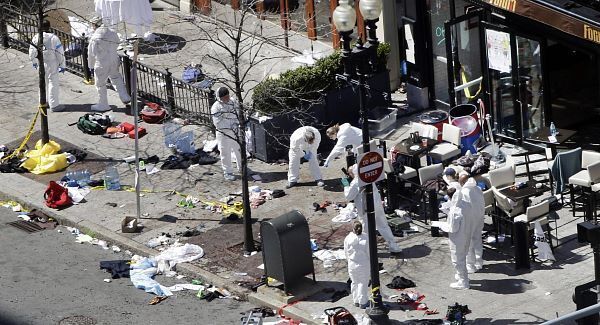
Boston Marathon investigators have found a piece of circuit board they believe was part of one of the bombs.
Forensic teams also discovered the lid of one of the pressure cooker devices that was apparently catapulted onto the roof of a nearby building.
Police circulated information about the bombs, which were packed with explosives, nails and other lethal shrapnel – but the FBI said nobody had claimed responsibility for killing three people and injuring scores more.
“Someone knows who did this,” Richard DesLauriers, FBI agent in charge in Boston, said.
“Importantly, the person who did this is someone’s friend, neighbour, co-worker or relative.”
Agent DesLauriers said cooperation from the community will play a key role in the investigation.
He said the range of suspects remained wide open, but by midday Tuesday more than 2,000 tips had been received.
He confirmed they had found pieces of black nylon from a bag or backpack and fragments of pellets and nails, possibly contained in a pressure cooker. All were being analysed.
Pressure-cooker explosives have been used in international terrorism, and have been recommended for lone-wolf operatives by al-Qaida’s branch in Yemen.
But information on how to make the bombs is readily found online, and US officials said Americans should not rush to judgment in linking the attack to overseas terrorists.
Pressure-cooker explosives have been used in Afghanistan, India, Nepal and Pakistan, according to a July 2010 intelligence report by the FBI and the Homeland Security Department. One of the three devices used in the May 2010 Times Square attempted bombing was a pressure cooker, the report said.
“Placed carefully, such devices provide little or no indication of an impending attack,” the report said.
Boston investigators were combing surveillance tapes from businesses around the finish line and asking travellers at Logan Airport to share any photos or video that might help.
“This is probably one of the most photographed areas in the country,” said Boston Police Commissioner Edward Davis. He said two security sweeps of the marathon route had been conducted before the blasts.
Many victims remained in hospital with grievous injuries. The surgery chief at Boston Medical Centre said most of the injuries were to the lower legs.
“We have a lot of lower extremity injuries, so I think the damage was low to the ground and wasn’t up,” Dr. Peter Burke said.
“The patients who do have head injuries were blown into things or were hit by fragments that went up.”
Dozens of patients have been released from hospitals around the Boston area.