No clear front-runner for Pope
No clear front-runner has emerged as a successor to Pope Benedict XVI who formally resigns today as leader of the Roman Catholic Church.

No clear front-runner for Pope

No clear front-runner has emerged as a successor to Pope Benedict XVI who formally resigns today as leader of the Roman Catholic Church.

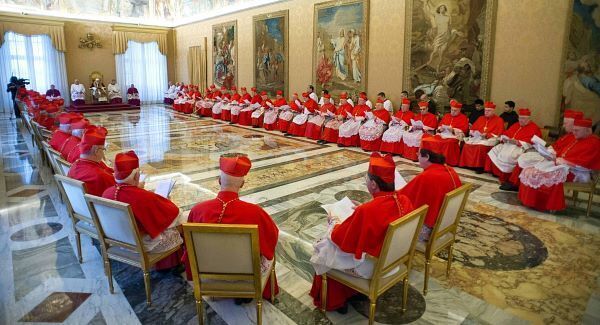
Cardinals across the globe are arriving in Rome in advance of the conclave, when those eligible to vote are literally locked away to cast ballots in secret in the Vatican’s Sistine Chapel.

Before the conclave starts, cardinals are expected to take part in general congregations, pre-conclave meetings where they discuss the qualities needed in a future pope.

Speculation is mounting that the cardinals could choose to back a candidate from the developing world – either Africa, Latin America, or Asia – which have the largest Catholic populations.

But it is unclear whether a cardinal from any of these continents would be able to command the necessary majority.

By country, Italian cardinals make up the biggest group of electors, at 28 votes and by continent, Europe is dominant with 62 electors.

There has not been an Italian pope since John Paul I died in 1978 and some commentators believe that the papacy could well revert back after the reigns of John Paul II, a Pole, and Pope Benedict, who is German-born.

Michael Walsh, a Vatican expert and historian who revised the latest edition of the Oxford Dictionary of Popes, said he believed the papacy could return to an Italian.

He said Pope Benedict’s choice of Cardinal Gianfranco Ravasi to lead the Vatican’s Lenten spiritual retreat this year was “significant” as this was viewed as a papal favour.

Cardinal Karol Wojtyla was chosen for this task before going on to become Pope John Paul II, he said.

“Clearly there is a lot of pressure from around the church for somebody from Africa or Latin America,” he said.

“The question is – who is it going to be?

“The only names being regularly mentioned are Cardinal Peter Turkson from Ghana and Cardinal Odilo Scherer from Brazil.

“I think what they may very well do is go back to an Italian.

“The Italians are a very large contingent.

“They are more likely than most to operate as a bloc, because they know one another.

“Most of the 28 are cardinals in the curia (the Vatican departments which govern the global Church) and they know one another.”

Mr Walsh said he backed a return to a more collegial style of governing the Church with less power centralised in the hands of the curia.

“I believe there ought to be an Italian pope because I believe we ought to cut down on the power of the Vatican,” he said.

“It ought to return to being a Bishop of Rome and if there is a return to the Bishop of Rome then it ought to be an Italian.”

Mr Walsh said his personal favourite to become Pope would be Cardinal Luis Tagle, Archbishop of Manila since 2011 but he did not think he would be elected.

“He has been a great success in Manila, he is very approachable and very well liked by everybody.

“He won’t get it for one very good reason which is simply that he is too young, at 55-years-old, he could be pope for 30 years, which is an awfully long time,” he said.

Here are some of the possible contenders to replace Pope Benedict XVI, who resigns today as pontiff, the first to do so for nearly 600 years.

:: Cardinal Marc Ouellet, 68, the Canadian head of the Vatican’s office for bishops.

Archbishop of Quebec between 2003 and 2010, he spent 10 years as a missionary priest in Colombia, and is fluent in a range of languages. He is known as a strong defender of orthodoxy and is said to come from the same school of theological thought as Pope Benedict.

:: Cardinal Gianfranco Ravasi, 70, president of the Pontifical Council for Culture.

A former academic theologian and Biblical scholar, he is noted for his work encouraging dialogue between believers and non-believers and his “outreach” to science. He was chosen this year by Pope Benedict to lead the Vatican’s Lenten spiritual retreat – a papal favour which could mark him out as a frontrunner.

:: Cardinal Leonardo Sandri, 69, an Argentinian and prefect of the Congregation for the Oriental Churches.

A “consummate” Vatican insider and viewed as a pair of “safe hands”, he announced Pope John Paul II’s death to the world on April 2, 2005, saying: “We all feel like orphans this evening.”

His experience as head of the Congregation for the Oriental Churches is said to have given him a special understanding of the experience of Christians in the Middle East including the plight of the Christian population in Iraq following the war in 2003.

:: Cardinal Odilo Scherer, 63, Archbishop of Sao Paolo in Brazil.

He is head of the largest diocese in the world’s largest Catholic country and spent several years working at the congregation for bishops at the Vatican. A German Brazilian by birth, he is seen as the strongest Latin American candidate.

:: Cardinal Christoph Schonborn, 68, Archbishop of Vienna.

An intellectual and a scholar who studied under Pope Benedict and is close to the outgoing pope. He is currently dealing with a rebellion in Austria by Catholics who are calling for reform of the Church in areas such as priestly celibacy and the role of women. The cardinals may not want to elect two German-speaking popes in a row.

:: Cardinal Angelo Scola, 71, Archbishop of Milan.

Cardinal Scola was said to have been “papabile” – a possible contender for pope – during the conclave to replace Pope John Paul II in 2005, and is an influential philosopher and theologian.

He is a member of the powerful Congregation for the Doctrine of the Faith (CDF), responsible for ensuring Catholic orthodoxy.

:: Cardinal Luis Tagle, 55, Archbishop of Manila, Philippines.

Highly praised and described by Vatican commentator John Allen as a “genuine intellectual with a common touch”. He is seen as an outside chance to be elected because he is considered too young. If elected at 55, he could be pope for more than 30 years.

:: Cardinal Peter Turkson, 64, from Ghana, president of the Pontifical Council for Justice and Peace.

Charismatic and approachable, Cardinal Turkson is a popular figure and would be the first pope from Africa since Gelasius I more than 1,500 years ago.

But the department he heads is not powerful within the Roman curia, and he has raised eyebrows by his willingness to discuss his chances of becoming pope. He is also seen by some as being gaffe-prone.

More in this section

Cookie Policy Privacy Policy Brand Safety FAQ Help Contact Us Terms and Conditions

© Examiner Echo Group Limited