Assad troops attack ahead of truce
Syrian troops have launched a fierce assault on a Damascus suburb, days ahead of a deadline for a UN-brokered ceasefire.
Activists described it as one of the most violent attacks around the capital since the year-old uprising began.
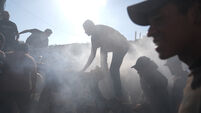
In the suburb of Douma, activists said snipers on 20 buildings were firing at “anything that moved” and residents had endured eight hours of shelling. They said soldiers marched into a main square behind detainees used as human shields. The offensive tapered off by late afternoon, and an activist said five civilians were killed.
A team led by a Norwegian major general arrived in Damascus to negotiate the possible deployment of a UN team that would monitor the ceasefire agreement between Syrian government troops and rebel forces, a spokesman for the UN-Arab League envoy Kofi Annan said. Annan brokered the truce, which is supposed to take effect on Tuesday.
But the operation in Douma, with other offensives around the country, bolstered the opposition’s claim that President Bashar Assad is only intensifying violence ahead of the deadline to start implementing the truce. Activists say Assad wants to make gains on the ground before the ceasefire is supposed to take effect.
Assad accepted Annan’s ceasefire plan last week, but the violence has continued unabated and tanks, troops, checkpoints and snipers remain in all major flashpoint towns and cities.
French Foreign Minister Alain Juppe said he believes Assad “is deceiving us” when he promises to abide by the peace plan, which was brokered by former UN chief Kofi Annan.
“Can we be optimistic? I am not,” Juppe told reporters. He said if all the conditions of the cease-fire plan are not met, including the arrival of 200 observers, then “we must go back to the UN Security Council.”
Annan said “alarming levels” of casualties are still being reported daily in Syria. He told the UN General Assembly in a videoconference briefing from Geneva that Syria has informed him of a partial withdrawal from three locations in Daraa, Idlib and Zabadani, though he said more far-reaching action is “urgently needed.”
Mohammed Fares, an activist in Zabadani, denied claims that troops withdrew and said the army is still in the town with checkpoints backed by tanks.
Other activists reported attacks on both Daraa and Idlib on Wednesday. Activist groups reported around two dozen dead nationwide today.
There are other signs as well that the government has no intention of abiding by the deal.
The pro-government daily Al Watan quoted an unnamed official saying the government is not bound by Tuesday’s deadline for a ceasefire because that day marks “the beginning of army units’ withdrawal and not the end. It is not a deadline by itself.”
In Geneva, Annan’s spokesman Ahmad Fawzi said both sides are expected to end the hostilities within 48 hours of the April 10th deadline.
Annan has asked the Norwegian Maj. Gen. Robert Mood to begin discussing with the Syrian authorities “the eventual deployment of this UN supervision and monitoring mission,” Fawzi said.
Syrian Deputy Foreign Minister Faisal Mekdad said the government has not yet agreed on a timetable for work with the UN “But we will discuss these issues in a democratic way because we do want to listen to them,”.
He insisted the Syrian military has started withdrawing troops from some areas and will continue pulling back over the next days.
Douma-based activist Mohammed Saeed reported that troops shelled residential areas Thursday with tanks “in one of the most violent campaigns against the area since the uprising started.” He said troops were using detainees as human shields as they marched into one of the suburb’s main squares, a few miles northwest of Damascus.
The Britain-based Syrian Observatory for Human Rights also reported one of the biggest operations of the uprising in Douma, where hundreds of army defectors are believed to be active.
The Observatory said troops also clashed with army defectors in the northern towns of Hraytan and Anadan near Syria’s largest city of Aleppo.
The Observatory and the Local Coordination Committees, reported intense shelling of the rebel-held town of Rastan in the central province of Homs and the nearby town of Talbiseh and said four people were killed in each area.
The opposition is deeply sceptical that Assad will live up to his commitment to a truce and accuses him of trying to manipulate it to buy more time to continue his military crackdown on the revolt.
The truce is the keystone of a plan put forward by Annan in his role as joint UN-Arab League envoy in an effort to end bloodshed that the UN says has claimed more than 9,000 lives since March 2011.
Annan’s plan requires regime forces to withdraw from towns and cities, followed by a withdrawal by rebel fighters. Then all sides are supposed to hold talks on a political solution.