Japan seeks international help to stabilise nuclear plant
Japan is turning to other countries for help as it struggles to stabilise its tsunami-stricken nuclear plant and stop radiation leaks.
French, American and international experts – even a robot – are either in Japan or on their way, and French President Nicholas Sarkozy met with the prime minister in Tokyo today.
Workers are racing to find the source of contaminated water that has been pooling in the Fukushima Dai-ichi nuclear plant since the March 11 earthquake and tsunami.
The leaks have often forced workers to flee the plant, preventing them from restarting important cooling systems.
“The amount of water is enormous, and we need any wisdom available,” said nuclear safety agency spokesman Hidehiko Nishiyama.
A spokesman for plant operator Tokyo Electric Power said today that radioactive contamination in groundwater 15 yards (metres) under one of six reactors there had been measured at 10,000 times the government standard.
But spokesman Naoyuki Matsumo said the company does not believe any drinking water supply is affected by the elevated levels of iodine-131, a radioactive substance that decays quickly, with half disappearing in eight days.
Experts from French nuclear giant Areva, which supplied fuel to the plant, are helping work out how to dispose of the contaminated water that has begun leaking into the ground and the sea.
“We are not a supplier only for happy days,” CEO Anne Lauvergeon told reporters in Tokyo. “We are effectively also there when things become difficult.”
Officials from Tokyo Electric Power, said they welcome the help.
“US nuclear plants aren’t by the ocean, unlike Japanese ones, so we think the French may be able to help us more than the Americans,” said TEPCO Manager Teruaki Kobayashi.
Officials with his company also said they expect to use a remote-controlled robot sent by the US within a few days to evaluate areas with high radiation. They are also setting up a panel of Japanese and American nuclear experts and American military personnel to address the crisis.
Tens of thousands of people have been displaced by the tsunami and magnitude-9.0 earthquake.
Some saw their homes destroyed by the wall of water, while others have been ordered to leave a 12-mile (20-kms) zone around the plant because of radiation leaks. Authorities have recommended that people in a 20-mile (30-kms) band might also want to leave.
Frustrated evacuees had begun trickling back into the smaller zone to gather belongings and check on their homes, but officials in Fukushima prefecture posted warnings at evacuation centres telling them not to go back for any reason.
“There is not only a risk that you may be contaminated, but also that you could contaminate others in the evacuation centres when you return,” the warnings said. “The national government is now considering whether to allow brief return visits, so please bear with us.”
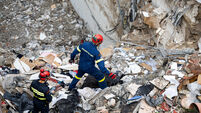
The radiation has forced police officers trying to recover the dead from the evacuation zone to don white hazmat suits and radiation monitors. Officials believe more than 19,000 people died, but so far only about 11,000 bodies have been found. Local media estimate that hundreds of corpses remain.
“We find bodies everywhere – in cars, in rivers, under debris and in streets,” a police official from the hard-hit Fukushima prefecture said.
In the small coastal city of Miyako, many people still have no idea what happened to their relatives.
Giant tractors and dump trucks cleared roads and sorted debris into giant piles. Huge barges with onboard cranes docked offshore and scooped up wreckage in the shallow bays.
“I lost three grandchildren,” says Isamu Aneishi, 69, who sat on a log for hours and watched the men search the bay.
A vacant lot outside Miyako has been turned into a car graveyard, with hundreds of wrecked vehicles from across the region deposited in neat rows. Some looked ready to be driven away, while others were little more than mangled heaps of metal. Many were marked with red spray paint, indicating bodies had been found inside, and some still had keys in the ignition. Residents walked up and down the rows looking for their cars.
Meanwhile, at the nuclear plant 140 miles (220 kms) north-east of Tokyo, workers go inside in shifts and are often forced to turn back because radiation levels are too high.
They have been lauded as heroes, but Kazuma Yokota, head of the Fukushima local office Japan’s Nuclear and Industrial Safety Agency, said he saw them living under harsh conditions during a recent inspection visit. They got only two meals a day and just one blanket each when it was time to sleep.
“They sleep on the floor, inside a conference room, or even in the hallway or in front of a bathroom. That’s where they sleep, with only one blanket each to wrap themselves around,” he told a televised news conference. Nishiyama said TEPCO is working to improve the conditions.
Sarkozy, the first major international leader to visit since the disaster, praised the work being done at the plant.
“Every image I have seen is really, really disturbing, and I am really impressed by the workers in Fukushima who work at the nuclear plant with courage,” he said before meeting Japanese Prime Minister Naoto Kan.
After the meeting, he urged the world to learn from Japan’s crisis and suggested that the Group of 20 nations set international nuclear safety standards.

CONNECT WITH US TODAY



Be the first to know the latest news and updates