US Senate tells Gadaffi to go immediately
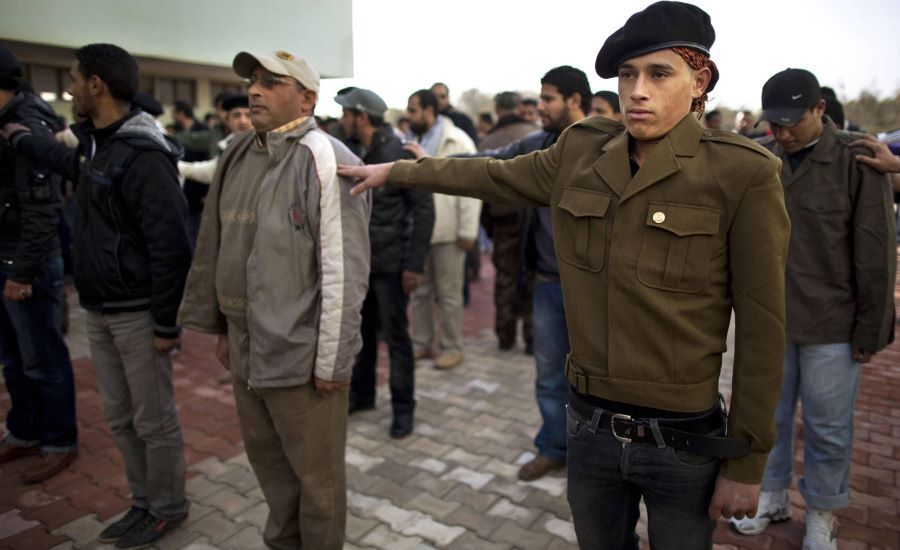
The US Senate condemned the “gross and systematic violations of human rights in Libya” and demanded that its leader Muammar Gaddafi leave office.
Senators unanimously passed a resolution early today that also urged the United Nations Security Council to impose a no-fly zone over Libya.
It came after the 192 member nations of the UN General Assembly suspended Libya from the world body’s Human Rights Council in the latest international effort to halt Gaddafi’s violent crackdown on protesters.
The US Senate resolution, which does not have the force of law, applauded the Libyan people for standing up “against the brutal dictatorship” of Gaddafi and for demanding democratic reforms.
It called on the Libyan leader to desist from further violence, release people who had been arbitrarily detained and ensure the safe passage of those wishing to leave the country.
The proposal was sponsored by Democratic senator Robert Menendez from New Jersey and Senator Mark Kirk, a Republican from Illinois.
Meanwhile Gaddafi’s forces battled poorly-armed rebels for control of towns near the capital Tripoli, trying to create a buffer zone around his seat of power.
The increasingly violent clashes threatened to transform the 15-day popular rebellion in Libya into a drawn-out civil war.
Amid the intensified fighting, the international community stepped up moves to isolate the long-time Libyan leader.
US defence secretary Robert Gates said he ordered two ships into the Mediterranean, including the amphibious assault ship USS Kearsarge, and he was sending 400 marines to the vessel to replace some troops that left recently for Afghanistan.
Military leaders considering a no-fly zone over Libya said it would be a complex task that would require taking out Gaddafi’s air defences and Russia’s top diplomat dismissed the idea as “superfluous”, saying world powers should focus on sanctions.
Gaddafi’s son Saif warned Western forces not to take military action and said the country was prepared to defend itself against foreign intervention.
“If they attack us, we are ready,” he said, adding that the Gaddafis were ready to implement reforms.
Facing an unprecedented challenge to his 41-year rule, Gaddafi’s regime has launched the bloodiest crackdown in a wave of uprising against authoritarian rulers in the Middle East. Gaddafi has already lost control of the eastern half of the country but still holds Tripoli and other nearby cities.
An exact death toll has been difficult to obtain in the chaos, but a medical committee in the eastern city of Benghazi, where the uprising began on February 15, said at least 228 people had been killed, including 30 unidentified bodies and 1,932 wounded.
UN secretary general Ban Ki-moon cited reports that perhaps 1,000 have died in Libya.
US secretary of state Hillary Clinton told Congress that America must lead an international response to the crisis, including expanding already tough financial and travel sanctions against Gaddafi, his family and confidants and possibly imposing a no-fly zone over Libya.
“In the years ahead, Libya could become a peaceful democracy, or it could face protracted civil war. The stakes are high,” she said.
Gaddafi’s regime has retaken at least two towns and threatened a third, while rebels repulsed attacks on three other key areas – Misrata to the east, Zawiya to the west, and the mountain town of Zintan to the south of the capital.
One person in Zwara, which fell to anti-government forces days ago, said guards were posted at every sensitive building and all the entrances to the town.
“We are threatened every day by pro-Gaddafi forces,” the nervous resident said, adding that a pro-Gaddafi figure met the town’s leaders a few days ago and told them they had “a choice” to go back into orbit “and he will forget what happened, or else he is going to attack us with military force. He even offered us money”.
One sergeant in the Libyan army of Tuareg ethnicity and fighting on Gaddafi’s side said the military was divided.
“Us foreigners, we don’t have much choice. We have to support Gaddafi,” he said in a telephone interview. “It because of him we are here.
“There is nothing that’s going to convince Gaddafi to quit. ”The only way Gaddafi is going to go is if someone puts a bullet in his head, and I can’t imagine that. The soldiers who are close to him would never let it happen.“
Susan Rice, the US ambassador to the United Nations, meanwhile, urged Gaddafi to consider exile, saying she was worried the African nation could plummet into a “humanitarian disaster”.
More than 140,000 people have streamed into Tunisia and Egypt, and the situation at the Tunisian border has reached a “crisis point,” with up to 75,000 people gathering in just nine days said UN refugee agency spokeswoman Melissa Fleming.
Many had returned to their homes in Tunisia and Egypt, but thousands of Vietnamese and Bangladeshis at the Libyan side of border with Tunisia were “in urgent need of food, water and shelter,” said Jemini Pandya, a spokeswoman for International Organisation for Migration. Nepalese, Ghanaians and Nigerians were also sleeping unprotected at the borders, she added.
Thousands of foreigners – many of them Egyptians – have been stranded for at least a week at Tripoli’s airport, where they have little food, no shelter and face mistreatment by Libyan authorities.
AP