Libya braced for new push by rebels
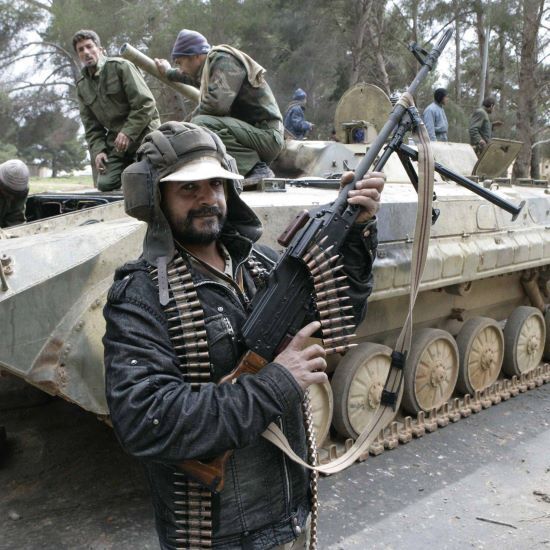
Libyans are bracing for mass protests as the rebel movement called for a new push to oust Muammar Gaddafi after a day of fierce fighting.
At least 17 people died in clashes as rebels made new gains and advanced closer to his stronghold in Tripoli and pro-government forces attacked two nearby cities.
International momentum has been building for action to punish Gaddafi’s regime for the bloodshed.
The European Union’s foreign policy chief, Catherine Ashton, said today that the bloc needs to consider sanctions such as travel restrictions and an asset freeze against Libya to achieve a halt to the violence there and move toward democracy.
Nato’s main decision-making body also planned to meet in emergency session today to consider the deteriorating situation, although Secretary-General Anders Fogh Rasmussen has said the alliance has no intention of intervening in the North African nation.
The UN’s top human rights official, Navi Pillay, meanwhile, said there are reports of mass killings of thousands in Libya that should spur the international community to “step in vigorously” to end the crackdown against anti-government protesters.
Most of the eastern half of Libya has already broken away, and diplomats, ministers and even a high-ranking cousin have abandoned Gaddafi, who has ruled Libya for 41 years.
He is still believed to be firmly in control only of the capital, some towns around it, the far desert south and parts of Libya’s sparsely populated centre.
Residents in several cities said the opposition had called on people to rally in demonstrations after Friday prayers.
Some Tripoli residents also reported receiving text messages on their mobile phones urging them to go and protest in the capital’s central Green Square after Friday prayers.
The plaza was the site of intense clashes earlier in the week between government supporters and protesters.
Gaddafi's crackdown - the harshest by any Arab leader in the wave of protests that has swept the Middle East the past month - has so far helped him maintain control of Tripoli, home to about a third of Libya's six million population.
But the uprising has divided the country and raised the spectre of civil war.
The New York-based Human Rights Watch has put the death toll in Libya at nearly 300. Italy’s Foreign Minister Franco Frattini said estimates of some 1,000 people killed were “credible.”
In cities across the east, anti-Gaddafi forces rose up and overwhelmed government buildings and army bases, joined in many cases by local army units that defected. In those cities, tribal leaders, residents and military officers have formed local administrations, passing out weapons looted from the security forces’ arsenals.
The rebels now control a swathe of territory from the Egyptian border in the east, across nearly half Libya’s 1,000-mile Mediterranean coast to the key oil port of Breqa, about 440 miles east of Tripoli.
A witness said police had disappeared from the streets and a committee had been formed to run things in Misrata, where pro-Gaddafi militiamen battled with government opponents who had been guarding an airport outside the city. Seven people were killed in the fighting, according to a medical official.
He said a protest was planned later today in Misrata, Libya’s third-largest city about 120 miles from the capital.
The worst bloodshed yesterday was in Zawiya, 30 miles west of the capital Tripoli. An army unit loyal to Gaddafi opened fire with automatic weapons on a mosque where residents were holding a sit-in to support protesters in the capital.
A doctor at a field clinic said he saw the bodies of 10 dead, shot in the head and chest, as well as around 150 wounded. A Libyan news website, Qureyna, put the death toll at 23.
The upheaval in the Opec nation has taken most of Libya’s oil production of 1.6 million barrels a day off the market. Oil prices hovered above 98 dollars a barrel in Asia, backing away from a spike to 103 dollars the day before amid signs the crisis in Libya may have cut crude supplies less that previously estimated.
Hours after the attack in Zawiya, Gaddafi called in to state TV and in a rambling speech expressed condolences for the dead but then angrily scolded the city’s residents for siding with the uprising.
He blamed the revolt on al-Qaida leader Osama bin Laden and teenagers hopped up on hallucinogenic pills given to them “in their coffee with milk, like Nescafe.”
In another blow to the Libyan leader, a cousin who is one of his closest aides, Ahmed Gadhaf al-Dam, announced that he has defected to Egypt in protest against the regime’s bloody crackdown.
CONNECT WITH US TODAY



Be the first to know the latest news and updates