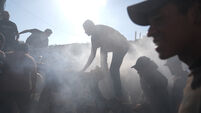
Chilean miners prepare for rescue operation

The first of Chile’s 33 trapped miners is expected to be lifted to the surface in the early hours of tomorrow after more than two months below ground.

Chilean miners prepare for rescue operation

The first of Chile’s 33 trapped miners is expected to be lifted to the surface in the early hours of tomorrow after more than two months below ground.

Chile’s Mining Minister Laurence Golborne announced the final rescue details near the site today, saying they hope “to have at least one of our miners on the surface” before midnight local time (4am Irish time).

Nearby, the miners’ families have been holding vigil at a place called “Camp Hope.”

“Here the tension is higher than down below. Down there they are calm,” said Veronica Ticona, sister of 29-year-old Ariel Ticona, a trapped rubble-removal machine operator.

After 68 days of shared fears and jitters – all of it under the close scrutiny of the world’s media – the early fellowship has frayed. Some relationships, once at least cordial, are as hostile as the desolate sands of the surrounding Acatama desert.

The feuds and jealousies within families centred on such matters as who got to take part in weekend video conferences with the miners, who received letters and why – or even who should speak to the media and how much they should be revealing about a family’s interior life.

Some relatives complained about distant kin seeking the international media limelight, giving interviews about trapped miners they barely know.

Then there are those who, despite only distant blood ties to miners, lined up for donated gifts including sexy lingerie, bottles of wine and electronic toys and Halloween costumes for children.

There were even fights over who constitutes a close relative – or even a miner’s preferred conjugal companion.

So Alberto Iturra, the chief of the psychology team advising the trapped men, decided that after each miner rides an escape capsule to daylight, the rescued man will meet with between one and three people whom the miner has personally designated.

Then there is the question of money.

It has already strained relations between families as some seem to be getting more than others, including from some news media, who outnumber the miners’ relations several fold.

Aware of the emotional toll, Mr Iturra recommended that the relatives leave the mine, go home and get some rest.

“I explained to the families that the only way one can receive someone is to first be home to open the door,” he said.

The dramatic endgame was hastening as the rescuers finished reinforcing the escape shaft yesterday and the 13-foot rescue chamber descended flawlessly nearly all the way to the trapped men in a series of test runs.

Mr Iturra said he recommended the extractions begin at dawn Wednesday. No official decision was announced, but Andre Sougarret, the rescue team co-ordinator, said yesterday that “today the miners sleep their last night together!”

The Phoenix I capsule – the biggest of three built by Chilean navy engineers - made its first test runs after the top 180 feet of the shaft were lined with steel pipe yesterday.

Then the empty capsule was winched down 2,000 feet, just 40 feet short of the shaft system that has been the miners’ refuge since an August 5 collapse.

“We didn’t send it (all the way) down because we could risk that someone will jump in,” a grinning Mr Golborne said earlier.

Engineers had planned to extend the piping nearly twice as far, but they decided to stop after the sleeve – the hole is angled 11 degrees off vertical at its top before falling vertically – became jammed during a probe.

Mr Iturra said he recommended the first man be pulled out at dawn because the miners are to be taken by Chilean air force helicopters to the nearby city of Copiapo and fog tends to enshroud the mine at night.

It is a roughly 10-minute flight, said Lt. Col. Aldo Carbone, the choppers’ squadron commander. He said the pilots have night-vision goggles but will not fly unless it is clear. Ambulances will be ready for backup. The drive would take about an hour.

Officials have drawn up a secret list of which miners should come out first, but the order could change after paramedics and a mining expert first descend in the capsule to evaluate the men and oversee the journey upward.

First out will be the four miners fittest of frame and mind, health minister Jaime Manalich said. Should glitches occur, these men will be best prepared to ride them out and tell their comrades what to expect.

Next will be 10 who are weakest or ill. One miner suffers from hypertension. Another is a diabetic, and others have dental and respiratory infections or skin lesions from the mine’s oppressive humidity.

The last out is expected to be Luiz Urzua, who was shift chief when the men became entombed.

The men will take a twisting, 20-minute ride to the surface. It should take about an hour for the rescue capsule to make a round trip.

Plans called for the media to be blocked by a screen from viewing the miners when they reach the surface. A media platform has been set up more than 300 feet away.

After being extracted, the miners will be ushered through inflatable tunnels, like the ones used in sports stadiums, to ambulances that will take them to a medical station.

Once cleared by doctors there, they are to be taken to another area where they will be reunited with the chosen family members. Next stop: a heliport and the flight to Copiapo.

At the hospital, all the miners will be kept for 48 hours of observation that will begin when the last one exits the escape shaft.

x

More in this section

Cookie Policy Privacy Policy Brand Safety FAQ Help Contact Us Terms and Conditions

© Examiner Echo Group Limited