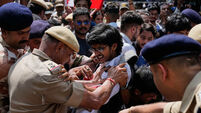
More violence predicted after Thailand bloodshed
Both government and protesters mourned their dead after savage street fighting killed 21 people in Thailand’s capital, but neither side appeared ready to compromise to end a five-year political stalemate that threatens more violence.
Hundreds more were injured when security forces tried on Saturday night to clear a demonstrators’ base in the historic district from where they’ve staged disruptive protests in Bangkok for more than a month, seeking to force new elections.
The country’s worst political violence in nearly two decades spurred dozens of countries to warn their citizens about visiting Thailand, where tourism is a lifeblood industry.
Bullet casings, pools of blood and shattered army vehicles littered the streets yesterday near a main tourist area where soldiers had pitched nighttime battles with the protesters.
The fighting halted after the army pulled back its troops and initiated an informal truce. However, there was no sign that either side was willing to negotiate the issues underlying the protests.
Jatuporn Prompan, a leader of the Red Shirt protest movement, said Prime Minister Abhisit Vejjajiva’s hands were “bloodied” by the clashes.
“Red Shirts will never negotiate with murderers,” Mr Jatuporn announced from a makeshift stage.
“Although the road is rough and full of obstacles, it’s our duty to honour the dead by bringing democracy to this country.”
The government, meanwhile, focused on the immediate issue of public safety.
Government spokesman Panithan Wattanayagorn defended the soldiers’ performance and accused the demonstrators of using heavy weapons against them.
He said a return to normalcy would be difficult when people do not respect the rule of law, and because any talks on a solution should include other groups in Thai society – a complex and contentious process.
The demonstrations are part of a long-running battle between the mostly poor and rural supporters of former Prime Minister Thaksin Shinawatra, and the ruling elite they say orchestrated the 2006 military coup that removed him from power amid corruption allegations.
The protesters, called Red Shirts for their garb, see the Oxford-educated Mr Abhisit as a symbol of an elite impervious to the plight of Thailand’s poor and claim he took office illegitimately in December 2008 after the military pressured Parliament to vote for him.
“Within the next two weeks there will be more violence. The standpoint from both sides is clear – that negotiation and compromise will not happen,” said Siripan Nogsuan Sawasdee, a political scientist at Bangkok’s Chulalongkorn University. “This fight will not end any time soon. It’s too complex.”
CONNECT WITH US TODAY



Be the first to know the latest news and updates