Putin vows to 'destroy' tube terrorists
Flags flew at half-mast on government buildings and at the Kremlin as a day of national mourning for the victims of the Moscow tube blasts began.
Police with machine guns patrolled underground station entrances amid tight security after yesterday's suicide bombings.
The death toll from the attack rose to 39 today after a woman died in a Moscow clinic from her injuries.
Russia's prime minister vowed to track down and kill the terrorists behind the atrocity which injured scores of people.
Health official Andrei Seltsovsky told the Rossiya-24 state news channel that five people out of 71 in hospital remained in a critical condition.
He said only eight of the victims had been formally identified.
The two women bombers targeted the city's tube network during the rush hour, the first in Moscow in six years. One attack was at the station beneath the headquarters of the secret police.
Russian police have killed several Islamic militant leaders in the North Caucasus recently, including one last week in the Kabardino-Balkariya region, which raised fears of retaliatory strikes and escalating bloodshed by the militants.
As smoke billowed through the underground tunnels not far from the Kremlin and dazed survivors streamed out of the vast transportation system, al-Qaida-affiliated websites were abuzz with celebration of the attacks by the bombers.
The bombings followed a warning last month from Chechen rebel leader Doku Umarov that "the war is coming to their cities".
Prime minister Vladimir Putin, who built much of his political capital by directing a fierce war against Chechen separatists a decade ago, promised to hunt down and kill the organisers of what he called a "disgusting" crime.
"The terrorists will be destroyed," he said on national television.
In a televised meeting with President Dmitry Medvedev, Federal Security Service head Alexander Bortnikov said the remains of the two bombers pointed to a Caucasus connection.
"We will continue the fight against terrorism unswervingly and to the end," Mr Medvedev said.
Umarov, the Chechen rebel leader, has relied on al-Qaida's financial support and has several al-Qaida emissaries in his entourage, says Alexander Ignatenko, the head of the independent Moscow-based Institute for Religion and Politics, who has closely followed the Islamic uprising in the Caucasus.
Yesterday's first explosion took place just before 8am at the Lubyanka station in central Moscow, beneath the notorious headquarters of the Federal Security Service or FSB, the KGB's main successor agency.
The FSB is a symbol of power under Mr Putin, a former KGB officer who headed the agency before his election as president in 2000.
About 45 minutes later, a second blast hit the Park Kultury station on the same line, which is near Gorky Park. In both cases, the bombs were detonated as the trains pulled into the stations and the doors were opening.
"I was getting off the train when I heard the sound of an explosion and saw clouds of smoke," said Yegor Barbatunov, 29.
"The (Park Kultury) station was jammed with people trying to get out, but there was no panic. I saw a young man walking past, blood pouring off his head and neck and trickling to the floor."
Amateur video on Russian TV showed wounded and possibly dead commuters on the floor of the smoke-filled Lubyanka station. One video showed gruesome images of dead passengers sprawled inside a mangled train carriage and a bloody leg lying on a station platform.
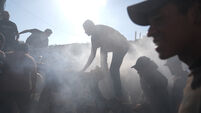
Passengers streamed out of the stations, many crying and making frantic calls on mobile phones. The wounded were put in ambulances and helicopters, some with their heads wrapped in bloody bandages, as sirens wailed.
World leaders, including Prime Minister Gordon Brown and US president Barack Obama, condemned the attacks. Mr Obama telephoned Mr Medvedev to convey the condolences of the US.
At 4pm the two stations, scrubbed clean, reopened and dozens boarded waiting trains.
"It's really terrifying," said Vasily Vlastinin, 16. "It's become dangerous to ride the metro, but I'll keep taking the metro. You have to get to school, to college, to work somehow."
The ornate Moscow tube system is the world's second-busiest after Tokyo's, carrying around seven million passengers on an average work day.
The last confirmed terrorist attack in Moscow was in August 2004 when a suicide bomber blew herself up outside a tube station, killing 10 people. Chechen rebels claimed responsibility.
In February 2004, a suicide bomber from the North Caucasus attacked a train during the morning rush hour, killing more than 40 people and wounding more than 100.
Dozens of contributors to three web sites affiliated with al Qaida wrote comments in praise of yesterday's attacks.
One site opened a special page to "receive congratulations" for the Chechen rebels who "started the dark tunnel attacks in the apostate countries" and all wished for God to accept the two women as martyrs.
Mr Ignatenko said Islamic militants in the Caucasus often recruited women whose relatives were killed by Russian security services.
"They tell them that if they become martyrs, they will join their husbands, brothers and fathers," he said. "And they also persuade them that the Russians as a nation share a collective guilt."

CONNECT WITH US TODAY



Be the first to know the latest news and updates