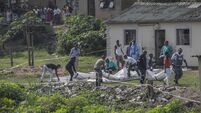
Desperation grows amid quake aid logjam
The world still cannot get enough food and water to the hungry and thirsty, one week after an earthquake shattered Haiti’s capital.
The airport remains a bottleneck, the port is a shambles. The Haitian government is invisible, nobody has taken firm charge, and the police have largely given up.
Even as US troops landed in Seahawk helicopters on the manicured lawn of the National Palace in Port-au-Prince yesterday, the colossal efforts to help Haiti are proving inadequate because of the scale of the disaster and the limitations of the world’s governments.
Expectations exceeded what money, will and military might have been able to achieve so far in the face of unimaginable calamity.
“God has abandoned us! The foreigners have abandoned us!” yelled Micheline Ursulin, tearing at her hair as she rushed past a large pile of decaying bodies.
Three of her children died in the quake and her surviving daughter is in the hospital with broken limbs and a serious infection.
Rescue groups continue to work, even though time is running out for those buried by the quake.
A Mexican team created after that nation’s 1985 earthquake rescued Ena Zizi, 69, who had survived a week buried in the ruins of the residence of Haiti’s Roman Catholic archbishop, Monsignor Joseph Serge Miot. the archbishop’s body was found yesterday sitting in a chair in what appeared to be his office.
Doctors said Ms Zizi was dehydrated and had dislocated a hip and broken a leg.
“I’m all right, sort of,” she said, lying on a foil thermal blanket outside the Cuban hospital, her grey hair covered in white dust.
Ardent Catholic Ms Zizi sang a hymn of praise and thanks to God in a strong, but strained voice that resonated across the hospital garden filled with ailing quake victims on stretchers.
“This is a miracle,” said one of her sons, bank clerk Joseph Josner.
Those who survived the quake from the beginning but had lost their homes and possessions were growing desperate as they camped out in the streets and in a plaza across from the National Palace.
“We need so much. Food, clothes. We need everything. I don’t know whose responsibility it is, but they need to give us something soon,” said Sophia Eltime, a 29-year-old mother of two who has been living under a bedsheet with seven members of her extended family.
It is not just Haitians questioning why aid has been so slow for victims of one of the worst earthquakes in history: an estimated 200,000 dead, 250,000 injured and 1.5 million homeless.
Officials in France and Brazil and aid groups such as Doctors Without Borders have complained of bottlenecks, skewed priorities and a crippling lack of leadership and co-ordination.
The reasons are varied. Both national and international authorities suffered great losses in the quake, taking out many of the leaders best suited to organise a response;
Woefully inadequate infrastructure and a near-complete failure in telephone and internet communications complicate efforts to reach millions of people forced from homes turned into piles of rubble;
Fears of looting and violence keep aid groups and governments from moving as quickly as they would like and pre-existing poverty and malnutrition put some at risk even before the quake hit.
Governments have pledged more than £600 million in aid and thousands of tons of food and medical supplies have been shipped. But much remains trapped in warehouses, diverted to the neighbouring Dominican Republic, or left hovering in the air. The non-functioning seaport and impassable roads make it even more difficult to get aid to the people.
Aid is being turned back from the single-runway airport, where the US military has come under criticism for poorly prioritising flights.
Doctors Without Borders said a plane carrying 12 tons of medical equipment, including drugs, surgical supplies and two dialysis machines, had been turned away three times from the Port-au-Prince airport since Sunday night, resulting in the deaths of five patients.
“We were forced to buy a saw in the market to continue amputations,” co-ordinator Loris de Filippi said.
The US Air Force said it had raised the airport’s daily capacity from 30 flights before the quake to 180 yesterday.
“We’re doing everything in our power to speed aid to Haiti as fast as humanly possible,” said General Douglas Fraser, head of US Southern Command.
The World Food Programme said more than 250,000 ready-to-eat food rations had been distributed in Haiti by yesterday, only a fraction of the three million people thought to be in desperate need.
The WFP said it needs to deliver 100 million ready-to-eat rations in the next 30 days. Based on pledges from the US, Italy and Denmark, it has 16 million in the pipeline.
CONNECT WITH US TODAY



Be the first to know the latest news and updates