White House condemns Iraq attacks that leave 121 dead
The US has condemned the coordinated bomb attacks in Baghdad today that have killed at least 121 people.
White House press secretary Robert Gibbs said Iraqi leaders are moving the country in the right direction, and that "there are clearly those who are threatened by that".
The coordinated attacks struck Baghdad today, including two suicide car bombers and another vehicle that blew up near government sites.
Mr Gibbs spoke in a gathering with reporters.
Iraq's military spokesman blamed the carnage on an alliance of al-Qaida in Iraq and members of Saddam Hussein's banned Baath Party.
Security forces worry the lead-up to the election date could bring an escalation in attacks seeking to discredit the pro-Western government of Prime Minister Nouri Maliki.
The core of the attacks hit central Baghdad with three blasts in the span of a few minutes.
The targets were the latest assaults directed at Iraqi authorities: near a compound with the Labour Ministry building, a court complex near the Iraqi-protected Green Zone and near the new site of the Finance Ministry after its previous building was destroyed in major attacks in August.
Police and hospital officials said at least 114 people were killed in those three car bombs and at least 192 injured. The officials spoke on condition of anonymity because he was not authorised to give information to media.
About an hour before the blasts, a suicide car bomber struck a police patrol in the mostly Sunni district of Dora in southern Baghdad, killing at least three policemen and one civilian and injuring five people, said a police official.
In eastern Baghdad, a roadside bomb exploded near the Technology University in eastern Baghdad, missing a passing police patrol but killing one civilian passer-by and wounding four others, Baghdad police said.
Iraq's Health Ministry said as many as 513 people were injured.
Iraqi police said at least two of the Baghdad blasts were suicide bombers - one driving a bomb-rigged ambulance heading for the Finance Ministry and the other ploughing through a barrier near the Appeals Court building and exploding the car as guards opened fire.
"The (court) building is severely damaged," said the spokesman of Iraq's Supreme Judicial Council, Abdul-Sattar.
The third explosion may have been bomb-rigged cars detonated by a timer or a trigger.
"What crime have we committed? Children and women were buried under debris. Why did they (Iraqi troops) let this car bomb pass?" cried Ahmed Jabbar as he staggered through the debris near the new Finance Ministry building - an area where all cars pass through checkpoints manned by Iraqi forces.
A Kurdish parliament member, Mohammed Shareef Ahmed, was among several politicians demanding a full-scale inquiry.
"The parliament today is so angry toward the security services which we feel have failed to prevent these attacks ... We all feel - and all the world feels - that the Iraqi people are fed up of sufferings and something should be done to stop this."
The blast tore through a nearby market and toppled at least one building nearby. Rescue teams - some using construction cranes - tried to pull away the rubble to look for survivors.
The breakdown of casualties among the sites was not immediately clear, but the most serious bloodshed had been reported outside the new Finance Ministry building and the court complex, where at least one building was almost completely levelled.
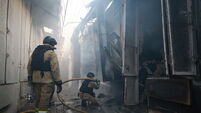
Rescue workers climbed through twisted steel bars and crushed concrete at the flattened court building. Dozens of cars and trucks were burned and crushed.
Firefighters pulled survivors from behind huge slabs of toppled concrete. US soldiers helped provide security and assisted the Iraqis with the collection of evidence from the rubble.