280 dead as Israel renews attacks on Hamas
Warplanes pressing one of Israel’s deadliest assaults ever on Palestinian militants dropped bombs and missiles on a top security installation, a mosque, a TV station and dozens of other targets across the Hamas-ruled Gaza Strip today.
Some 280 Palestinians have been killed and 600 people wounded since Israel’s campaign to quash rocket barrages from Gaza began midday yesterday, a Gaza health official said. Most of the dead were Hamas police.
Israel’s prime minister said the campaign could last longer than initially anticipated, and the Israeli Cabinet was discussing a possible call-up of thousands of reservists at its weekly meeting today.
Israel launched some 250 airstrikes over the first 24 hours, and infantry and armoured units were already headed to the Gaza border for a possible ground invasion.
Militants, unbowed, kept up the pressure on Israel, firing dozens more rockets and mortars at Israeli border communities today. Two rockets struck close to the largest city in southern Israel, Ashdod, some 23 miles from Gaza, reaching deeper into Israel than ever before. The targeting of Ashdod confirmed Israel’s concern that militants are capable of putting major cities within rocket range. No injuries were reported.
The Palestinians’ moderate President Mahmoud Abbas, a fierce rival of Hamas’, urged the Islamic militant group to renew a truce with Israel that collapsed last week.
In New York, the UN Security Council expressed serious concern about the escalating situation in Gaza and called on Israel and the Palestinians to immediately halt all violence and military activities. The UN’s most powerful body called for a new cease-fire between Israel and Hamas, and for opening border crossings into Gaza to enable humanitarian supplies to reach the territory.
Israeli Defence Minister Ehud Barak allowed limited supplies of fuel and medicine to enter Gaza.
Many of Israel’s Western allies urged restraint on both sides, though the US blamed Hamas for the fighting.
The offensive began eight days after a six-month truce between Israel and the militants expired.
The Israeli army says Palestinian militants have fired more than 300 rockets and mortars at Israeli targets over the past week, and 10 times that number over the past year.
Streets were empty in Gaza City as most residents stayed home, fearing more airstrikes. A few lined up to buy bread outside two bakeries. Schools were shut for a three-day mourning period the Gaza government declared Saturday for the campaign’s dead.
Hamas police kept a low profile, wearing jackets over their dark blue uniforms and walking close to walls, hoping to evade the detection by Israeli pilots.
Aircraft struck one of Hamas’ main security compounds in Gaza City – a major symbol of the group’s authority. Health officials said four people were killed and 25 wounded in the attack.
A column of black smoke towered from the building, and some inmates of the compound’s prison fled after the missiles struck. Hamas police recaptured some of them.
One prisoner trapped under the rubble waved his hand in the hope of being rescued. Two other prisoners helped a bleeding friend walk through the debris.
Minutes after the strike, Hamas police defiantly planted the movement’s green flag in the rubble.
“These strikes fuel our popular support, our military power and the firmness of our positions,” said Mushir al-Masri, a Hamas legislator. “We will survive, we will move forward, we will not surrender, we will not be shaken.”
Senior Hamas leaders went into hiding before the offensive began, shutting off their phones.
Hamas’ Gaza prime minister, Ismail Haniyeh, spoke on a televised address on Saturday evening, but it was not immediately clear where the address was taped.
Earlier, Palestinians said Israeli bombs destroyed a mosque outside Gaza’s main hospital in Gaza City; the military called it a “base for terrorist activities”.
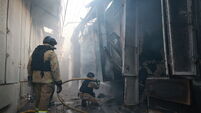
In southern Gaza, aircraft targeted a Gaza tanker truck, touching off a blaze that raged out of control and spread to about a dozen nearby houses. One of the main medicine warehouses supplying local pharmacies in southern Gaza was attacked in another sortie.
Local residents said the tanker and the warehouse contained supplies that had been smuggled in from Gaza through underground tunnels with Egypt, suggesting Israel was widening its offensive to go after businesses that are a source of income for Hamas.
Warplanes attacked the headquarters of the local Hamas television station early today, but it continued to broadcast from a mobile unit.
The initial waves of attacks on Saturday focused on key Hamas security installations and rocket-launching pads.
Gaza health official Dr Moaiya Hassanain said at least 280 people were killed, including 183 members of Hamas’ uniformed security forces. It was not clear how many of the others were gunmen or civilians.
The civilian casualties included a 15-year-old boy who died in southern Gaza on Sunday in an attack on a greenhouse near the border. At least 644 people were wounded, Hassanain said.
Israeli Prime Minister Ehud Olmert said it was unclear when the operation would end. The situation in southern Israel “is liable to last longer than we are able to foresee at this time,” he told his Cabinet.
Gaza’s Hamas rulers have been stockpiling weapons in recent months, including medium-range missiles. Until today, the deepest targets inside Israel had been the city of Ashkelon and the town of Netivot, which are about 12 miles from Gaza.
Since the campaign began, around 150 rockets and mortars have bombarded southern Israel, according to the military’s count.
In Ashkelon, a city of 120,000 people about 11 miles from Gaza, bustling pavements immediately emptied after a rocket fell in the city centre. “I am afraid to walk,” said Tzipi Moshe, 59, nervously puffing a cigarette as she ran into a building for cover.
The Palestine Liberation Organisation, dominated by Abbas’ Fatah movement, called a one-day commercial strike through the West Bank and urged Palestinians to take to the streets in peaceful protests.
Israel’s military was on alert for possible disturbances in the West Bank. The campaign has inflamed public opinion across the Arab world, which has responded with protests and condemnations.