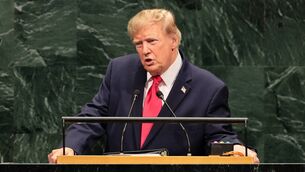
Bush: 'Time is right for peace conference'
Palestinians and Israelis understand that helping the other to realise their aspirations is the key to realising their own, US President George Bush will say today.
Mr Bush will open the US-sponsored international conference on the Middle East in Annapolis, Maryland, today as he is joined by more than 40 Arab leaders and international envoys, including former prime minister Tony Blair.
His speech will follow a trilateral meeting with both Palestinian President Mahmoud Abbas and Israeli Prime Minister Ehud Olmert.
Mr Bush will say: “Palestinians and Israelis each understand that helping the other to realise their aspirations is the key to realising their own – and both require an independent, democratic, viable Palestinian state.
“Such a state will provide Palestinians with the chance to lead lives of freedom, purpose and dignity.
“And such a state will help provide Israelis with something they have been seeking for generations: to live in peace with their neighbours.
“Achieving this goal will not be easy – if it were easy, it would have happened a long time ago.”
He will say the aim of the conference is to launch negotiations, not conclude the argument, and that now is the right time to pursue peace.
“First, the time is right because Palestinians and Israelis have leaders who are determined to achieve peace.
“Second, the time is right because a battle is under way for the future of the Middle East – and we must not cede victory to the extremists.
“Third, the time is right because the world understands the urgency of supporting these negotiations.”
He will go on: “The task begun here at Annapolis will be difficult. This is the beginning of the process, not the end of it – and much work remains to be done.
“Yet the parties can approach this work with confidence. The time is right. The cause is just. And with hard effort, I know they can succeed.”
Yesterday, the US president held talks with Mr Olmert and Mr Abbas separately in the Oval Office at the White House.
Mr Olmert said: “This time it’s different, because we are going to have lots of participants in what I hope will launch a serious process of negotiations between us and the Palestinians.
“This will be a bilateral process, but the international support is very important for us.”
Mr Abbas called the conference “a great initiative”.
“I am delighted to have the opportunity to meet with President Bush after his invitation and this historic initiative that he launched to convene the Annapolis Conference,” Mr Abbas said.
“We have a great deal of hope that this conference will produce permanent status negotiations, expanded negotiations, overall permanent status issues that would lead to a peace agreement between Israel and the Palestinian people, an agreement to secure security and stability.”
A statement released by the Quartet of Europe, Russia, the UN and the US - represented by Mr Blair – also welcomed the commitment of the Israeli and Palestinians leaders to launch bilateral negotiations and the realisation of Israeli-Palestinian peace.
It said: “The Quartet affirmed its commitment to seize this opportunity to mobilise international support to achieve meaningful progress towards a just and lasting negotiated settlement to this conflict, and ultimately a comprehensive peace in the Middle East.”
The conference, which started with a dinner last night, is the first time in years that Israel, a large group of Arab states and international envoys from around the world sit down together to try to relaunch a peace process.
Mr Blair will be there in his role as Middle East envoy for the Quartet, which represents Europe, Russia, the US and the UN.
He is expected to report on the actions he has taken to support efforts by Salam Fayyad, prime minister of the Palestinian National Authority, to build Palestinian institutions.
The run-up to the meeting has been fraught with disputes, scepticism and suspicion about the opposing parties’ good faith and expectations remain low.
Any joint agreement the Israelis and Palestinians present at Annapolis will be a starting point and the big questions that have doomed previous peace efforts will come later.
Criticism directed at the conference from afar pointed to the enormity of the challenge.
Leaders of the Islamic militant group Hamas labelled Mr Abbas a traitor even for coming to the meeting, and vowed to reject any decisions to come out of the conference.
In Jerusalem, more than 20,000 Israelis gathered at the Western Wall, the holiest site where Jews can pray, to protest against the conference.
Israeli opposition leader Benjamin Netanyahu labelled the summit “a continuation of one-sided concessions”.
In Iran, Ayatollah Ali Khamenei said in a speech that the conference “has already failed” and that the US is only trying to preserve its reputation.
The events unfolded as the Israeli military killed four Palestinians in the Gaza Strip in an airstrike and a ground clash.
US officials have tried to keep expectations for the US-sponsored conference low, an easy task among sceptical Arab states, calling it a starting point for talks and not an attempt to settle anything.
CONNECT WITH US TODAY



Be the first to know the latest news and updates