Plane crash victims 'burned beyond recognition'

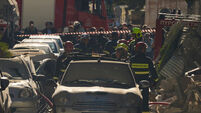
More than 30 bodies recovered from a plane that crashed on a Thai island have not been unidentified because they were so badly burned, officials said today.

Plane crash victims 'burned beyond recognition'

More than 30 bodies recovered from a plane that crashed on a Thai island have not been unidentified because they were so badly burned, officials said today.

The budget One-Two-Go Airlines flight was carrying 123 passengers and seven crew from Bangkok to Phuket when the plane skidded off a runway on Sunday while landing in driving wind and rain, catching fire and killing 89 people.

Forty-one others were injured.

The 89 dead came from at least 10 countries, including Britain, Ireland, the United States, Australia, France, Germany, Iran, Israel, Sweden and Thailand.

Official tallies of the dead showed Thailand had the most victims with 36, followed by Iran with 18.

Nine French, six Israelis, six British, five Americans and four Irish nationals were also among the dead, according to embassy reports and documents obtained by The Associated Press from Thai immigration police.

Amporn Charuchinda, police commissioner of forensics, said 33 of the dead had yet to be identified.

“They were burned beyond recognition,” he said, standing at the site where they have stored the remaining bodies in a guarded area on the west end of the airport near the beach on the Andaman Sea.

Most of the Thai bodies and that of the Indonesian pilot have been retrieved by relatives and some have been flown by commercial flights to Bangkok, according to Major General Santhan Chayanon, deputy police commander of the region that includes Phuket.

The remaining dead are being stored in a cavernous refrigerated cargo hold.

Photos of charred bodies – including those of children – hang on the wall for identification and burned luggage is stacked in a corner.

Amid the horror, officials from Israel and Iran put aside their political animosity and agreed to cooperate in identifying crash victims.

Relations are minimal and tense between the Jewish state and the Islamic Republic – whose president once denied the Holocaust – but diplomats from both nations shrugged off any suggestion the antagonism would hinder efforts to help grieving families.

“It’s human nature to help in solving this problem as soon as possible,” Safdar Shafiee from the Iranian Embassy in Bangkok said yesterday after shaking hands with Yaki Oved, head representative of Israeli police in Southeast Asia and the Pacific.

“In situations like this you forget the division,” agreed Oved. “The main thing is to help; you don’t think about the politics.”

Shafiee said 15 of the dead Iranians had been identified, but fingerprints or DNA samples to be sent from relatives in Iran were needed to try to identify the remaining three.

“He told our delegation how they were worried about their missing. I told him we can help him,” Oved said, referring to an Israeli forensics team that came to Thailand.

The team, from an emergency rescue service, has long experience in dealing with victims of traumatic injuries from the decades of Arab-Israeli conflict.

It will try to match bodies with dental records, fingerprints, DNA and distinguishing features described by relatives.

More in this section

Cookie Policy Privacy Policy Brand Safety FAQ Help Contact Us Terms and Conditions

© Examiner Echo Group Limited