Death toll rises in Greek forest fires
Fires tore through parched forests and swallowed villages across Greece, bearing down on communities near Ancient Olympia in the south today. At least 49 people were dead.
The government has declared a nationwide state of emergency.
Efforts to contain the inferno were helped, however, by a drop in the gale-force winds that swept fires through thousands of acres of forest and scrub since Friday, the fire department said today.
“Fires are burning in more than half the country,” department spokesman Nikos Diamandis said. “This is definitely an unprecedented disaster for Greece.”
Diamandis said it was impossible to estimate how large an area, and how many homes had been destroyed.
“We are optimistic that, if the weather and the reduction in the winds hold long enough, we may be able to be more effective,” Diamandis said.
The worst blazes – 42 major fronts – were concentrated in the mountains of the Peloponnese in southern Greece and on the island of Evia north of Athens. Arson has been blamed in several cases, and seven people have been detained on suspicion of causing fires.
Early today, flames were approaching villages a few miles from Ancient Olympia and the town of Pyrgos in the western Peloponnese. Desperate residents and officials appeared on television to appeal for help.
“We’re going to burn alive here,” one woman told Greek television from the village of Lambeti. She said residents were using garden hoses in an attempt to save their homes.
The fire department said that Pyrgos, and the town of Kalamata 56 miles southwest, were not in danger.
Church bells rang out in the village of Kolyri, near Ancient Olympia, as residents tried to gather their belongings and flee through the night, said one man who called the television station.
After first light, firefighting planes began dropping water in the area, and Ancient Olympia Mayor Giorgos Aidonis said the ancient site was no longer in imminent peril.
“We are among the lucky,” he said. “Ancient Olympia is not in danger at the moment.”
Guards at the 2,800-year-old site said the fire was not visible from Ancient Olympia, which was closed to visitors. The ancient site is protected by a firefighting sprinkler system.
But other areas were still being consumed by flames, with much of the western, southern and eastern Peloponnese ablaze. Prayers were held in churches across the country for the blazes to relent.
Flames were also approaching the ancient temple of Apollo Epikourios, near the town of Andritsaina in the southwestern Peloponnese.
Andritsaina Mayor Tryphon Athanassopoulos said the fire was about less than 2 miles from the 2,500-year-old monument.
“We are trying to save the Temple of Apollo, as well as Andritsaina itself, where the flames are less than a mile away,” he told state NET television.
A blaze in the area of Kalyvia, between Athens and the ancient site of Sounion to the south, had abated early today, while 42 fires in various parts of the country had been brought under control.
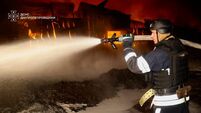
Nearly 1,000 soldiers, backed by military helicopters, reinforced firefighters stretched to the limit by Greece’s worst summer of wildfires. In the most ravaged area – a string of mountain villages in the Peloponnese – rescue crews picked through a grim aftermath that spoke of last-minute desperation as the fires closed in.
Dozens of charred bodies were found across fields, homes, along roads and in cars, including the remains of a mother hugging her four children.
By sea and by land, authorities evacuated hundreds of people trapped by the flames in villages, hotels and resorts.
Senior Health Ministry official Panagiotis Efstathiou said the bodies of 49 people who died because of the fires had been taken to hospitals. The fire department said it could confirm 47 deaths. There were fears the toll could increase as rescue crews searched recently burned areas.
At least 12 countries were sending reinforcements for Greece’s overstretched firefighters, and six water-dropping planes from France and Italy joined operations today.
Foreign Minister Dora Bakoyannis said the EU and other countries would send a total 31 firefighting aircraft, while the US and Russia also promised help.
“I warmly thank all the countries that responded,” she said.
Prime Minister Costas Karamanlis implied arson was the cause of the blazes.
“So many fires breaking out simultaneously in so many parts of the country cannot be a coincidence,” he said in a nationally televised address last night. “The state will do everything it can to find those responsible and punish them.”
A 65-year-old man was arrested and charged with arson and multiple counts of homicide in a fire that killed six people in Areopolis, a town in the southern Peloponnese, the fire department spokesman, Diamandis, said.
Separately, two youths were arrested on suspicion of arson in the northern city of Kavala, and four people were detained on suspicion of unintentionally causing fires on the island of Evia.
Hospitals across Greece were on alert, and the Health Ministry sent tents for 1,500 people to the south to house those made homeless.
The worst-affected region was around the town of Zaharo, south of Ancient Olympia. Thick smoke, which blocked out the intense summer sun, could be seen from more than 60 miles away. The blaze broke out on Friday afternoon and quickly engulfed villages, trapping dozens of people and killing at least 39. Scores of people were treated in hospitals for burns and breathing problems.
“I feel deep grief for our dead,” Karamanlis said in his address. “I feel deep pain for the mother who perished in the flames with her arms round her children. I feel anger – the same that you feel.”
On the island of Evia, a massive fire burned across hillsides and through villages. Police and coast guards used patrol boats yesterday to evacuate 300 people from the island’s town of Aliveri and 40 from the nearby town of Styra.