Race to save miners trapped in US cave
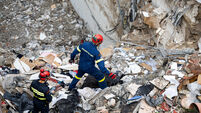
Hundreds of rescuers smashed through walls of rock in a desperate race to reach six coal miners trapped 1,500 feet below ground by a cave-in so powerful authorities initially thought it was an earthquake.
Hours after the collapse, which did not appear to be related to an explosion, searchers had been unable to contact the miners and could not say whether they were dead or alive. If they survived, a mine executive said, they could have enough air and water to last several days.
“We’re going to get them,” said Robert Murray, chairman of Murray Energy Corporation of Cleveland, a part owner of the Crandall Canyon mine near Huntingdon, Utah.
“There is nothing on my mind right now except getting those miners out.”
The mining crew was believed to be about four miles from the mine entrance. Rescuers were working to free the men by drilling into the mine vertically from the mountaintop and horizontally from the side, Murray said.
Officials estimated that drilling vertically could take three days.
If they are able to open an old mine shaft, Murray says, rescuers believe they can get within 100 feet of where the men are trapped.
“The idea is to get a hole into where they are,” Murray said. “They could be in a chamber 1,000 feet long or they could be dead. We just don’t know right now.”
Doug Johnson, director of corporate services at an affiliated company, UtahAmerican Energy, said rescuers had made “decent progress”, but were not much closer to the men.
Relatives of the miners waited for news at a nearby old folk’s centre. Many of the family members do not speak English, so Huntington mayor Hilary Gordon hugged them, put her hands over her heart and then clasped them together to let them know she was praying for them, she said.
Ariana Sanchez, 16, said her father Manuel, 42, was among the trapped miners.
The mine uses a method called “retreat mining”, in which pillars of coal are used to hold up an area of the mine’s roof. When that area is completely mined, the company pulls the pillar and grabs the useful coal, causing an intentional collapse. Experts say it is one of the most dangerous mining methods.
Mine-safety inspectors, who have issued more than 300 citations against the mine since January 2004, were also on hand to help oversee the search.
Murray said no expense would be spared to save the men. The company had enlisted the help of 200 employees and four rescue crews, and brought in all available equipment from around the state.
The mine is built into a mountain in the rugged Manti-La Sal National Forest, 140 miles south of Salt Lake City, in a sparsely populated area.
University of Utah seismograph stations recorded seismic waves of 3.9 magnitude around early yesterday, local time, in the area of the mine, causing speculation that a minor earthquake had caused the cave-in.
Scientists later realised the collapse at the mine had caused the disturbance, reported to authorities at around 4am. But by late afternoon, they said a natural earthquake could not be ruled out and more information was needed to conclusively determine what happened.
Murray said the earthquake’s epicentre was a mile from the trapped miners.
“There is no evidence that the earthquake triggered the mine collapse,” said Walter Arabasz, director of the seismography stations.
But Murray disputed those findings, saying the epicentre was a mile from the trapped miners. “The whole problem has been caused by an earthquake,” he insisted angrily.
Since the mid-1990s, at least a half-dozen other mine collapses have caused similar seismic waves, including a 1995 cave-in in south-western Wyoming that caused readings as high as a magnitude 5.4.
Murray believes the miners have plenty of air because oxygen leaks into the mine naturally. The mine also is stocked with drinking water.
“I’m so hopeful for those guys. They should have lots of oxygen to breathe,” said Mary Ann Wright, associate director for mining in the Utah Division of Oil, Gas and Mining.
“From not having heard that there’s any type of fire, that’s always good news. If they’re trapped in a cavern area, there should be oxygen to breathe.”
Asked about safety, Murray told reporters: “I believe we run a very safe coal mine. We’ve had an excellent record.”

CONNECT WITH US TODAY



Be the first to know the latest news and updates