Five dead as earthquake hits Japan
A 6.8-magnitude earthquake hit Japan's north-west coast today, killing at least five people.
The quake injured more than 260 people, flattened dozens of wooden buildings and triggered a fire at a nuclear power plant.
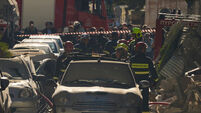
Fire engine sirens could be heard in hard-hit Kashiwazaki city, and older buildings were reduced to piles of lumber. National broadcaster NHK reported more than 260 people were hurt, with injuries including broken bones, cuts and bruises.
Two women in Kashiwazaki died, the local hospital said. NHK reported that the women were in their 80s and had been buried in separate buildings.
"I was so scared - the violent shaking went on for 20 seconds," Ritei Wakatsuki, a store worker, said from Kashiwazaki. "I almost fainted by the fear of shaking."
Flames and billows of black smoke poured from the Kashiwazaki nuclear plant, which automatically shut down during the quake. The fire, at an electrical transformer, was put out shortly after noon local time and there was no release of radioactivity or damage to the reactors, said Motoyasu Tamaki of Tokyo Electric Power.
Around 440 people were evacuated from the quake zone, NHK reported. The force of the quake buckled seaside roads and bridges, and yard-wide fissures could been seen in the ground along the coastline.
One of two people buried under a collapsed apartment house had been rescued, though the person's condition was unknown, police said. Separately, TV footage showed rescue workers and firefighters hacking at the roof of a damaged home searching for anyone trapped within.
A ceiling collapsed in a gym in Kashiwazaki where about 200 people had gathered for a badminton tournament, and one person received minor facial injuries, Kyodo reported. The quake also knocked a train car off the rails while it was stopped at a station. No-one was injured.
The Meteorological Agency issued tsunami warnings along the coast of Niigata state, but the warnings were later lifted. Waves as high as 20ins were believed to have hit the coast, but no damage was reported.
The quake, which hit the region at 2.13am Irish time was centred off the coast of Niigata, 160 miles north west of the capital, Tokyo. The tremor made buildings in Tokyo sway and was also felt in northern and central Japan.
The agency initially measured the quake at a 6.6 magnitude, but later revised that to 6.8. The US Geological Survey said the quake registered 6.7.
A series of smaller aftershocks rattled the area, including one with a 4.2 magnitude. Koichi Uhira of the Meteorological Agency warned that the aftershocks could continue for a week.
Several bullet train services linking Tokyo and northern and north-western Japan have been suspended. Officials said water and gas services for Kashiwazaki's 35,000 households were suspended after reports of gas leaks. About 18,000 households were without power.
Prime minister Shinzo Abe, campaigning in southern Japan for parliamentary elections later this month, is returning to Tokyo to deal with the quake and the government has set up a task force, reports said.
Niigata Airport, which had suspended flights shortly after the quake, resumed services after finding no damage, Kyodo said.
Japan sits atop four tectonic plates and is one of the world's most earthquake-prone countries. The last major quake to hit Tokyo killed some 142,000 people in 1923, and experts say the capital has a 90% chance of suffering a major quake in the next 50 years.
In October 2004, a magnitude-6.8 earthquake hit Niigata, killing 40 people and damaging more than 6,000 homes. It was the deadliest to hit Japan since 1995, when a magnitude-7.2 quake killed 6,433 people in the western city of Kobe.