Refugees flee as violence continues in Lebanese camp
People flooded out of a besieged refugee camp in Lebanon last night after three days of fighting between Lebanese troops and Islamic militants.
Earlier in the day, a relief convoy came under fire when a cease-fire abruptly shattered as UN workers tried to deliver food and water to residents.
The nighttime lull that allowed the escape did not appear to be part of an organised truce - and there was no sign the battle was over.
The government of Prime Minister Fuad Saniora said it was determined to uproot Fatah Islam, which took up residence in the camp late last year.
There was no immediate indication of whether the flight of civilians would give the government a freer hand in bombarding militants holed up in the camp.
The army has said its troops were trying to target only militant positions.
Lebanon yesterday asked the United States for US $280m (€208m) in military assistance to help put down the uprising, the US State Department said. Spokesman Sean McCormack said the US is weighing the request.
The White House, meanwhile, said militants operating out of the refugee camp want to disrupt the nation’s security and distract international attention from an effort at the United Nations to establish a special tribunal to try suspects in the 2005 assassination of former Prime Minister Rafik Hariri in Beirut.
White House press secretary Tony Snow reaffirmed support for Lebanese Prime Minister Fuad Saniora’s Western-backed government.
Twenty-nine soldiers and at least 20 militants had been killed since the battle began on Sunday in the heaviest internal fighting in Lebanon since the 1975-90 civil war.
However, the number of civilian casualties remained unknown because relief workers were not able to get inside the camp.
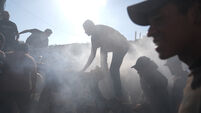
When fighting quietened after sunset, thousands of people took the chance to escape.
They streamed out of Nahr el-Bared’s western gate on foot and in cars, pickups and minivans jammed with men, women and children.
Many waved white towels or white plastic bags from the windows as they passed Lebanese soldiers encircling the camp.
“The smell of corpses was everywhere. There was no food, water or electricity and they were shooting at us,” Dania Mahmoud Kassem, a 21-year-old university student, said of the past three days in the camp, which is on the outskirts of the northern port city of Tripoli.
Another refugee, Ibrahim Issa Dawoud, said he, his wife and six children – aged 3 to 13 – had taken refuge in a mosque for three days, living off crisps while Lebanese army tanks and artillery fired at militants armed with mortars and automatic weapons.
“Even the cemetery was bombarded and the skeletons were uprooted,” the 42-year-old said as the left with his family. “We thought this was our last chance because they will bulldoze the camp.”
The camp is home to some 31,000 Palestinians who live crowded along narrow streets.
Fatah Islam’s leader, Palestinian Shaker al-Absi, has been linked to the former head of al-Qaida in Iraq and is believed to have recruited about 100 fighters, including militants from Saudi Arabia, Yemen and other Arab countries.
Angry Palestinians elsewhere in Lebanon burned tyres to protest the military assault, raising the threat of wider unrest in the country’s volatile refugee camps.
Some 215,000 people live in the 11 camps, which are rife with armed groups and Islamic extremists.
Reports from fleeing residents raised fears of a high civilian toll.
“There’s been a massacre. I witnessed it. In one room alone there are 10 dead. Six shells fell on us, the bodies were cut to pieces,” one man shouted angrily as he and a few others managed to get out of the camp during the brief afternoon truce.
The UN relief agency for Palestinian refugees, UNRWA, tried to get a convoy of water and other supplies into the camp, but as workers distributed supplies, shooting broke out.
Richard Cook, the UNWRA chief in Lebanon, said: “We were hit, initially by light arms fire, then by heavier fire.
“We’ve not had any staff hurt, but there were injuries and possibly deaths among those coming to collect the food.”
During the day’s fighting, Lebanese troops tried to capture militant positions just outside the camp, which they are not allowed to enter under a 1969 agreement with Palestinian groups.
The refugees fleeing Nahr el-Bared moved into the nearby Beddawi refugee camp. UNWRA officials registered them and distributed mattresses, food and water.
Hundreds bunked at a school, while others moved in with relatives at the camp, already home to 15,000 people.
CONNECT WITH US TODAY



Be the first to know the latest news and updates