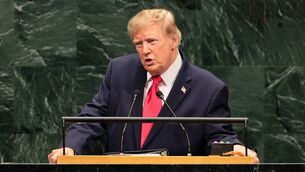
Iraq problem 'far too big for America'
Senior Russian defence ministry official Vladimir Shamanov said today that more US troops in Iraq “won’t be able to radically change the situation with ensuring peace and security".
He said the main weakness of the US plan is that it sends most of the additional troops to Baghdad: “Without firm authority in the provinces, it’s not possible to establish law and order in the country,” he told the ITAR-Tass news agency.
British Foreign Secretary Margaret Beckett said Bush’s promise to boost US troop strength in Iraq demonstrates the American and Iraqi governments’ determination to deal with the deteriorating security situation.
But Beckett was also quick to distance the British government from the new US move.
“It is not our intention at the present time to send more troops,” she told reporters at 10 Downing St. She said Britain was continuing to work “progressively” toward transferring security responsibility to authorities in southern Iraq, where it has about 7,000 troops.
Elsewhere, two war analysts at top British think-tanks – Gareth Stansfield of Chatham House and Toby Dodge of the International Institute of Strategic Studies - were not optimistic. Both said Bush’s plan to send more troops to Iraq would be too little, too late.
“Iraq is in the midst of a civil war. This problem is far too big for America,” said Dodge. He urged Washington to seek the help of the United Nations, western powers such as Russia and France, and Iraq’s neighbours of Iran and Syria.
In Sweden, Foreign Minister Carl Bildt said Bush’s speech lacked any new political ideas, and in Denmark, a key opposition politician put blame for the Iraq quagmire squarely at the feet of the US president.
“George W. Bush lives in his own world,” said Helle Thorning-Schmidt, leader of Denmark’s Social Democrats. ”We are dealing with a stubborn president who continues with an uncertain strategy for Iraq’s future.”
French Foreign Minister Philippe Douste-Blazy said the solution for Iraq, beyond Bush’s troop increase, is “the participation of all civilian, political and religious elements in Iraqi society.
“It is through a comprehensive approach, through a political strategy, that Iraq and the whole region will regain their stability,” Douste-Blazy said in a carefully worded statement.
France was one of the main critics of Bush’s push to invade Iraq in 2003.
Retired French general Jean Salvan, who commanded troops in the first UN peacekeeping force in Lebanon, said he believed Bush was paving the way for an honourable pullout in an effort to avoid the shame suffered when US forces left Vietnam.
“What Bush is apparently trying to do is to depart from Iraq honourably, without leaving behind catastrophic images like when the Americans left Saigon,” he said.
In Asia, key US allies such as South Korea, Australia and Japan all pledged continued support for the US war effort.
“If America retreats in Iraq, then that has enormous consequences for the stability of the Middle East and it will also be an enormous boost to terrorism in our part of the world,” Australian Prime Minister John Howard said in Sydney. Howard, whose country has 1,300 troops in and around Iraq, called Bush’s plan “very clear, calm and above all, realistic.”
Japanese Foreign Minister Taro Aso said Tokyo would continue its humanitarian air support and loans to Baghdad for reconstruction.
“I strongly hope that the US efforts toward the stability in Iraq and reconstruction will proceed effectively and bring good results,” Aso said in a statement. “Japan will continue to closely communicate and cooperate with the US”

CONNECT WITH US TODAY



Be the first to know the latest news and updates