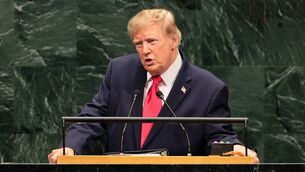
Bush begins three-day consultation on Iraq

US President George W Bush today opened three days of intensive consultations on Iraq, aiming to reverse the course of the nearly four-year-old war and energise his final two years in office.

Bush begins three-day consultation on Iraq

US President George W Bush today opened three days of intensive consultations on Iraq, aiming to reverse the course of the nearly four-year-old war and energise his final two years in office.

President Bush went to the State Department in Washington to review diplomatic and political options - the latest in a series of consultations that dominate his agenda.

Later, in the Oval Office, he was to seek advice from a handful of experts, including Stephen Biddle of the Council of Foreign Relations, Eliot Cohen of the School of Advanced International Studies and three retired Army generals: Wayne Downing, Jack Keane and Barry McCaffrey.

White House press secretary Tony Snow said Bush hoped to be able to announce his decisions by December 25, but that the timing could slip.

"It's something that we would like to see, but I'm not going to promise it," Snow said.

Administration officials are weighing options, including a short-term build-up of troops and a revamped approach to dealing with Iraq's warring factions.

Whatever the choice, Bush is out to show he is not acting alone. He is seeking advice at home and abroad - brought on by a humbling election in which voters handed control of Congress to Democrats and made clear their dissatisfaction with progress in Iraq.

On Tuesday, Bush will hold a video conference with senior military commanders and the US ambassador to Iraq, Zalmay Khalilzad, and then host Iraqi vice president Tariq al-Hashemi at the White House. On Wednesday, he is to meet officials at the Pentagon.

Last week, Bush met Shiite political leader Abdul-Aziz al-Hakim, members of the bipartisan Iraq Study Group and British prime minister Tony Blair, as well as politicians from the armed services, intelligence and foreign relations committees.

"This is unusually intensive, as you would expect, given the situation we find ourselves in," White House counsellor Dan Bartlett said on Sunday.

"It's a very complex set of issues, ranging from military strategy and tactical decisions to economic and political and diplomatic matters," Bartlett said. "All these elements coming together will help him sort through all the different interests and recommendations, and then pull it together for a comprehensive decision and announcement."

The urgency and the pressure are rising.

Republican Senator Trent Lott, the incoming number two party leader, said on Sunday: "The president this week is going to be meeting with any and everybody he can talk to."

"He knows that the circumstances are not what we wanted them to be, and that you've got to do some different things," Lott said on CBS television's Face The Nation.

Americans' dissatisfaction with Bush's handling of Iraq is at an all-time high of 71% in the latest Associated Press-Ipsos poll.

Heading towards the new year, Bush is awaiting reports from the Pentagon, the State Department and the National Security Council.

He has already received the highly-anticipated findings of the Iraq Study Group, headed by Republican James Baker III and Democrat Lee Hamilton. The group called the situation in Iraq "grave and deteriorating" and urged a broad new direction.

More in this section

Cookie Policy Privacy Policy Brand Safety FAQ Help Contact Us Terms and Conditions

© Examiner Echo Group Limited