Olmert ratings plummet after Lebanon war
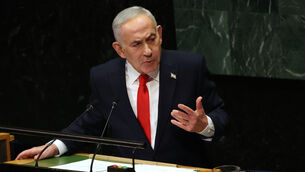
Israelis would vote Ehud Olmert out of office if elections were held now, polls indicated today, as the defiant prime minister defended his performance in the Lebanon war and lashed out at his critics.
In newspaper and TV interviews marking the Jewish New Year, Olmert said he had no doubt Israel won this summerâs war against Hezbollah â even though the army was unable to stop rocket attacks on Israel during 34 days of fighting and failed to win the release of two soldiers captured by the Lebanese guerrillas.
Hezbollah has also claimed victory and planned a large rally in Beirut tomorrow, though it was unclear whether its chief, Hassan Nasrallah, would attend, in what would be his first public appearance since the start of the war.
Olmert was evasive when asked whether Nasrallah remained a target for assassination. However, army chief Lt. Gen. Dan Halutz suggested Israel was no longer hunting Nasrallah, saying his fate âwonât depend on us.â
In the Gaza Strip, five Palestinians were killed by army fire â three alleged members of a rocket squad, a gunman and a 37-year-old woman.
Two polls published today indicted Olmert was rapidly losing support and archrival Benjamin Netanyahu, leader of the hawkish Likud, was poised for a comeback.
A survey by the Dialog polling company, published in the Haaretz newspaper showed 68% of Israelis were unhappy with Olmert, compared with 40% on August 1, midway through the war. Just 22% were satisfied with his performance, compared to 48% in the previous poll.
The survey of 507 people had an error margin of 4.8 percentage points.
If an election were held today, Likud would double its strength, winning 24 of 120 parliament seats â making it the largest party and Netanyahu the possible premier â while Olmertâs centrist Kadima would fall from 29 to 16 seats, according to the poll.
Elections are not scheduled until 2010, but no Israeli government in the past decade has completed its four-year term.
In a survey in the Yediot Ahronot daily, 27% said Netanyahu was most suited to be prime minister, compared to just 7% who chose Olmert. The Dahaf poll of 499 people had an error margin of 4.5 percentage points.
After winning March elections, Olmert set out with confidence, saying he would draw Israelâs final borders by unilaterally pulling out of much of the West Bank.
However, his aides have acknowledged that the Lebanon war squashed that plan and stripped Olmertâs government of its central mission.
Olmert and his allies, Defence Minister Amir Peretz and army chief Lt. Gen. Dan Halutz, have been criticised for their wartime performance. Opponents say the trio was indecisive and confused, defined unachievable war goals â such as crushing Hezbollah â and that it negotiated a bad ceasefire deal.
Digging in, Olmert defended himself in a round of New Years interviews with local media.
âI have no doubt we won the war,â he was quoted as telling the Maariv daily, adding that his critics were inexperienced and âharbingers of doom.â
Two of his harshest detractors, former army chiefs Shaul Mofaz and Moshe Yaalon, were driven by bitterness over not being more successful at politics, he said. Mofaz, also a former defence minister, is a leading Kadima minister.
Olmert also responded to charges that he was too inexperienced. âI did not feel that I had to deal with decisions that I was incapable of handling,â he said.
The prime minister told Channel 2 TV that Peretz would remain in the job. He also defended one of the most controversial decisions of the war â to widen a ground offensive in Lebanon after the UN approved a ceasefire. Thirty-three soldiers were killed in that offensive, which Yaalon and other critics said was launched for political, not military reasons.
Olmert said today that the army had asked for the offensive to improve Israelâs positions. However, Israel quickly pulled back after the ceasefire took hold and was expected to finish withdrawing from Lebanon in the coming das.
Meanwhile, a Palestinian security chief accused Hamas of involvement in the assassination of a top intelligence officer, further raising tensions between Hamas and the rival Fatah movement. The Fatah-allied officer, Jad Tayeh, was killed last week in a Gaza drive-by shooting, along with four bodyguards.
Deputy intelligence chief Tawfik Tirawi, who is close to Fatah, said investigators had given Interior Minister Said Siyam of Hamas names of suspects in the killing â some of them Hamas members â but Siyam had not taken any action.
Siyam said Tirawiâs criticism was baseless and politically motivated.
Since Hamas came to power in March, it has been wrangling with Fatah over control of the security forces. Tirawi said Tayehâs killing was meant to undermine the security branches loyal to Fatah. Hamas has said the shooting was part of an internal dispute in the intelligence services.