UN warns Iraq of civil war danger
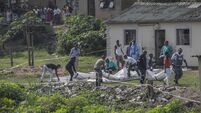
Iraqi police today found the blindfolded bodies of three people dumped in two separate parts of eastern Baghdad, while the US military command in Iraq said two American soldiers had been killed.
The deaths come as UN Secretary General Kofi Annan in New York warned that Iraq was in “grave danger” of collapsing into civil war, and urged the government to do more to foster national unity.
“If current patterns of alienation and violence persist much longer, there is a grave danger that the Iraqi state will break down, possibly in the midst of a full-scale civil war,” Annan told a meeting of foreign ministers at the United Nations.
However, he said that if Iraqi leaders could “address the needs and common interests of all Iraqis, the promise of peace and prosperity is still within reach”.
Two US soldiers were killed on Sunday, the US military command said in a statement today. One was killed by small arms fire in north-central Baghdad, while the other died after his vehicle was hit by a roadside bomb in the north-east of the capital.
Their identities were not released while military authorities contact their families.
In eastern parts of the capital, Iraqi police recovered three bodies, said police Lieutenant Bilal Ali.
All three had been shot and blindfolded, and bore signs of torture, he said.
Yesterday bombers and gunmen killed at least 41 people and injured dozens across Iraq, while the country’s politicians again failed to agree on legislation some fear could divide the country and lead to further violence.
Political leaders postponed a parliamentary debate that had been set for today on a draft bill to establish autonomous regions as part of a federated Iraq.
At a meeting in New York, Turkish foreign minister Abdullah Gul warned that a federal system that could lead to autonomous Shiite, Sunni and Kurdish regions in Iraq could break up the country and threaten regional stability.
“The core of the problem is that if Iraq is divided, definitely there will be civil war and definitely neighbouring countries will be involved in this,” said Gul, whose country borders Iraq to the north.
“The Middle East can’t shoulder this. It’s too much.”
Iraqi Shiite, Kurdish and Sunni Arab leaders yesterday discussed the federalism bill submitted to parliament earlier this month by the largest Shiite bloc, the United Iraqi Alliance.
The leader of the largest Sunni Arab alliance, Adnan Dulaimi, said the leaders would meet again for talks today, but that the bill would not be up for debate in parliament until a later, as yet unspecified, date.
Sunni Arabs fear that creating autonomous regions could deprive them of a share of Iraq’s oil riches, which are concentrated in the Shiite-dominated south and the largely Kurdish north.
They say that before such legislation can be passed parliament must set up a committee to amend the constitution, a key demand they made when they agreed to join Shiite Prime Minister Nouri Maliki’s national unity government.
One of the amendments they seek would weaken the possibility of setting up self-ruling cantons.
Dulaimi, as well as Shiite and Kurdish lawmakers, said the Kurds had proposed doing both at once, setting up the committee and submitting the draft bill for future debate. He said it would take about a year for both to work their way through parliament.
As political discussions continue, hundreds of Iraqis have been killed in bombings and shootings that show few signs of abating.
The government has said it will announce increased security measures ahead of the holy month of Ramadan, which begins next week, when violence tends to spike in Iraq.
Defence Ministry spokesman Mohammed Askari said the measures would be adopted two or three days before the holy month begins to “protect citizens from terrorists attacks during this month”.
Security measures could include a series of trenches and berms the government has said it plans to create to help secure Baghdad.
Vehicle and pedestrian traffic entering the city would be restricted to just 28 entry points with manned checkpoints. The berms and trenches would funnel vehicle traffic to those 28 checkpoints.
In one positive development for the government, predominantly Sunni Arab tribes in one of the most volatile provinces joined together to fight the insurgency in their region.
They called on the government and the US-led military coalition to supply them with weapons, a prominent tribal leader said yesterday.
Tribal leaders and clerics in Ramadi, the capital of violent Anbar province, met last week and have set up a force of about 20,000 men “ready to purge the city of these infidels”, Sheikh Fassal Guood, a prominent tribal leader from Ramadi, said.
“People are fed up with the acts of those criminals who take Islam as a cover for their crimes,” he said. “The situation in the province is unbearable. The city is abandoned. Most of the families have fled the city and all services are poor.”

CONNECT WITH US TODAY



Be the first to know the latest news and updates