'Get out of Darfur', Sudan tells African Union

The Sudanese government significantly raised the stakes in Khartoum’s stand-off with the international community, calling yesterday for the AU to withdraw its troops from all of Darfur.

The government significantly raised the stakes in Khartoum’s stand-off with the international community, calling yesterday for the AU to withdraw its troops from all of Darfur.

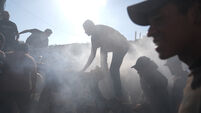
Rebels in Sudan’s ravaged Darfur region have said that government forces backed by bombers were pursuing a week-old offensive and African Union peacekeepers reported continued fighting.

The rebels said that aircraft were carrying out daily bombing raids as government troops seek to drive guerrillas from the National Redemption Front from their strongholds north of Darfur’s provincial capital El Fasher.

The government, which on Thursday rejected a UN Security Council resolution for the deployment of a 20,000-strong UN force in troubled Darfur, about a week ago launched a major attack reportedly involving thousands of troops and Janjaweed militias in the northern part of Darfur.

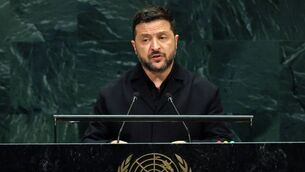
The Sudanese news agency SUNA, meanwhile, quoted President Omar al-Bashir as saying UN attempts to deploy peacekeepers was a bid by the international community to take over his country.

“The call for deployment of international forces in Darfur is part of a comprehensive conspiracy for confiscating the country’s sovereignty and imposing guardianship on the Sudanese people,” al-Bashir said.

“Our decision is decisive rejection (of the UN resolution) then preparation for the confrontation (with the UN forces),” SUNA quoted him as saying.

Also yesterday, the government issued a call for the AU to pull its forces out of Darfur before September 30.

State media reported the cabinet as saying that it would take over Darfur security, which “has improved, except for some violations perpetrated by the National Redemption Front which has refused to sign the agreement".

Northern Darfur is controlled by the rebels, who did not sign a US-brokered peace deal in May aimed at ending a three-year conflict that has killed more than 200,000 people and displaced 2.5 million.

Rebel commander Abubakar Hamid Elnur said by satellite telephone from northern Darfur that there were many civilian casualties.

“The government is still bombing with aircraft. It is very difficult for us to protect our civilians, especially from the air,” he told The Associated Press. Many civilians have fled their villages for the hills and valleys, according to the rebels.

Elnur said that the government forces were concentrated in the area of Um-Sidir and that heavy fighting had been taking place in recent days between Um-Sidir and Kulkul, a base abandoned by the rebels at the start of the current Sudanese offensive, which lies some 50 kilometres north of El Fasher.

A government armed forces’ spokesman denied any aerial bombing of villages in northern Darfur and described current army activities in the area as administrative operations.

“The allegation that the army used military aircraft and bombed the area is false and unfounded,” said the spokesman, who spoke on condition of anonymity because he was not authorised to speak to the media.

“The rebels are interpreting in their own interest ordinary administrative operations the army is conducting in the area,” he added.

The ill-equipped AU force of 7,000 troops has been unable to stop the humanitarian catastrophe in Darfur, where the peace deal signed by the government and one of the ethnic African rebel groups operating in the region has had little effect.

An AU spokesman said its forces’ command in Darfur had received reports about ongoing clashes since August 28 in Kulkul, Sayeh and other areas in northern Darfur.

Noureddine Mezni said the nearest AU military unit was investigating the fighting and will submit a report to the AU Cease-fire Commission.

A top AU official in Khartoum overseeing the May peace deal, Sam Ibok, said on Friday that more than 20 civilians had been killed and more than 1,000 displaced since major clashes started early in the week according to reports from the affected areas.

The African Union has called for the UN to take control of the peacekeeping force, whose formal mandate expires on September 30.

x

More in this section

Cookie Policy Privacy Policy Brand Safety FAQ Help Contact Us Terms and Conditions

© Examiner Echo Group Limited