Tamils rule out ceasefire
The Tamil Tiger rebels ruled out peace talks as battles raged in Sri Lanka’s north and east.
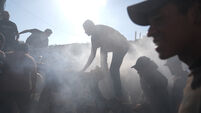
A pro-rebel website today accused government forces of killing 58 people in separate strikes on a church and a children’s home.
A military spokesman, denying the website account of the attack on the church, said rebels fired artillery when government commandos sought to flush out insurgents hiding in the building.
There was no immediate government comment on the reported attack on the children’s home.
With hopes fading for a quick end to the latest round of clashes, soldiers and rebels backed by artillery and mortars clashed in eastern Sri Lanka and the northern Jaffna Peninsula, the heartland of the country’s Tamil minority in whose name the insurgents claim to fight.
After dawn today, Sri Lankan air force jets bombed the north-eastern Mullaitivu district, deep inside territory controlled by the Tamil Tigers, hitting a children’s home and killing 43 schoolgirls who were there taking a first aid course, the TamilNet website reported.
Another 60 girls were wounded in the morning air raid on the home, TamilNet said, citing rebel officials.
The reported attack came nearly 24 hours after the fighting around the St. Philip Neri Church in Allaipiddy, a predominantly Tamil village located on an island just west of the Jaffna Peninsula. The island is held by the government.
TamilNet said civilians had taken refuge from weekend fighting in the church, and at least 15 people were killed and another 34 wounded, 20 of them seriously, when it was hit yesterday by rocket and artillery fire from a government position on the peninsula.
But military spokesman Major. Upali Rajapakse denied government forces hit the church, saying instead that guerrillas fired on troops as they tried to enter the building to flush out Tamil rebels hiding among the civilians inside.
“The Tigers are firing artillery at the commandos and the civilians are suffering,” Rajapakse said.
TamilNet stopped short of saying government forces intentionally targeted the church. But the site alleged that no help was sent to the wounded for hours after the attack.
A 2002 ceasefire was intended to halt more than two decades of bloodshed between the government, dominated by Sri Lanka’s 14 million Sinhalese, and the rebels, who have been fighting since 1983 for an independent homeland for the country’s 3.2 million Tamils.
The ceasefire remains officially in effect, but months of shootings and bombings already had left it in tatters before the latest round of clashes.
Attempts to restart peace talks and end the fighting have so far failed, with both sides blaming each other for the clashes.
“The Sri Lankan government’s offensive attacks make peace talks and the implementation of the cease-fire agreement impossible,” said Seevarathnam Puleedevan, a senior rebel official.
His comments came in response to a statement by the chief of the Sri Lankan government’s peace secretariat, Palitha Kohona, who said yesterday that the rebels recently told a Nordic cease-fire monitoring mission that they wanted to renew talks.
The spokesman for the Nordic mission, Thorfinnur Omarsson, confirmed that Puleedevan made a verbal request for renewed talks and said the Tigers would follow up with a formal, written offer.
But Puleedevan denied making any overtures, said he only talked to the monitors about the “Sri Lankan government’s duplicity after they undermined our goodwill gestures”.
The latest round of fighting began in late July over a rebel-controlled water supply near the eastern port of Trincomalee, and has in recent days spread to other parts of the east and the Jaffna Peninsula, the scene of intense fighting during Sri Lanka’s two decade-long civil war.
Government and rebel estimates of the death toll in the fighting since July vary wildly, but scores have been killed, including 17 Sri Lankans working for the Paris-based aid group Action Against Hunger. All but one of the aid workers was Tamil.