Quake death toll rises
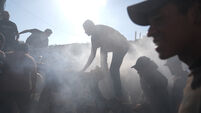
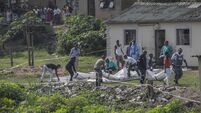
The death toll in a powerful earthquake which hit central Indonesia rose to more than 4,000 today as exhausted and grieving survivors dug through their crumpled homes searching for clothes, food and valuables.
The magnitude-6.3 quake struck early on Saturday and injured thousands more in the heart of densely populated Java island, in the country’s worst disaster since the 2004 tsunami. It also triggered fears that a nearby rumbling volcano would erupt and caused serious damage to the world-famous 9th century Prambanan temple.
The disaster zone stretched across hundreds of square miles of mostly farming communities in Yogyakarta province. The worst devastation was in the town of Bantul, which accounted for three-quarters of the deaths. More than 80% of the homes were flattened.
“I have to start my life from zero again,” said Poniran, whose five-year-old daughter Ellie was killed in the quake.
Poniran dug up his still-breathing daughter from the rubble of her bedroom, but she died in a hospital awaiting treatment along with hundreds of others.
“Her last words were ’Daddy, Daddy,”’ he said.
At least 4,332 people were killed in the quake, according to figures provided by the Social Ministry and a Idham Samawi, a government official in one of the affected districts.
Another 200,000 people were left homeless, according to the International Federation of Red Cross and Red Crescent.
Tens of thousands spent the night sleeping in any open space available – on streets, in cassava fields, even on the narrow paths between rice fields. Power and telephone service was out across much of the region, adding to the terror of some 450 aftershocks, the strongest measuring 5.2.
Survivors searched the ruins of their homes today for anything still usable and complained that they hadn’t received any aid.
“We’re short of everything – clothes, food, water, all are gone. We are poor people, but our lives still matter,” said Budi Wiyana, 63, whose house was destroyed.
Doctors struggled to care for the injured, hundreds of whom were lying on plastic sheets, straw mats and even newspapers outside overcrowded hospitals, some hooked to intravenous drips dangling from trees.
Bloodstains littered the floor at Yogyakarta’s Dr Sardjito Hospital, along with piles of soiled bandages and used medical supplies.
Relatives fanned victims in the heat in temporary shelters set up in the parking lot and corridors.
“We have too many patients and they’re still arriving,” said Aru, a doctor, adding that the hospital had received more than 2,000 patients.
Though some corpses were pulled from the rubble early today, residents in villages visited by reporters said there were few people or bodies trapped beneath collapsed houses, mostly simple brick and wood structures.
But in Peni, a small village on Bantul’s southern outskirts, 20 residents were not ready to give up. They found the bodies of a woman and her three children Saturday, and were still trying to find the family’s father, Purwoko.
Most of the dead were buried in village graveyards within hours of the disaster, in line with Islamic tradition.
In Peni, villagers set up simple clinics to treat injuries, but were hampered by shortages of medicine and equipment. A group of women cooked catfish caught in a nearby pond for dozens of people huddled under a large tent.
The earthquake hit at 5.54am caving in tile roofs and sending walls crashing down. Survivors screamed as they ran from their homes, some clutching bloodied children and the elderly.
The quake was the latest in a series of disasters to hit Indonesia – including the 2004 tsunami that killed 131,000 people in Aceh province, terrorist attacks, a widening bird flu outbreak and the threat of eruption from nearby Mount Merapi.
The quake’s epicentre was 50 miles south of Merapi, and activity increased soon after the temblor. A large burst spewed hot clouds and sent debris cascading some two miles down its western flank. No one was injured because nearby residents had already been evacuated.
Bambang Dwiyanto of the Energy and Mineral Ministry could not say whether the quake caused the volcanic activity but warned that it could trigger a larger eruption.
International agencies and other nations pledged millions of dollars of aid.
Officials said the famed 7th century Borobudur Buddhist temple, one of Indonesia’s most popular tourist attractions, was not affected by the quake. But Prambanan, a spectacular Hindu temple to the southeast, suffered serious damage, with hundreds of stone carvings and blocks scattered around the ancient site.
It will be closed to the public until archeologists are able to determine whether the foundation was damaged, said Agus Waluyo, head of the Yogyakarta Archaeological Conservation Agency.
Close to one million tourists visit the Borobudur and Prambanan temples every year.

CONNECT WITH US TODAY



Be the first to know the latest news and updates