North Korean leader wants peaceful resolution to nuclear stand-off
North Korean leader Kim Jong Il told China’s president he is committed to a peaceful resolution of the stand-off over the North’s nuclear ambitions as he wrapped up a week-long, secrecy-shrouded trip to his last major ally.
Immediately after Kim’s departure, the US envoy to stalled six-nation disarmament talks made a surprise visit to Beijing that reportedly included a meeting with his North Korean counterpart, though neither side released any details.
There was no immediate indication that Kim promised to return to the talks, despite prodding from Chinese President Hu Jintao, who called them the “correct choice” for resolving the dispute.
Kim told Hu that North Korea was committed to carrying out a joint statement issued at talks in September in which his government promised to give up nuclear development in exchange for aid and a security guarantee, the North’s official Korean Central News Agency reported.
Kim said North Korea still supports “pursuing a negotiated peaceful settlement,” the agency reported.
The nuclear talks, begun in 2003, have been stalled since November over Pyongyang’s anger at what it calls hostile US policies. The other participants are South Korea, Japan and Russia.
Hu told Kim that Beijing was “ready to unswervingly make joint efforts” to promote the talks, China’s official Xinhua News Agency said.
“Describing the six-party talks as an efficient mechanism to solve the Korean Peninsula nuclear issue appropriately, Hu reiterated China’s principled stance, noting that it is a correct choice to properly settle the relevant problems by peaceful means through dialogues,” the report said.
Beijing is under US pressure to use its status as the North’s main aid donor to press Kim for progress in the nuclear talks.
The tone of Hu’s reported comments to Kim was amicable. They didn’t mention any demand for Pyongyang to return to the bargaining table or of possible penalties if it doesn’t.
According to KCNA, Kim mentioned unspecified “difficulties” facing the talks. He called for a joint effort with the Chinese “to overcome the difficulties in the six-way talks and to find a way to move forward.”
The North has refused to return to the negotiations unless Washington ends financial sanctions imposed over Pyongyang’s alleged illegal activities. US officials have rejected the demand, saying the matter is a criminal issue unrelated to the nuclear talks.
After Kim left, US Assistant Secretary of State Christopher Hill arrived in Beijing and met with Chinese officials. South Korean news reports said he also had a meeting with his North Korean counterpart to discuss reviving the six-nation talks.
As he prepared to head home, Hill told reporters at the Beijing airport that he had “good discussions” with Chinese officials but gave no details and made no mention of a possible meeting with North Korean envoys.
Hill said no date has been set for resuming the six-nation talks.
According to South Korea’s Yonhap News Agency, Hill met at a Chinese government guesthouse with North Korea’s nuclear envoy, Vice Foreign Minister Kim Kye Gwan. Yonhap said the talks were mediated by Chinese Vice Foreign Minister Wu Dawei.
“They had lunch together and discussed the nuclear issue,” Yonhap quoted an unidentified source as saying.
A US Embassy spokeswoman said she had no comment on whether Hill met with North Korean officials.
China’s state television devoted 10 minutes at the top of its evening news to Kim’s visit, showing him receiving a lavish official welcome and meeting with Hu, No. 2 Communist Party leader Wu Bangguo, Premier Wen Jiabao and other officials.
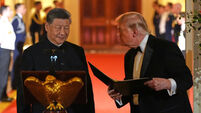
Kim and Hu were shown smiling and shaking hands as they posed for a crush of Chinese photographers. The two leaders visited a crop research institute, where they were shown examining potatoes and grain.
Kim visited the cities of Wuhan and Yichang on the Yellow River in central China and Guangzhou, Zhuhai and Shenzhen in the southern province of Guangdong, the heart of the country’s economic boom, according to Xinhua and KCNA.
Chinese television showed Kim visiting what appeared to be a steel mill in Wuhan and a hydroelectric dam and travelling on a subway in an unidentified city, accompanied by the Communist Party secretary of Guangdong.
Kim’s trip to Guangdong already had been reported by news outlets in Hong Kong and elsewhere. He reportedly toured China’s biggest maker of telecommunications equipment, a port, a university and other sites.
The North Korean leader was believed to be studying Chinese reforms in search of ideas to revive his country’s dilapidated economy, which relies on foreign aid to feed its 23 million people.